walking upstream…
Korn

sourcesGuitar World — Korn's Fieldy on his bass tone (Bill Gould/Faith No More comparison) · Guitar World — Korn share 20 tracks that shaped their guitar approach (Head and Munky on Faith No More, Munky on Mr. Bungle) · Louder/Metal Hammer — The albums that changed Korn guitarist Head's life (Faith No More's The Real Thing) · Guitar World — Korn guitarists Munky and Head on being architects of nu-metal (Head on writing "Blind" under Mr. Bungle's influence) · Loudwire — Korn's studio cover of Faith No More's "We Care a Lot" (Metal Hammer's Decades of Destruction) · Rock Sins — An Interview with James "Munky" Shaffer of Korn (808 drum programming on guitar) · Free Press Houston — Black Labyrinth
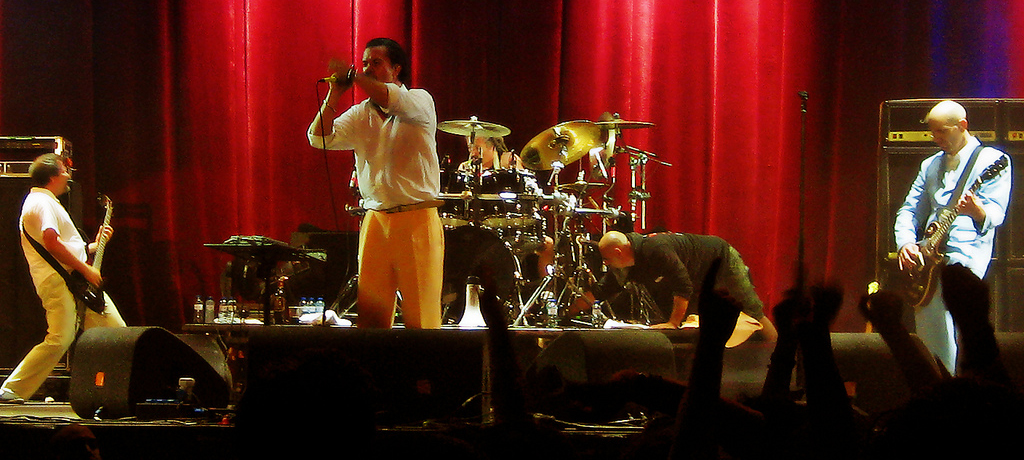
Korn formed in Bakersfield, California, in 1993, when three members of a local band called L.A.P.D. — guitarist James "Munky" Shaffer, bassist Reginald "Fieldy" Arvizu, drummer David Silveria — brought in guitarist Brian "Head" Welch and singer Jonathan Davis, whose scarred, half-sung, half-screamed voice became the band's signature. Davis has described the town plainly: "there wasn't a lot to do; that's why I got into music." The five-piece built a sound around detuned seven-string guitars, a bass played like a drum, and a willingness to let dissonance and hip-hop rhythm live inside a metal frame. Their 1994 self-titled debut and 1998's Follow the Leader made that hybrid enormous — Korn didn't just play heavy music, they widened what heavy music was allowed to sound like.
the sound in question
1998
Freak on a LeashKorn
walk the tributaries ↓
Faith No More1990s · Alternative metal / Funk metal / Experimental rock
Three of Korn's five members name Faith No More independently, each citing a different mechanism. Munky was a teenager when "The Real Thing" hit, and he and Fieldy chased it to the source: "we became real fanatics — started researching the guy and going up to San Francisco to see them play," he said, crediting the record: "Faith No More steered us in the direction where we ultimately ended up." Head, separately, pointed to Mike Patton singing "over very minor music" as the door into something stranger than metal. In 2016, Korn made the debt literal, covering Faith No More's "We Care a Lot" for a Metal Hammer anniversary disc.
listen: upstream & heresource: The Skinny — Under the Influence ↗
1985
We Care a LotFaith No More
2016
We Care a LotKorn
listen forFaith No More's 1985 title track opens on a thudding drum entrance, then a shouted group-chant hook declaring the title — a joke turned earworm. Korn's 2016 cover keeps that structure almost beat for beat, but Jonathan Davis pushes the chant down into his own scarred register while the seven-string guitars replace the original's spare punch with distorted low end. Underneath both sits a connection Fieldy names outright: "he and I kind of play the same," he said of Bill Gould, "but he plays on-beat and with a pick most of the time, even though it sounds like he's slapping." Listen for that trick in Fieldy's own bass line.
Mr. Bungle1990s · Experimental rock / Avant-garde metal / Funk metal
Mr. Bungle is a separate band from Faith No More but shares a frontman, Mike Patton, and Munky and Head both credit it directly. Once they learned Patton fronted a second, weirder band, Munky and Fieldy went hunting for evidence: "we started trying to find out more about who they were and when they were playing — tracking down VHS tapes of their gigs," Munky said, naming the band's 1991 self-titled debut as the bigger jolt. Welch ties the debt to a specific Korn song: "when we wrote Blind, we were listening to a lot of Mr. Bungle. They were so weird, with all those dissonant chords which we loved."
listen: upstream & heresource: The Skinny — Under the Influence ↗
1991
Quote UnquoteMr. Bungle
1994
BlindKorn
listen forMunky remembers exactly what got him: "there's a bottle smash, and then it comes in so heavy. It was like nothing I'd ever heard." Mr. Bungle's "Quote Unquote" detonates that way, a jump cut from noise into a queasy, off-kilter riff that refuses to resolve. Korn's "Blind" opens on a different shock — Jonathan Davis's spoken "are you ready?" building into a lurching riff Welch has tied to that same record's dissonant chord vocabulary. Listen for how neither song's central riff lands on a clean major or minor chord; the discomfort is left hanging, not released.
N.W.A1980s · Hip hop / Gangsta rap / West Coast hip hop
Munky and Head found N.W.A "when we first started" and never let go, following the group's members into their solo careers as Dr. Dre built The Chronic. "He was using a lot of samples and we were really trying to emulate that with our guitars," Munky said, "so Head and I started getting into the way they produced the drums with the 808." Days later, in a separate interview, he pinned the technique down precisely: "from our first record, you know, with the 808 bits and stuff, that was something we've always tried to do." Ice Cube, N.W.A's own former voice, later guested on Korn's "Children of the Korn."
listen: upstream & here
1988
Straight Outta ComptonN.W.A
1998
Children of the KornKorn
listen forN.W.A's title track rides a stark, sample-heavy drum groove and Dre's clipped low end — the exact texture Munky says he and Head chased "with our guitars" from Korn's very first record onward. "Children of the Korn" carries that same thick, hip-hop-swung low end, and the connection turns literal here: Ice Cube himself steps onto the track, the same MC whose group sent Munky and Head down this road in the first place, trading verses over a Korn groove built to carry him.