walking upstream…
Slipknot


sourcesWikipedia
Slipknot formed in Des Moines, Iowa, in 1995, when percussionist Shawn Crahan, bassist Paul Gray, and vocalist Anders Colsefni began building a nine-member lineup organized around numbered identities, animal-and-horror masks, and matching jumpsuits — a uniform that erased the individual behind a collective monster. Corey Taylor replaced Colsefni before the self-titled 1999 debut, which paired detuned, percussion-heavy aggression with an unnerving theatricality that producer Ross Robinson pushed even further into extremity on 2001's Iowa. The band's mix of nu metal groove, death-metal blast beats, and carnival-grotesque spectacle made them commercial outliers who still headlined festivals worldwide, and later records like Vol. 3: (The Subliminal Verses) and .5: The Gray Chapter showed a band capable of melody without ever removing the masks.
the sound in question
1999
Wait and BleedSlipknot
walk the tributaries ↓
Faith No More1990s · Alternative metal / Funk metal / Experimental rock
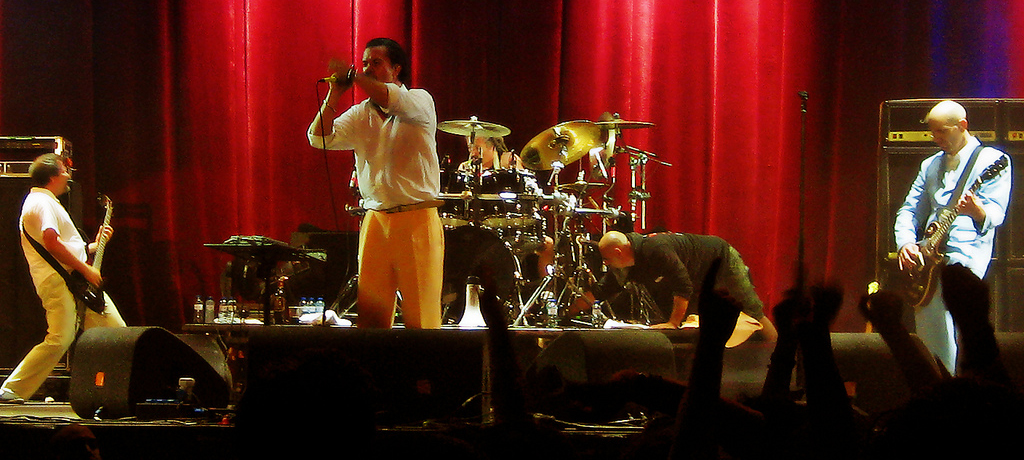
Corey Taylor has said that watching Faith No More perform 'Epic' at the 1990 MTV Video Music Awards, while recovering from a suicide attempt as a teenager, reset the course of his life — 'if it wasn't for Faith No More, I wouldn't be here.' Beyond that personal debt, writers have traced Faith No More's structural fingerprints — songs that lurch from tender melody into full-throttle aggression and back — onto tracks from Iowa and Vol. 3: (The Subliminal Verses), and singer Mike Patton's other band Mr. Bungle (masks, pseudonyms, matching jumpsuits) shaped the collective, identity-erasing visual language Shawn Crahan built around Slipknot.
listen: upstream & heresource: MusicRadar ↗
1989
EpicFaith No More
2004
DualitySlipknot
listen forPut 'Epic' beside 'Duality': both stack a huge, gang-vocal hook on top of music that keeps threatening to fly apart, alternating tender near-melody with sudden lurches into full aggression rather than settling into one lane.
Korn1990s · Nu metal / Alternative metal / Funk metal
Accounts of Slipknot's formation cite Korn's self-titled 1994 debut as one of the records that convinced the band heavy music could trade thrash-metal precision for something slower, lower, and groove-driven — down-tuned guitars locked to a rap-cadence vocal delivery. That downtuned, syncopated low end runs through Slipknot's own self-titled debut, and producer Ross Robinson — who had shaped Korn's raw early sound — carried the same live-take philosophy into Slipknot's first two records.
listen: upstream & here
1994
BlindKorn
1999
(sic)Slipknot
listen forCompare the album-opening one-two of 'Blind' and '(sic)': both drop a detuned, palm-muted riff into a lurching, off-kilter groove before the vocal arrives as a bark rather than a melody, making the low tuning itself the hook.
Slayer1980s · Thrash metal
Drummer Joey Jordison called Slayer's Reign in Blood 'the best fucking speed metal/thrash metal hybrid of all time' and named Slayer among his favorite bands of all time, citing Dave Lombardo as his single biggest influence as a player — 'he doesn't play the drums, he is the drums.' That worship of raw velocity surfaces whenever Slipknot's rhythm section drops the nu-metal groove entirely for pure blast-beat thrash intensity, a mode Iowa leaned into harder than the self-titled debut had.
listen: upstream & heresource: Louder ↗
1986
Raining BloodSlayer
2001
The Heretic AnthemSlipknot
listen forLine up 'Raining Blood' with 'The Heretic Anthem': both abandon any groove pocket for a relentless double-bass sprint under tremolo-picked riffing, the drummer setting a tempo that never lets the song catch its breath.