walking upstream…
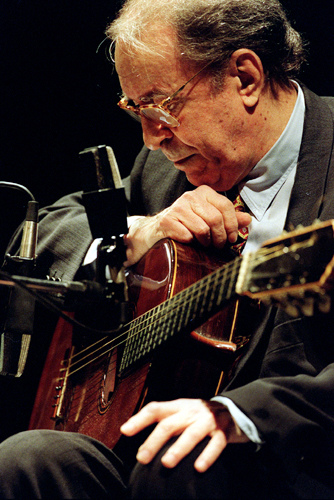
João Gilberto

sourcesWikipedia — João Gilberto biography · Daniella Thompson (Brazzil) — 'The Man Who Invented Bossa Nova,' on his youth, vocal idols, and the 1958 Odeon sessions · Carlos Rennó — 'Orlando Silva,' from 'Os Inventores da Música Brasileira' (UOL, 2001), on Silva as bossa nova's vocal foundation · Discografia Brasileira (Instituto Moreira Salles) — on 'Preconceito' and João Gilberto's 1985 Montreux re-recording · Tiago de Souza, Revista Orfeu (2016) — musicology article on João Gilberto's 'Rosa Morena' against Caymmi's original, with the 1971 Veja quote · Discografia Brasileira (Instituto Moreira Salles) — 'Sorriu Para Mim' fonograma record, confirming the 1954 Venilton Santos original
João Gilberto do Prado Pereira de Oliveira was born June 10, 1931, in Juazeiro, Bahia, and given a guitar at fourteen by a bohemian godfather that never left his side afterward. Broke and half-obsessed through the 1950s, he retreated to a bathroom for its acoustics and taught himself to sing almost without vibrato, clipping phrases short so the words floated loose from the guitar instead of riding it — a technique that became bossa nova's founding "batida." Odeon's label chief balked at signing him until Tom Jobim pleaded and Dorival Caymmi personally vouched; the sessions that followed, "Chega de Saudade" and "Bim Bom," launched the genre on July 10, 1958. He stayed a private, exacting figure for six decades; the hushed, syncopated delivery he worked out alone became the default register of Brazilian popular singing after him.
the sound in question
1958
Chega de SaudadeJoão Gilberto
walk the tributaries ↓
Orlando Silva1930s-40s · Samba-canção / Valsa-canção / Samba
Boyhood friends remembered João could imitate Orlando Silva "to perfection" — a stunt that later embarrassed him, since Silva's soft-voiced, no-vibrato phrasing struck 1940s ears as barely masculine. Silva was, in critic Carlos Rennó's account, simply "the greatest singer in the world" to João, the voice he built bossa nova's whole edifice against; the Instituto Moreira Salles's own documentary on Silva puts it plainer still, crediting João for having "elected him his greatest influence as a singer" and returning to his songbook again and again.
listen: upstream & heresource: Rádio Batuta (Instituto Moreira Salles) — 'Orlando Silva – A voz e a vida,' on João Gilberto electing Silva his greatest influence ↗
1941
PreconceitoOrlando Silva
1985
Preconceito (Live at Montreux)João Gilberto
listen forSilva's 1941 "Preconceito" rides clean, unhurried diction over a full dance-orchestra samba — every syllable placed exactly, no note held past its natural weight. João's 1985 Montreux performance of the same Wilson Batista/Marino Pinto song strips that orchestra down to just guitar and breath: the phrasing Silva made sound effortlessly correct becomes, in João's hands, closer to a whisper, syllables clipped shorter still and set loose from the beat entirely.
Dorival Caymmi1940s-50s · Samba-canção / Canção praieira / MPB
"One of the songs that woke me up, that showed me I could try something different, was Caymmi's 'Rosa Morena,'" João told Veja magazine in 1971 — the singers before him, he felt, dragged notes out until they hurt the song's natural balance, so he shortened them and let the lyric "float." Caymmi, amused, called the result ardiloso — cunning: "he leaves the ball in your hand knowing he's going to take it back." Caymmi's own recommendation, in fact, was what finally got João's stalled 1958 debut single approved at Odeon.
listen: upstream & heresource: Correio IMS (Instituto Moreira Salles) — Dorival Caymmi profile ↗
1955
Rosa MorenaDorival Caymmi
1959
Rosa MorenaJoão Gilberto
listen forCaymmi's 1955 "Rosa Morena" holds each phrase long and legato, a warm voice floating over gentle guitar. João's 1959 version keeps the same loping samba pulse and melody but clips every phrase short, leaving gaps mid-line where Caymmi would have sustained a note — precisely the empty space Caymmi said his young admirer knew how to exploit. The guitar underneath tightens into João's new, syncopated batida, doing rhythmically what the voice alone used to carry.
Garoto1950s · Choro / Brazilian jazz
"Garoto is a clever fellow," João said of Aníbal Augusto Sardinha, the guitarist known simply as Garoto, "he knows how to make those chord progressions, he accompanies in a way that becomes more beautiful." João admired specifically how Garoto "linked chords through beautiful musical phrases," a harmonic sophistication Garoto had pulled from choro and American jazz years before bossa nova existed. In 1991 João finally recorded a Garoto original himself, "Sorriu Para Mim," written with Garoto's wife under the pen name Luís Cláudio — 37 years after its first recording, 36 after Garoto's early death.
listen: upstream & heresource: Euler de França Belém, Jornal Opção — review of Jorge Mello's Garoto biography, with the direct João Gilberto quote on Garoto's chords ↗
1954
Sorriu Para MimGaroto
1991
Sorriu Pra MimJoão Gilberto
listen forGaroto and his wife wrote "Sorriu Para Mim" as a samba built on the same close, jazz-tinted chord movement critics single out as his signature — harmony reaching past simple triads, the "belas frases musicais" João praised him for. No recording of Garoto's own original survives online, but João's 1991 version, cut with arranger Clare Fischer decades after Garoto's death, still carries that same chord logic under his familiar hushed vocal and clipped guitar batida.