walking upstream…
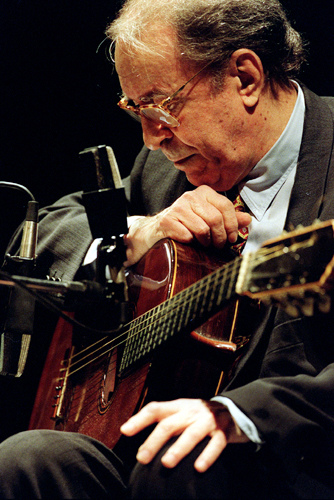
Caetano Veloso


sourcesThe New Yorker — "How Caetano Veloso Revolutionized Brazil's Sound and Spirit" (João Gilberto framed as Veloso's "greatest inspiration"; bio material) · Tropicália (tropicalia.com.br) — Caetano Veloso interview (Gilberto Gil's proposal to engage the Beatles and mass culture at Tropicália's founding) · Jornal A Voz da Serra, Discopédia column — "Let it Bahia · "Je pleure sans raison que je pourrais vous dire" — dates Dorival Caymmi's "É Doce Morrer no Mar" (written 1941, recorded 1954 on Canções Praieiras)
Caetano Veloso was born in 1942 in Santo Amaro, a Bahia town the New Yorker likened to "a Jorge Amado novel or a Fellini film," where a parlor piano let him and his sister Maria Bethânia chase the radio's songs by ear. At eighteen he moved to Salvador, met Gilberto Gil, and by 1967-68 the two founded Tropicália, splicing bossa nova's hush into electric guitars, concrete poetry, and open provocation. Two weeks after Brazil's dictatorship issued Institutional Act No. 5 in December 1968, police took him from his apartment before dawn, and prison gave way to exile in Portugal, then London, until 1972. He returned home, resumed recording, and wrote the movement's history as a memoir, Verdade Tropical (1997). Everything in his catalog since traces to three lessons absorbed before he was famous: a hushed guitar record, a fellow Bahian's craft, and a British band's permission to plug in.
the sound in question
1968
Alegria, AlegriaCaetano Veloso
walk the tributaries ↓
João Gilberto1950s-60s · Bossa nova / Samba-canção
In 1959, a year before he left Santo Amaro, seventeen-year-old Caetano heard a record on the radio that rewired him: João Gilberto's title track "Chega de Saudade." "Hearing João Gilberto was a revolution in my mind; it was an enlightenment, really," he told the Los Angeles Review of Books — the moment he decided Brazil "could be freer and bigger." Two decades later, asked point-blank in a 1979 Playboy interview whether Gilberto had shaped him musically, he answered without qualification: "Sem dúvida!" — without a doubt.
listen: upstream & heresource: Los Angeles Review of Books — "An Interview with Caetano Veloso" (João Gilberto as a 1959 "revolution in my mind"; the Beatles and post-1965 rock's "energy") ↗
1959
Chega de SaudadeJoão Gilberto
1992
Chega de SaudadeCaetano Veloso
listen forGilberto's 1959 "Chega de Saudade" set the template Brazilian popular music has measured itself against since: a clipped, just-behind-the-beat guitar strum under an almost-spoken, unhurried vocal, all air and understatement. Caetano's 1992 live recording of the very same song, on the album Circuladô Vivo, keeps that hush intact more than three decades on — the same conversational near-whisper, the same guitar sitting a hair off the pulse — proof that the seventeen-year-old who heard it on the radio never fully put it down.
Dorival Caymmi1940s-50s · Samba-canção / Canção praieira / MPB
In the same 1979 interview, Playboy asked whether Caymmi had shaped him too. "Sem dúvida, também" — without a doubt, as well — Caetano answered, before going further than he did for any other elder in the piece: "Meu mestre é Caymmi," my master is Caymmi. He named the specific inheritance: writing lyrics and melody together as one fused "sung word," palavra cantada, rather than setting a poem to music afterward — and said he applied that method consciously on his own 1978 song "Muito Romântico."
listen: upstream & heresource: Playboy (Brasil), agosto de 1979 — reproduced by the fan archive Inside Playboy BR via the Wayback Machine (Caetano's "Sem dúvida!" on João Gilberto and "Meu mestre é Caymmi" on Dorival Caymmi) ↗
1954
É Doce Morrer no MarDorival Caymmi
1978
Muito RomânticoCaetano Veloso
listen forCaymmi's 1954 recording of "É Doce Morrer no Mar," a Jorge Amado lyric about a fisherman's death, is sung almost like plain speech — the melody bending to fit each word's natural weight rather than the reverse, with only a spare guitar underneath. That same unhurried, word-first phrasing carries into Caetano's "Muito Romântico" two decades later: no melisma, no vocal flourish outrunning the lyric, the tune shaped around how the sentence would actually be spoken — palavra cantada made audible.
The Beatles1960s · Rock / Pop / Rock and roll
Rock and roll held no interest for the aspiring-sophisticated teenager Caetano had been — "it was like vulgar music for vulgar young people," he told the Los Angeles Review of Books — until "the British added prestige to rock 'n' roll," and by 1965-66 its "energy" and "suggestions of new, even intellectual, creation really caught me." The debt outlived Tropicália's initial shock: on his 1975 album Qualquer Coisa, Caetano recorded three literal Beatles covers, among them "Eleanor Rigby," "For No One," and "Lady Madonna" — remade, the Brazilian newspaper column Discopédia noted, into "very Brazilian versions."
listen: upstream & heresource: Los Angeles Review of Books — "An Interview with Caetano Veloso" (João Gilberto as a 1959 "revolution in my mind"; the Beatles and post-1965 rock's "energy") ↗
1966
For No OneThe Beatles
1975
For No OneCaetano Veloso
listen forThe Beatles' 1966 "For No One" carries a stately, almost formal melancholy — French horn, a harpsichord-like piano figure, Paul McCartney's voice kept level and resigned. Caetano's 1975 version keeps every ounce of that sadness but slows the tempo into a bossa-nova sway, guitar and voice pushed to the front where the horn used to sit: grief that sat down instead of kept marching.