walking upstream…
Gilberto Gil

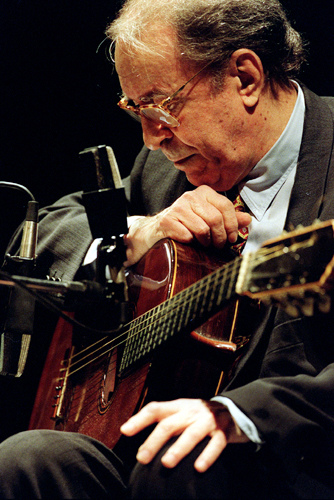
 photo: ricardo stuckert / pr · cc by-sa 2.0 ↗
Gilberto Gil
Gilberto Gil grew up between the sertão town of Ituaçu and the port city of Salvador, Bahia, where a chance childhood encounter with Luiz Gonzaga's touring accordion act set him on the road to becoming, alongside Caetano Veloso, the co-architect of Tropicália — the late-1960s collage of bossa nova, electric rock, and Brazilian vernacular music that got both of them jailed and exiled by the military government in 1969. His London exile pulled reggae, Jimi Hendrix's guitar, and West African highlife into his palette, and he carried those threads home into a five-decade solo catalog running from anthemic samba like 'Aquele Abraço' to reggae-inflected protest song, later serving as Brazil's Minister of Culture (2003–2008). He remains one of Brazilian popular music's most restless synthesizers, treating regional folk forms, radio pop, and global rhythm as equally native material.
the sound in question
1969
Aquele AbraçoGilberto Gil
walk the tributaries ↓
Luiz Gonzaga1940s-50s · Baião / Forró / Northeastern Brazilian folk
As a boy in Ituaçu, Gil heard Gonzaga's accordion over the radio and was so entranced that after his family moved to Salvador, his mother took him to see Gonzaga perform live in a city square — an encounter Gil has repeatedly credited as the moment he decided to become a musician, after which he began accordion lessons himself. Two decades later he folded that Northeastern baião pulse directly into Tropicália: he described 'Domingo no Parque' as 'a stylized baião,' rebuilt around berimbau and orchestral strings in place of Gonzaga's zabumba and triangle.
listen: upstream & heresource: Instituto Gilberto Gil — 'Gilberto Gil and Luiz Gonzaga' (the accordion/city-square origin story) ↗
1947
Asa BrancaLuiz Gonzaga
1967
Domingo no ParqueGilberto Gil
listen forLine up the insistent triangle-zabumba-accordion drone of 'Asa Branca' against 'Domingo no Parque': the same tight, circling rhythmic cell is still there, just re-scored for berimbau, strings, and psychedelic orchestration — Gil bending baião's chassis around a completely different engine.
João Gilberto1950s-60s · Bossa nova / Samba-canção
Hearing João Gilberto's 'Chega de Saudade' in the late 1950s was, by his own account, the second formative shock of Gil's musical life: he set the accordion aside and taught himself guitar to chase that hushed, syncopated batida. His 1967 debut album Louvação — reviewed as 'understated bossa nova' before Tropicália's louder arrangements arrived a year later — has Gil working directly inside João Gilberto's whispered vocal register and off-the-beat guitar pattern.
listen: upstream & heresource: Instituto Gilberto Gil — on 'Domingo no Parque' as 'a stylized baião' and Gil's adoption of João Gilberto's guitar ↗
1958
Chega de SaudadeJoão Gilberto
1967
LouvaçãoGilberto Gil
listen forCompare the close-mic'd, almost-spoken hush of 'Chega de Saudade' to the title track of Louvação: the guitar stutters in that same syncopated pocket, and Gil keeps his voice at conversational volume rather than reaching for a big note — exactly the discipline João Gilberto's batida demanded.
Dorival Caymmi1940s-50s · Samba-canção / Canção praieira / MPB
Caymmi was the third pole of Gil's formative Bahian triangle alongside Gonzaga and João Gilberto — the songwriter Gil later credited with 'the birth of Bahia as we know it today' for turning the state's fishermen, saints, and beaches into permanent subjects of national song. Gil grew close to the Caymmi family through his friendship with Dorival's daughter Nana, and in 1991 wrote 'Buda Nagô' as a direct tribute, a duet with Nana whose lyric names Dorival more than twenty times. This is a looser, more biographical thread than the Gonzaga and João Gilberto lines — closer to homage and personal lineage than a specific technical borrowing — so it carries a lower confidence.
listen: upstream & here
1941
É Doce Morrer no MarDorival Caymmi
1991
Buda NagôGilberto Gil
listen forCaymmi's 'É Doce Morrer no Mar' sets Bahian, sea-bound imagery over an unhurried, conversational samba-canção pulse; 'Buda Nagô' answers it directly, Gil and Nana Caymmi trading that same easy, storytelling cadence while the lyric itself walks through Dorival's own catalog and legend.