walking upstream…
Horace Silver


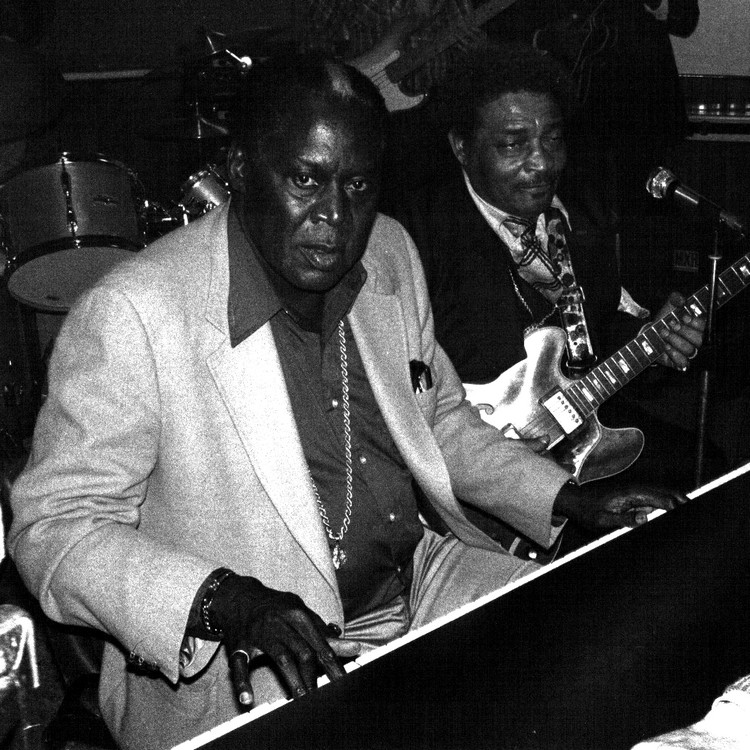

Horace Silver was born in Norwalk, Connecticut in 1928, the son of a Cape Verdean immigrant who anglicized the family name from Silva and worked in a rubber factory; the morna his father played at home surfaced decades later in "Song for My Father." Self-taught on piano, Silver discovered bebop as a teenager and began writing his own lines. The saxophonist Stan Getz heard him playing in a Hartford club in 1950 and hired his trio on the spot; by mid-decade Silver was co-leading the original Jazz Messengers with drummer Art Blakey, folding blues and gospel into bebop until, as he put it, "more of that music came into the bebop." He led his own bands into the 1990s and died in 2014, having given hard bop its blueprint.
the sound in question
1964
Song for My FatherHorace Silver
walk the tributaries ↓
Bud Powell1940s–50s · Bebop / Jazz
Nearly every account of Silver's teenage years names the same starting point. "I was 14 or 15 years old when I started wanting to write some music," he said, "after listening to Bud Powell and Thelonious Monk and Dizzy and Bird." He first tried to play like Powell outright, chasing the same cascading right hand and hammering attack, before conceding the technique wasn't his, and rebuilding in blues and space instead. Critic Marc Myers, writing in JazzWax, later measured Silver's 1952 Blue Note debut against that inheritance: before it, jazz piano was "largely modeled on the dexterity and relentless attack of Bud Powell."
listen: upstream & heresource: The Guardian — Horace Silver obituary (biography, Bud Powell/Cape Verde background) ↗
1951
Un Poco LocoBud Powell
1952
EcarohHorace Silver
listen forPlay Powell's "Un Poco Loco" first: a hammering left-hand vamp under a right hand that never stops moving, urgent and slightly reckless. Then put on Silver's "Ecaroh," recorded barely a year later on that same Blue Note debut — the same driving left-hand ostinato is there, but the top line has gone spare and riff-based, almost conversational where Powell's was a sprint. That gap is the story: Silver kept Powell's engine and swapped the virtuosity for space.
Thelonious Monk1950s–60s · Jazz / Bebop / Hard bop
Silver's devotion to Thelonious Monk went past listening into repetition. "One particular Thelonious Monk record I played quite a lot," he recalled, "...I played it over and over." One summer his own son picked up a Monk melody from the air, humming it around the house without ever hearing the record directly — proof, Silver said, that "if one is around it often enough and hears it often enough, it'll seep in sub-consciously." It's the clearest account he gave of how Monk's angular, dry compositional instinct got absorbed rather than studied.
listen: upstream & heresource: Bob Rosenbaum — An Interview with Horace Silver, 1981 (Thelonious Monk anecdote) ↗
1951
Straight, No ChaserThelonious Monk
1961
Filthy McNastyHorace Silver
listen forMonk's "Straight, No Chaser" rides one blunt, repeating blues riff, worried at from a slightly different angle every time it comes back around — comedy and dissonance in the same phrase. Silver's "Filthy McNasty," cut a decade later, does the same trick: a single lurching, off-balance figure that keeps returning instead of developing into a flowing bebop line. Neither tune is built to impress with speed; both let one crooked idea carry the whole performance.
Memphis Slim1940s–50s · Blues / Boogie-woogie
Asked what shaped him outside bebop, Silver didn't reach for R&B. "I wasn't that much influenced by it," he said. "I was influenced by real down home funky blues. I used to listen to the old singers like Muddy Waters and Lightning Hopkins, Memphis Minnie, Memphis Slim, all those kinds of cats." Of that list, Memphis Slim was the pianist — a Chicago boogie-woogie player whose rolling left hand under a riffing, speech-like right hand gave Silver a blues-piano vocabulary bebop alone couldn't supply.
listen: upstream & heresource: JazzTimes — Horace Silver ↗
1948
Messin' AroundMemphis Slim
1953
Opus de FunkHorace Silver
listen forMemphis Slim's "Messin' Around" rolls on a boogie-woogie left hand that never lets up while his right hand talks over it in short, bluesy phrases. Silver's "Opus de Funk," cut five years later, keeps that same rolling ostinato under the keys but bends it toward a jazz combo's swing rather than a barroom's stomp — the blues engine is identical, only the room around it has changed.