walking upstream…
Thelonious Monk


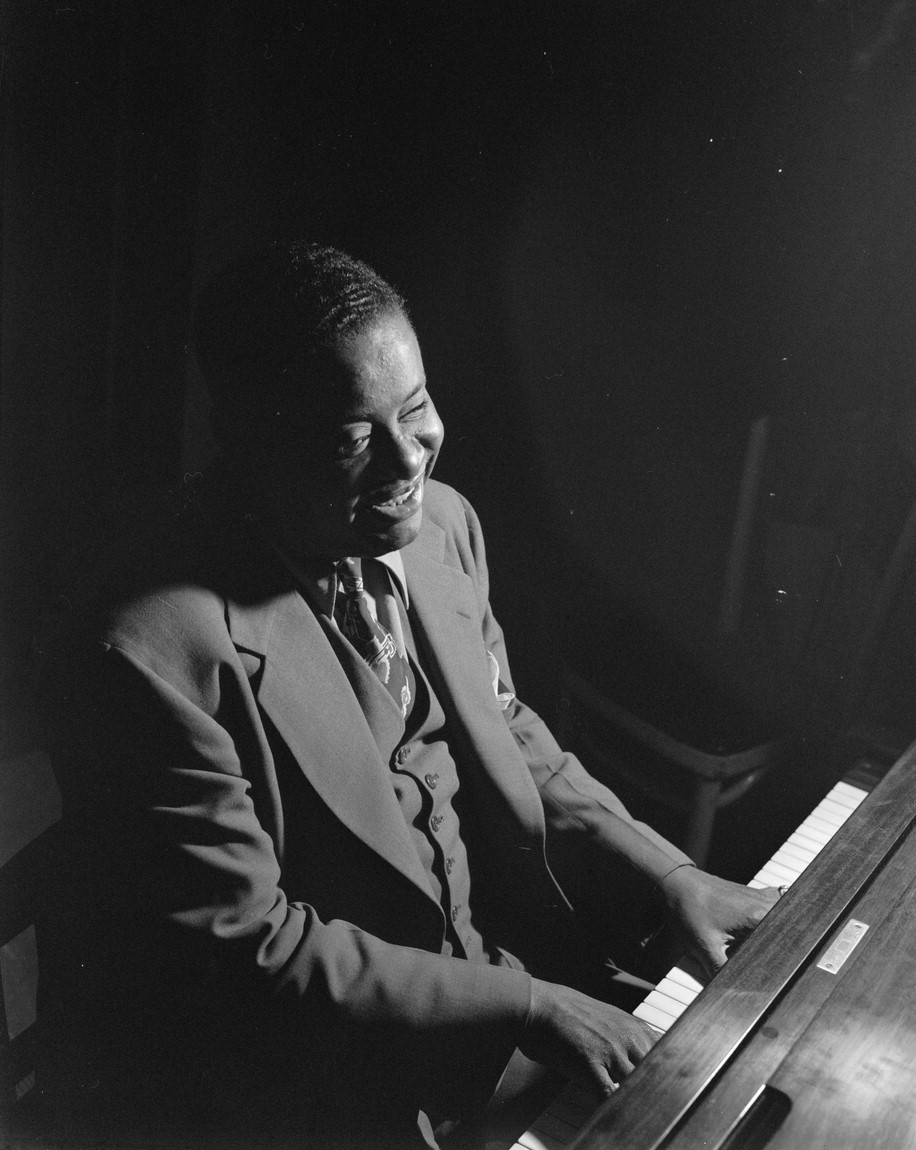
 photo: william p. gottlieb · public domain ↗
Thelonious Monk
sourcesWikipedia — Thelonious Monk (birth, San Juan Hill move, Alberta Simmons lessons, first recordings) · National Jazz Archive — Thelonious Monk interviewed by Les Tomkins, 1965 (Monk's own account of watching pianists as a child) · Wikipedia — Thelonious Monk Plays Duke Ellington (session dates, track list) · Joe Alterman — NEA Jazz Masters 2010
In 1922, five-year-old Thelonious Monk's family left Rocky Mount, North Carolina, for a tenement block called San Juan Hill on Manhattan's West Side — a neighborhood so full of pianos that, he said, "if anybody sat down and played the piano, I would just stand there and watch 'em all the time." A neighbor, Alberta Simmons, gave him his first real lessons in stride piano before he was ten; by his teens he was playing rent parties for three dollars a night and touring as a church organist. He cut his first commercial sides with Coleman Hawkins's quartet in 1944, then spent the rest of the decade at Minton's Playhouse helping invent bebop from the piano bench. What emerged was a style built on everything he had absorbed and then deliberately withheld — silence and dissonance standing in where other pianists reached for resolution.
the sound in question
1951
Straight, No ChaserThelonious Monk
walk the tributaries ↓
Duke Ellington1930s–40s · Jazz / Big band
By 1955, Monk had a reputation that scared away paying customers — audiences found him difficult, discordant, or worse. Producer Orrin Keepnews, at Riverside Records, looked for an entry point and found one in Duke Ellington's own songbook, betting that "with the appropriate primer, a wider audience would inexorably learn to love Thelonious." Over two July sessions, Monk recorded eight Ellington standards start to finish — not tribute playing but a pianist showing he had been fluent in that vocabulary all along, years before he began bending it into something stranger.
listen: upstream & heresource: PopMatters — Thelonious Monk ↗
1933
Sophisticated LadyDuke Ellington
1955
Sophisticated LadyThelonious Monk
listen forEllington's 1933 studio recording of "Sophisticated Lady" moves in long, sumptuous lines, the reed section carrying the melody in one unbroken sweep. Monk's 1955 solo reading keeps the tune recognizable at every bar, but listen for what he does between the notes: the melody arrives late, hangs on unresolved chords, and gets interrupted by silence where Ellington's arrangement would keep gliding — Monk's own fingerprints pressed directly over Ellington's composition.
James P. Johnson1920s · Stride piano / Jazz / Ragtime
Before Monk owned a style of his own, he owned James P. Johnson's. His first teacher, a neighbor named Alberta Simmons, had "assimilated the stride styles of Fats Waller, James P. Johnson and Eubie Blake," and passed that vocabulary straight to her pupil — "before her earnings as a teacher dried up, Thelonious Monk learned stride piano from the woman." Monk did not stop at secondhand study: as a teenager he visited Johnson's own home and sat in on the older stride players' legendary "cutting sessions," watching the tradition performed live by the man who had invented it.
listen: upstream & heresource: NPR — The Women Who Made Thelonious Monk (Alberta Simmons's stride teaching and Monk's visits to James P. Johnson's home) ↗
1921
Carolina ShoutJames P. Johnson
1957
FunctionalThelonious Monk
listen forNo recording ties a specific Johnson piece to a specific Monk one — this pairing traces shared architecture, not a citation. Johnson's "Carolina Shout" rides a relentless, wide-reaching left hand under quick right-hand breaks, the stride vocabulary Simmons taught by ear. Monk's solo blues "Functional" keeps that left-hand-forward drive but strips away Johnson's constant motion: listen for the long silences between phrases, stride's engine idling rather than running, dissonance standing in for the ornamented right hand Johnson never stopped playing.
Art Tatum1930s–40s · Jazz / Stride piano / Swing
Pianist Billy Taylor, a close friend and fellow NEA Jazz Master, spent much of his career explaining that Monk's angular reputation hid a virtuoso. "Monk could really play like Tatum," he said. "He really had all the technique and he could really play like Art." The two pianists, Taylor said, bonded specifically over what set them apart from everyone else at the keyboard: "They had such unbelievable left hands. I couldn't play like that, and neither could Monk." Monk rarely let that side of his playing show, burying it under the dissonance and space his mature style was built from.
listen: upstream & here
1933
Tiger RagArt Tatum
1957
'Round MidnightThelonious Monk
listen forTatum's 1933 solo "Tiger Rag" is stride pushed past showmanship into pure speed — cascading right-hand runs over a left hand that never loses the beat, technique on total display. Taylor pointed to exactly where that virtuosity resurfaces in Monk: "you can hear it on some of his versions of 'Round Midnight.'" On the 1957 solo take, listen through Monk's spare, halting phrasing for the sudden clusters of notes that flash by too fast to be anything but Tatum's technique breaking through.