walking upstream…
Chick Corea


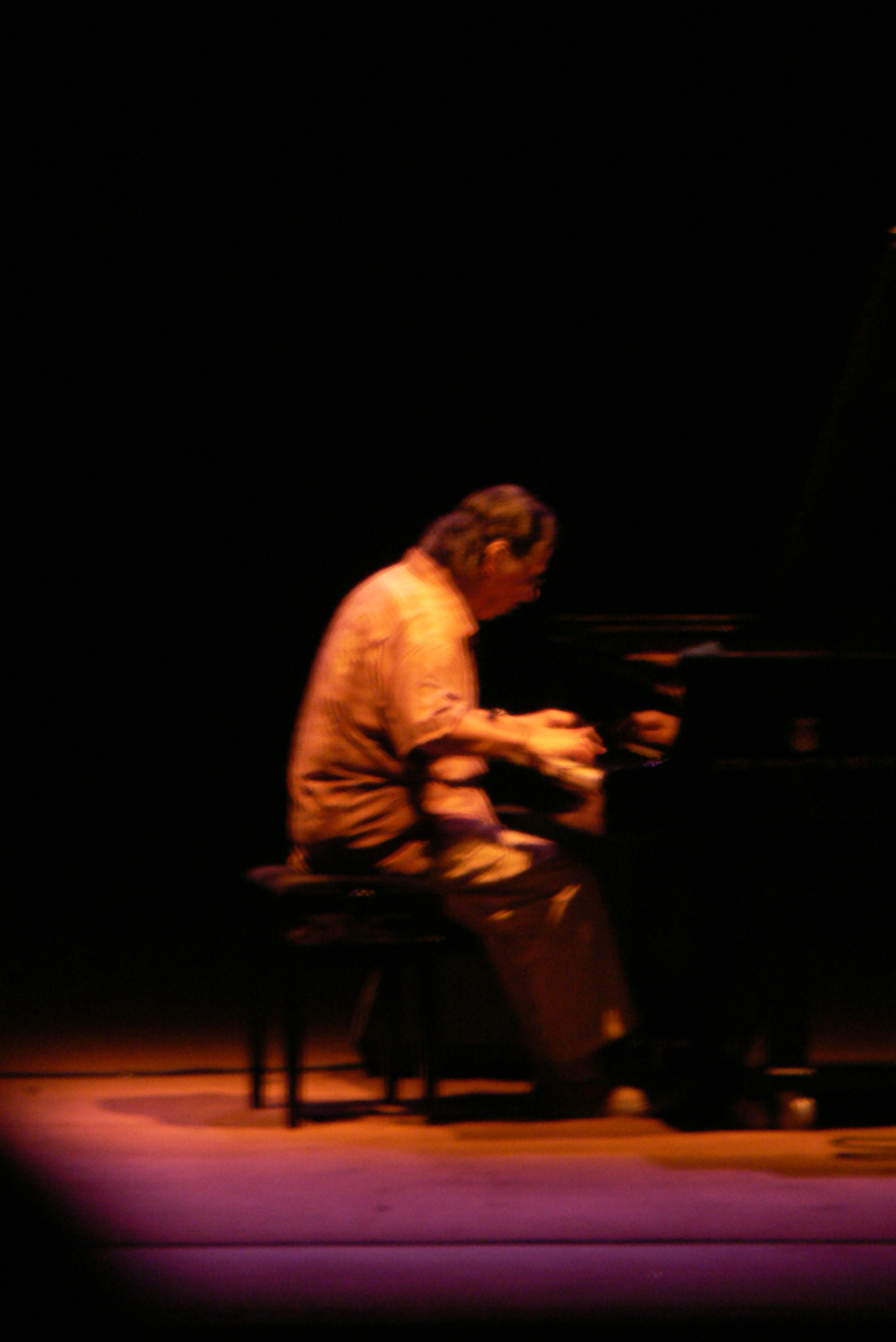 photo: amir yalon · cc by-sa 2.0 ↗
Chick Corea
sourcesClassical Music (BBC Music Magazine) — Chick Corea · Jazz Journal — JJ 05/80 · National Jazz Archive — Chick Corea · Mark Towns (JazzHouston) — Chick Corea Interview (how "Spain" grew out of Rodrigo's Concierto de Aranjuez) · Michael Stewart — Interview with Chick Corea (the structural device borrowed from Mozart for his own Piano Concerto) · The Atlantic — How Chick Corea Wrote 'Spain' (as-told-to account of writing "Spain" from Rodrigo's theme) · Chick Corea Productions — Early Years · Scroll.in — How classical music set the stage for jazz in Chick Corea's life (Salvatore Sullo lessons; classical grounding)
Born Armando Anthony Corea in Chelsea, Massachusetts, in 1941, Corea began at the keyboard at four, taught by his father, a Dixieland trumpeter who filled the house with Gillespie and Parker rather than classical records. Bebop took hold early: by high school he was transcribing solos by hand and running a Boston trio built entirely on Horace Silver's songbook — Silver and Bud Powell were, in his own words, his two biggest influences, though only Powell left a citable recording of the debt. Lessons with concert pianist Salvatore Sullo, begun at eight, planted a classical curiosity that survived brief stints at Columbia and Juilliard. New York apprenticeships with Cab Calloway, Mongo Santamaría, and Miles Davis's electric quintet pushed him toward fusion; he founded Return to Forever in 1972 and spent the rest of his career treating jazz, Latin rhythm, and classical composition as one language, until his death in 2021.
the sound in question
1972
SpainChick Corea
walk the tributaries ↓
Bud Powell1940s–50s · Bebop / Jazz
By high school Corea had turned Powell's records into a private curriculum: he'd cue up a solo, work out every note on the piano, and play it back note-for-note. "Bud Powell was one of my basic textbooks," he told Jazz Journal in 1980. "I actually took his playing apart in order to discover how he achieved what he did." One track absorbed him more than any other — Powell's 1951 solo recording "Oblivion," which he told BBC Music Magazine he "played all the time." Nearly half a century later, Corea recorded it himself, opening his 1997 tribute album Remembering Bud Powell with that same tune.
listen: upstream & heresource: Barcelona Metropolitan — Interview ↗
1951
OblivionBud Powell
1997
OblivionChick Corea
listen forPlay Powell's spare 1951 solo recording — just piano, the melody worked out alone, no rhythm section — against Corea's 1997 remake on Remembering Bud Powell, where a full band picks up the same tune. The theme, key, and phrasing shapes are identical; what's changed is the setting, from a lone pianist testing a phrase to a bandleader forty years deep in his own transcription of it.
Joaquín Rodrigo1930s–40s · Classical / Spanish classical
Corea has told the story the same way for over a decade, almost word for word: alone in his New York apartment during a break from Return to Forever's first tour, he was fooling around with the aching, B-minor melody from the Adagio of Joaquín Rodrigo's Concierto de Aranjuez — a piece he knew only through Gil Evans's arrangement on Miles Davis's Sketches of Spain. "I extended it and composed some melodies," he told The Atlantic in 2011, "which turned out to be the main themes of 'Spain.'" He still opens live performances of the song by playing Rodrigo's theme straight, as an announced quotation, before launching into his own.
listen: upstream & here
1939
Concierto de Aranjuez: II. AdagioJoaquín Rodrigo
1972
SpainChick Corea
listen forPlay the Adagio from Rodrigo's Concierto de Aranjuez in Narciso Yepes's guitar-and-orchestra recording, then Return to Forever's "Spain" from 1972's Light as a Feather. The track opens with Corea quoting Rodrigo's own melody almost note-for-note on electric piano before the band's Latin groove enters and the theme dissolves into Corea's own tune — a hit song that announces its source out loud, in its own first bars.
Wolfgang Amadeus Mozart1780s · Classical / Opera
Corea had studied Mozart's scores as a boy under Salvatore Sullo, but for years he filed him, in his words, in "an old guys' bin." The correction came in 1982, hearing pianist Friedrich Gulda play Mozart at the Munich Summer Piano Festival — "it took my head off," he told BBC Music Magazine — and within months Corea was performing Mozart with the Royal Concertgebouw Orchestra. He carried the encounter into his own writing, too: for his Piano Concerto he borrowed, as he told interviewer Michael Stewart, "the size of the orchestra and the chamber music orchestration," along with Mozart's habit of building "three distinct movements" into one concerto form.
listen: upstream & here
1786
Piano Concerto No. 23 in A major, K. 488: II. AdagioWolfgang Amadeus Mozart
1996
Piano Concerto No. 23 in A major, K. 488: II. Adagio (Vocal)Chick Corea
listen forHear Mozart's Piano Concerto No. 23 in Grigory Sokolov's recording of the Adagio — spare, songlike, scored for a chamber-scaled orchestra — then Corea and Bobby McFerrin's version of that same movement on 1996's The Mozart Sessions, where Corea plays Mozart's own notes but slips in his own cadenzas while McFerrin scats a vocal line over the top. The chamber-sized clarity Mozart wrote for is exactly what Corea scaled his own Piano Concerto down to match.