walking upstream…
Bud Powell


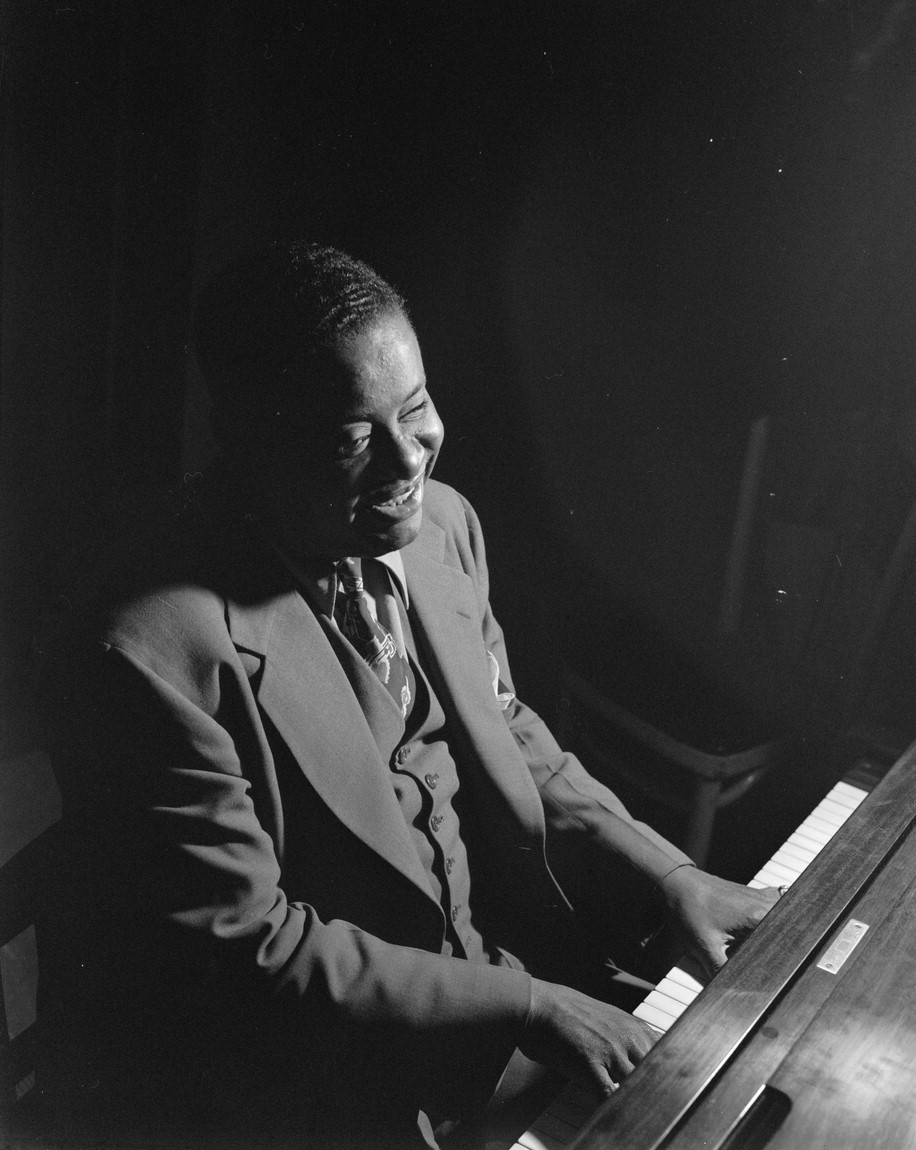

sourcesTed Panken — "Bud Powell · JazzProfiles — "A Portrait of Bud Powell As Drawn from the Jazz Literature," 2018 (Pullman on Monk; Horricks on Tatum and the Birdland anecdote) · Peter Pullman — Powell Chronology (childhood Tatum imitation; 1944 Parker encounter; 1950 Birdland showdown) · Perfect Sound Forever — "Bud Powell · Wikipedia
Earl "Bud" Powell grew up in Harlem, the son of a stride pianist, imitating Fats Waller and Art Tatum off the radio by age ten. At Minton's Playhouse in 1942 he fell in with Thelonious Monk, and by 1944, playing piano in Cootie Williams' band, he'd absorbed the alto lines of a young Charlie Parker. A 1945 police beating in Philadelphia left him with headaches and a lifetime of psychiatric hospitalizations, yet between stays he cut the recordings — for Roost, Blue Note, and Norman Granz's labels — that became bebop piano's founding vocabulary: fast, horn-like right-hand lines over spare, off-beat left-hand chords. He moved to Paris in 1959 and died in Brooklyn in 1966. Herbie Hancock's verdict stands: every jazz pianist since has either come through Powell or is deliberately trying to get away from him.
the sound in question
1951
Un Poco LocoBud Powell
walk the tributaries ↓
Thelonious Monk1950s–60s · Jazz / Bebop / Hard bop
Powell was a teenager sitting in at Minton's Playhouse in 1942 when he met Monk, and biographer Peter Pullman calls what followed a cross-pollination "comparable to that of King Oliver and Louis Armstrong." It was Powell who pushed Cootie Williams' band to record Monk's still-obscure "'Round Midnight" in 1944, years before Monk cut it himself. The debt was mutual: when police beat Powell in 1945 for defending Monk during an arrest, Monk answered by writing "In Walked Bud" and "52nd Street Theme" and keeping them, by his biographer's account, as "Bud's property alone."
listen: upstream & heresource: Amacord Jazz — "Thelonious Monk and Bud Powell" (Morgenstern liner notes; Fitterling on the 1945 beating and Monk's tribute compositions) ↗
1947
'Round MidnightThelonious Monk
1961
'Round MidnightBud Powell
listen forMonk's own 1947 studio take of "'Round Midnight" is all splayed dissonant chords and hesitations, the melody stopping short of where you expect it to land. Cue Powell's version from his Paris trio years at the Blue Note club and hear the same suspended, off-kilter harmony survive the trip — Powell just smooths it into something faster, denser, and more fluent, trading Monk's hesitations for a pianist's natural forward motion.
Charlie Parker1940s · Bebop / Jazz
Powell first heard Parker's alto in spring 1944, sharing a bandstand with him in Cootie Williams' orchestra, and the encounter reset his ambitions: "By 1950," Billy Taylor recalled, "he was making the piano sound just like Charlie Parker. Those lines that he played were long and complicated and very well played." Pianist David Hazeltine, analyzing Powell's playing decades later, put it more bluntly still: "All of Bud's vocabulary ... comes straight out of Bird." Where Monk gave Powell his harmony and Tatum set the bar for technique, it was Parker who supplied the actual grammar — the fast, linear, horn-phrased lines that became bebop piano's default language.
listen: upstream & here
1946
OrnithologyCharlie Parker
1949
OrnithologyBud Powell
listen forParker's 1946 quintet recording of "Ornithology" is a dense, rapid-fire alto line built on rhythm-changes harmony. Powell's own solo piano recording of the same tune three years later takes that saxophone line and reproduces it almost intact on the keyboard — listen for the arpeggiated runs and jagged phrase endings that Hazeltine traces straight back to Parker, now voiced entirely in Powell's right hand.
Art Tatum1930s–40s · Jazz / Stride piano / Swing
Powell was imitating Tatum's radio broadcasts by age ten, and biographer Raymond Horricks writes Tatum stayed "the major admiration of his life" — even after Powell chose a different path. Pianist Billy Taylor remembered arguing the point with him directly: Taylor pushed Tatum's harmonic virtuosity, and Powell answered, "I want to make the piano sound as much like Charlie Parker as I can." The rivalry turned personal in 1950, when Tatum dismissed Powell to his face as "just a right-handed piano player"; the next night at Birdland, Powell answered on the bandstand by improvising an entire number left-handed alone.
listen: upstream & here
1933
Tea for TwoArt Tatum
1950
Tea for TwoBud Powell
listen forTatum's 1933 solo "Tea for Two" is a torrent of cascading runs and reharmonized turns played at a pace built to intimidate. Powell's own "Tea for Two," cut seventeen years later, keeps Tatum's chosen showpiece and its breakneck tempo but strips out the ornamental filigree — listen for how much sparer Powell's right hand runs, trading Tatum's decoration for speed and horn-like directness.