walking upstream…
Death


sourcesWikipedia2 · Rolling Stone — Death, Chuck Schuldiner, and Death Metal's Birth · Blabbermouth — Jeff Becerra on Schuldiner as his 'protégé' (Possessed influence) · Blabbermouth — Becerra on Schuldiner citing Possessed as a 'primary influence,' and the Randy Burns / 'The Exorcist' cover detail · EmptyWords — Perry Grayson tribute piece, compiling Schuldiner's Venom/Rob Halford quotes from period print interviews · Guitar World — 'How Chuck Schuldiner pioneered the sound of death metal' (Maiden formative influence, Painkiller cover, Control Denied) · Death (Bandcamp) — 'The Exorcist' studio outtake, Individual Thought Patterns Deluxe Reissue · Louder — Death band history (NWOBHM influence, Slayer/Venom quote)
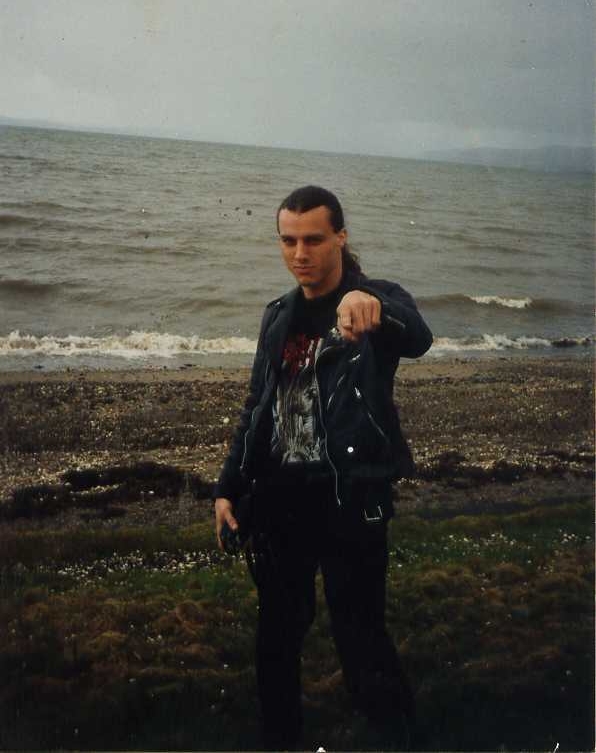
On a mid-December day in 1983, Chuck Schuldiner set up in his family's Altamonte Springs garage with guitarist Rick Rozz on one side and drummer Barney "Kam" Lee in the middle, and the three teenagers barreled through covers of Metallica, Mötley Crüe's "Live Wire" and Venom's "Teacher's Pet" — the rehearsal the family-authorized biography Born Human credits as the birth of Florida death metal. Schuldiner stayed the one constant as the band mutated through a rotating cast of musicians and seven albums, from 1987's gore-drenched debut Scream Bloody Gore to the increasingly technical Symbolic (1995) and The Sound of Perseverance (1998). Asked if he deserved the "father of death metal" title, he waved it off: "I'm just a guy from a band." He died of brain cancer in 2001, having spent nearly two decades restlessly rebuilding the genre he helped invent.
the sound in question
1988
Pull the PlugDeath
walk the tributaries ↓
Iron Maiden1980s · Heavy metal / Hard rock / New wave of British heavy metal
Schuldiner's love for Iron Maiden predates Death itself — family accounts have him wearing Maiden T-shirts as a young teenager, tugging at his hair in hopes it would grow long enough to match. Years later, discussing his heroes with the Italian magazine Metal Shock, he put it in absolute terms: "the records of Iron Maiden and Judas Priest don't have equals in today's musical panorama... without them, Death and hundreds of other groups would not exist." What he pulled from Maiden specifically was the twin-guitar melodic lead style of Dave Murray and Adrian Smith, buried under the gore on his first albums but steadily surfacing as his songwriting matured.
listen: upstream & heresource: EmptyWords (official Death archive) — Metal Shock (Italy), Oct. 1995 ↗
1983
The TrooperIron Maiden
1988
Pull the PlugDeath
listen forCue up Maiden's "The Trooper" beside Death's "Pull the Plug": both hinge on a clean, harmonized dual-guitar line that answers the verse's initial charge rather than just doubling it. Maiden's gallops at a mid-tempo canter under Bruce Dickinson's clean wail; Death's chops that same melodic instinct into a far harsher setting, burying it under distortion and Schuldiner's growl. The interlocking-harmony idea — one guitar holding a line while a second answers above it — is the exact move Schuldiner credited to Murray and Smith.
Possessed1980s · Death metal / Thrash metal
In September 1985, an 18-year-old Schuldiner moved across the country to be near Possessed, crashing on the couch of the band's fan-club president just to be close to the group he idolized. Possessed's Jeff Becerra remembers a fan, not yet a peer: "He was smitten with us... he modeled his existence after us... he then said it in countless magazines." No interview transcript in this record preserves Schuldiner's own words on Possessed as directly as Becerra's account of them, but the debt shows up on tape: Death hired Possessed's producer, Randy Burns, for Scream Bloody Gore, and later recorded its own studio version of Possessed's "The Exorcist."
listen: upstream & heresource: Decibel Magazine — 'Born Human' excerpt on Schuldiner's 1985 move to the Bay Area to be near Possessed ↗
1985
The ExorcistPossessed
2011
The Exorcist (Studio Outtake)Death
listen forPossessed cut "The Exorcist" for 1985's Seven Churches — a lurching, mid-tempo riff under Jeff Becerra's raw, half-shouted vocal. Death's own version, released as a studio outtake in 2011, keeps that central riff nearly intact but sharpens the attack: the tempo tightens, the vocal drops into Schuldiner's lower growl, and the production is cleaner and more controlled than Possessed's primitive original — the sound of a devoted student refining, rather than replacing, the teacher's blueprint.
Judas Priest1980s · Heavy metal
Schuldiner's ambitions for a more traditional-sounding project were never a secret: as early as 1993 he told Guitar School he planned "a more melodic, straight-forward heavy metal side project with a singer in the Rob Halford style" — the Judas Priest frontman's operatic range set as the standard to chase. He got there eventually with his later band Control Denied, but Death itself closed out its final album, 1998's The Sound of Perseverance, with a full studio cover of Priest's own "Painkiller," metal's most extreme song of 1990 answered in kind by one of its most extreme students.
listen: upstream & heresource: EmptyWords (official Death archive) — Metal Shock (Italy), Oct. 1995 ↗
1990
PainkillerJudas Priest
1998
PainkillerDeath
listen forJudas Priest's "Painkiller" is already redlining — Rob Halford's scream sits over a relentless double-kick pattern that was itself a nod to the extreme scene gathering around Priest. Death's cover keeps Halford's vocal melody's shape but regrounds it in Schuldiner's guttural register, and the guitar solo, replicated close to note-for-note, is the clearest place on any Death record to hear exactly how closely he'd studied Priest's phrasing before running it through his own band.