walking upstream…
Daddy Yankee
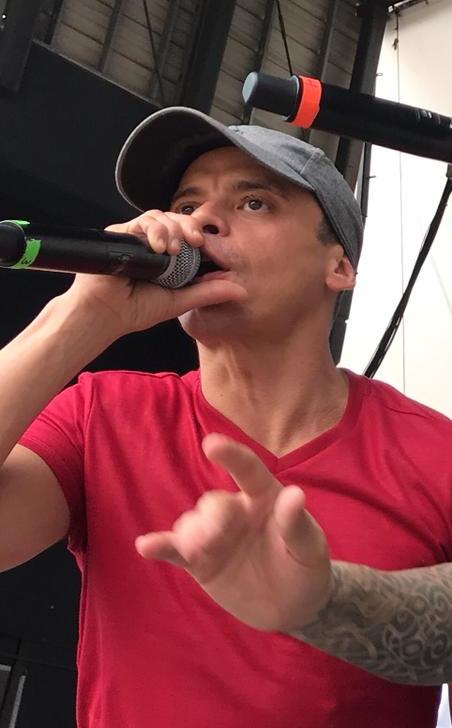

 photo: apoxyomenus · cc by-sa 4.0 ↗
Daddy Yankee
sourcesWikipedia — Daddy Yankee (biographical overview, Playero mixtape timeline) · Biography.com — Daddy Yankee (family background, early life) · Berklee — What Is Dembow? (the rhythm's Jamaican origins and migration to Puerto Rico) · Village Voice — Daddy Yankee Needs to Shut Up (Daddy Yankee's own words on the shooting)
Ramón Luis Ayala Rodríguez grew up in San Juan's Villa Kennedy housing projects, son of a salsa percussionist, chasing a baseball career until a stray bullet from an AK-47 caught him leaving a session with the underground DJ Playero in 1992 and never left his hip. 'The bullet made me be focused in music,' he later said, 'because I didn't have any other options — it was music or music.' He'd already been imitating the rhymes of rap pioneer Vico C and haunting Playero's cassette-mixtape scene, and the wound only sharpened his focus: by 1994's Playero 37 he was a name on the tape, and by 2004's 'Gasolina' he'd carried the dembow riddim — reggaeton's Jamaican rhythmic backbone — into a genre unto itself, becoming its reigning ambassador for two decades.
the sound in question
2004
GasolinaDaddy Yankee
walk the tributaries ↓
Vico C1990s · Hip-hop / Reggaeton / Christian hip-hop
Long before reggaeton had a name, a teenage Ramón Ayala was, by his own account, trying to rap like Vico C — Puerto Rico's first Spanish-language hip-hop star, so ubiquitous by the late 1980s that one critic called him 'the first Daddy Yankee, in popularity.' Vico C earned the nickname 'El Filósofo' for lyrics that stayed morally serious even as the scene around him turned raunchier and rougher; that model — a rapper who could hold the block's attention without losing the plot — is the one young Ayala first tried to copy before he'd found his own voice.
listen: upstream & heresource: Remezcla — The Evolution (or Not) of Vico C (Vico C's early influence and popularity) ↗
1991
Bomba Para AfincarVico C
1992
So' Persígueme, No Te DetengasDaddy Yankee
listen forPlay Vico C's 1991 'Bomba Para Afincar' next to Daddy Yankee's own 1992 debut verse, 'So' Persígueme, No Te Detengas,' recorded for DJ Playero's Playero 34 cassette. Both ride a spare, boom-bap-adjacent beat built to carry a rapid stream of syllables rather than a hook — the words doing the work a melody would elsewhere. Ayala's cadence is rawer and less schooled than Vico C's, but the shared instinct is unmistakable: rap first, rhythm second, and never let the beat outrun the lyric.
DJ Playero1990s · Reggaeton / Dancehall / Freestyle
DJ Playero didn't just produce Ayala's first record — he built the whole world Ayala grew up in as an artist. His underground cassette mixtapes, dubbed and passed hand to hand around San Juan's housing projects, were the era's only outlet for kids like him: 'The streets needed it,' Playero has said. 'The kids needed an outlet to express their frustration with the lives they were living.' Ayala debuted on 1992's Playero 34 as a teenager, and when a New York label boss 'took my masters for Playero 37 and re-issued the record,' Playero recalled, Ayala's voice went national before he'd left San Juan.
listen: upstream & heresource: Remezcla — DJ Playero, Pioneer of Reggaeton (Playero's own account of mentoring Daddy Yankee) ↗
1992
Playero 34 (Underground Reggae)DJ Playero
1994
Donde Mi No VengasDaddy Yankee
listen forPlay Daddy Yankee's 'Donde Mi No Vengas,' his 1994 spot on Playero 37, right after the DJ's own underground Playero 34 tape from two years earlier. Both are built the same way: a looped dancehall-descended riddim running underneath, a cassette-hiss rawness left in on purpose, and a rotating cast of teenage rappers trading verses over Playero's beat rather than any one voice carrying a hook. That chant-over-riddim mixtape format — DJ's name on the spine, kids' voices inside it — is the direct ancestor of the reggaeton album.
Shabba Ranks1990s · Dancehall / Reggae
The rhythm underneath nearly every Daddy Yankee record was never his own invention — it's Jamaican, tracing to producers Steely & Clevie's 1989 'Poco Man Jam' riddim and the song that gave it a name, Shabba Ranks' 1990 dancehall hit 'Dem Bow.' Decades later, appearing in the Peacock docuseries on reggaeton's history, Daddy Yankee finally said it plainly: 'This beat with the drums is what inspires us to create our own direction in terms of culture, rhythm, and lifestyle within the genre' — crediting the Jamaican foundation under his entire catalog, including the song that made him a global star.
listen: upstream & heresource: World Music Views — Daddy Yankee on Shabba Ranks' 'Dem Bow' (docuseries testimony on the dancehall influence) ↗
1990
Dem BowShabba Ranks
2004
GasolinaDaddy Yankee
listen forPlay 'Dem Bow' first: a single dancehall riddim, all clipped snare and empty space, built for a DJ to chat over rather than sing. Then play 'Gasolina' and listen for that exact boom-ch-boom-chick pulse underneath the synth stabs — the same two-bar skeleton, just sped up and dressed for a Latin pop chorus. Shabba's toasting patois became Daddy Yankee's rapid-fire Spanish; the riddim itself barely changed at all, which is the whole point of the connection.