walking upstream…
Big Bill Broonzy
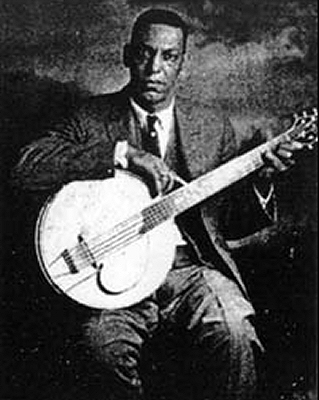

 photo: james j. kriegsmann · public domain ↗
Big Bill Broonzy
sourcesEncyclopedia of Arkansas — 'Big Bill' Broonzy (birthplace scholarship, biography, named influences) · Alan Lomax Collection (eGrove, Univ. of Mississippi) — 1947 Decca session catalog description (Jim Crow and lynching testimony) · Alan Lomax Collection (eGrove, Univ. of Mississippi) — 1952 Paris interview (Broonzy on race and personal dignity) · Wikipedia — Big Bill Broonzy (orientation; career chronology and 'Black, Brown and White')
In 1917 a Pine Bluff, Arkansas farmhand calling himself Big Bill Broonzy shipped to France with a segregated Army regiment, then came home to Jim Crow just the same; by 1920 he'd joined the Great Migration to Chicago, swapping his uncle Jerry Belcher's fiddle lessons for guitar. Over three decades and some 300 sides, he became Chicago's reigning bluesman and mentor to Maxwell Street newcomers. He wrote "Black, Brown and White," tracing a Black veteran's job prospects to his skin tone; every American label passed, and he couldn't record it until 1951, in Europe. In Paris the next year, he told Lomax his creed plainly: "I think a man in this world should be what he is, regardless of what you are, who you are, where you come from." He spent his final years bridging prewar blues and the folk revival, until throat cancer silenced him in 1957.
the sound in question
1941
Key to the HighwayBig Bill Broonzy
walk the tributaries ↓
Papa Charlie Jackson1920s · Hokum blues / Country blues
When Broonzy landed in Chicago around 1920, he still played the cigar-box fiddle his uncle had taught him; it was Papa Charlie Jackson — Paramount's biggest hokum star, working street corners and rent parties on the South Side — who put a guitar in his hands. Broonzy recalled that Jackson "taught me how to make my music correspond to my singing," and didn't stop at lessons: he introduced his student to Paramount's Black talent scout, J. Mayo Williams, setting up the recording career that followed. The bond outlasted the apprenticeship — in 1934 Jackson turned up as a sideman on one of Broonzy's own sessions.
listen: upstream & heresource: Association for Cultural Equity — Big Bill Broonzy (mentorship by Papa Charlie Jackson and Blind Blake, in Broonzy's own words) ↗
1924
Salty Dog BluesPapa Charlie Jackson
1927
House Rent StompBig Bill Broonzy
listen forPlay Jackson's breakout "Salty Dog Blues" (1924) against "House Rent Stomp" (1927), the tune on the flip side of Broonzy's first Paramount single: both keep a steady, syncopated thumb-bass driving underneath a bright, dance-floor lead line, built for a rent party rather than a front porch. It's the same hokum showmanship Jackson had been playing on Chicago's South Side street corners — a lesson in making the guitar itself carry the party, no singing required.
Blind Blake1920s · Piedmont blues / Ragtime blues
Jackson's circle of Chicago guitarists also put Broonzy in earshot of Blind Blake, whose fingerpicking left the deeper mark. Broonzy described the effect in near-astonished terms: Blake "began to show me what the guitar could do. He made it sound like every instrument in the band — saxophone, trombone, clarinets, bass fiddles, pianos — everything." It wasn't a lesson so much as a revelation about the instrument's range, and Broonzy spent the rest of the 1920s chasing that one-man-band sound on the ragtime-flavored sides he cut with his own group, the Hokum Boys.
listen: upstream & heresource: Association for Cultural Equity — Big Bill Broonzy (mentorship by Papa Charlie Jackson and Blind Blake, in Broonzy's own words) ↗
1926
West Coast BluesBlind Blake
1930
Saturday Night RubBig Bill Broonzy
listen forBlake's 1926 "West Coast Blues" is a one-guitar orchestra: his thumb keeps a rolling bass line while his fingers pick out a separate, syncopated melody on top, so the instrument seems to split into two players. Broonzy goes after that same trick on "Saturday Night Rub" (1930), a hard-driving rag where his thumb-and-finger interplay does the work of a full string band — the one-man-orchestra effect that first opened Broonzy's ears to the instrument's range, made audible on his own record.
Blind Lemon Jefferson1920s · Texas blues / Country blues
Broonzy likely never met Blind Lemon Jefferson, the blind Texas singer whose Paramount sides were on every jukebox and street corner by the mid-1920s, but his earliest recordings show him reaching for that voice anyway. Blues historian Sam Charters put it plainly: on those first sides, Broonzy "was trying to imitate Blind Lemon, but he didn't have Lemon's voice." It's a records-only debt, arm's-length compared with the hands-on tutoring from Jackson and Blake — but it's the closest thing Broonzy had to a singing teacher before he settled into his own drier, more conversational delivery.
listen: upstream & heresource: Encyclopedia.com / Gale Musicians and Composers of the 20th Century — Broonzy, Big Bill (Papa Charlie Jackson teaching guitar; Sam Charters on imitating Blind Lemon Jefferson) ↗
1926
That Black Snake MoanBlind Lemon Jefferson
1928
Down in the Basement BluesBig Bill Broonzy
listen forJefferson's "That Black Snake Moan" (1926) rides his signature high, keening shout, bending notes behind the beat in a way that ignores the guitar's meter entirely. On "Down in the Basement Blues," cut the following year, Broonzy is audibly reaching for that same strained, high-pitched cry, before he found the lower, plainspoken talking-blues voice that would define him. Historians hear the imitation as unconvincing — that's exactly what to listen for.