walking upstream…
Wynonie Harris
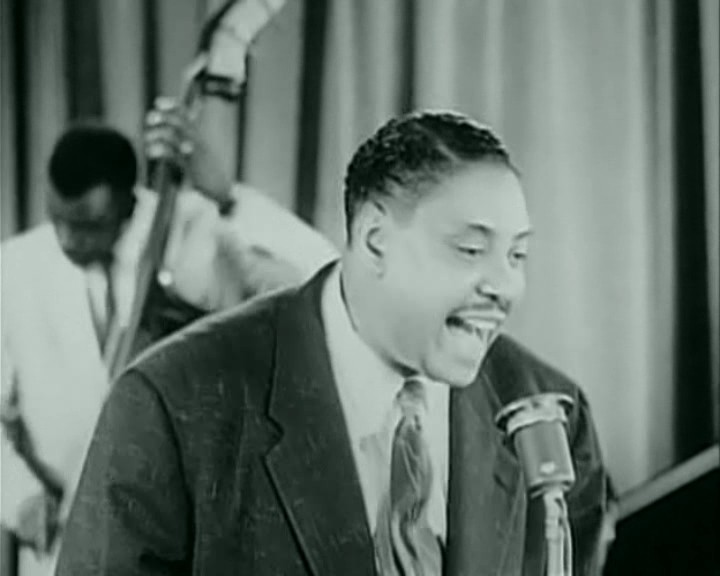


 photo: public domain ↗
Wynonie Harris
sourcesEncyclopedia of the Great Plains — Harris, Wynonie (1913-1969), by biographer Tony Collins (bio, Turner/Rushing influence) · The Blues Foundation — Blues Hall of Fame Inductee · The Blues Foundation — Blues Hall of Fame · Spontaneous Lunacy — Wynonie Harris · Spontaneous Lunacy — Artist Directory
In 1944, Lucky Millinder needed a new blues shouter for his big band and found one working Chicago clubs under the name "Mr. Blues." Wynonie Harris had learned the trade in Omaha, listening to two touring Kansas City belters, Big Joe Turner and Jimmy Rushing, until his own voice could ride over a full horn section unaided. The Millinder gig produced a number-one hit, "Who Threw the Whiskey in the Well," and set up Harris's biggest gamble: turning down a song called "Good Rockin' Tonight" from an unknown singer, then reversing himself once that singer's own version broke regionally. Harris explained his audience plainly — he sang for "women with meat on their bones," not "Coca-Cola-drinking bobby-soxers" — and that raunchy, full-throated persona, more than any one lyric, is what later rock frontmen inherited.
the sound in question
1949
All She Wants to Do Is RockWynonie Harris
walk the tributaries ↓
Big Joe Turner1950s · Blues / Jump blues / R&B
By the time Wynonie Harris was a national star, he called himself the greatest performer in recorded music, with one exception. "The one — and only — performer he held in even higher esteem than himself was Big Joe Turner," the music-history blog Spontaneous Lunacy wrote, and the two put that hierarchy on wax in 1947, cutting the duet "Battle of the Blues" as billed equals even as Harris's opening verses read like tribute before he turns, as ever, to bragging on himself. Turner, a decade into shouting over Pete Johnson's boogie-woogie piano in Kansas City, had already shown Harris what the job required.
listen: upstream & heresource: Spontaneous Lunacy — Wynonie Harris and Big Joe Turner ↗
1938
Roll 'Em PeteBig Joe Turner
1949
Battle of the Blues (Part I)Wynonie Harris
listen forPlay Turner's 1938 "Roll 'Em Pete" against the 1949 duet and the debt is plain: both ride a rolling boogie-woogie piano at a near-identical clip, with the singer shouting clear over the band instead of blending into it. On "Battle of the Blues," listen for Harris visibly downshifting in his opening bars — subdued next to Turner's "volcanic" bellow, in Spontaneous Lunacy's phrase — before he regains his nerve and turns the record back toward his own bravado, the same vocal swagger Turner had already made a style.
Jimmy Rushing1930s–40s · Blues / Jazz
The same Kansas City sound reached Harris through a second singer: Jimmy Rushing, the barrel-chested Count Basie vocalist known as "Mr. Five by Five." The Blues Hall of Fame credits Rushing with having "pioneered the big band blues belting style... influencing subsequent blues shouters like Big Joe Turner, Wynonie Harris, and Roy Brown" by name. Harris carried that model straight into his own breakout: when bandleader Lucky Millinder needed a shouter to ride his horns the way Basie's band had ridden Rushing's, Harris got the job, and "Who Threw the Whiskey in the Well" became his first number-one record.
listen: upstream & heresource: The Blues Foundation — Blues Hall of Fame Inductee ↗
1938
Sent for You Yesterday and Here You Come TodayJimmy Rushing
1945
Who Threw the Whiskey in the WellWynonie Harris
listen forSet Basie and Rushing's 1938 "Sent for You Yesterday and Here You Come Today" beside Harris's 1945 breakthrough and the shared architecture is plain: a big swing band vamps behind one voice that never has to strain to be heard over the horns. Rushing rides the beat with a jazz singer's ease; Harris, a rawer instrument, pushes the same format toward something closer to shouting as lyric, the horns punctuating his lines rather than cushioning them — the shift soon renamed rhythm and blues.
Roy Brown1940s–50s · Blues / R&B
Roy Brown wrote "Good Rocking Tonight" and offered it to Harris first — Harris turned it down. Only after Brown's own version broke regionally in late 1947 did Harris reconsider, cutting what the podcast 500 Songs calls an "almost identical" cover, distinguished mainly by a "hoy hoy" vocal hook borrowed from another record and a "When the Saints Go Marchin' In" intro. Released in early 1948, it hit number one — the version historians point to, not Brown's original, when they call it "the first rock and roll record." Harris went back to Brown's catalogue twice more; three of his seven Top Ten hits were songs Brown wrote.
listen: upstream & heresource: A History of Rock Music in 500 Songs — Episode 7 ↗
1947
Good Rocking TonightRoy Brown
1948
Good Rockin' TonightWynonie Harris
listen forCue up Brown's 1947 original next to Harris's 1948 cover and the arrangement barely moves — same tempo, same structure — which makes the differences count for more. Listen for Harris opening with a few bars of "When the Saints Go Marchin' In" before the song proper starts, and for the "hoy hoy" ad-lib he drops into the vocal, a hook lifted from elsewhere that Brown's version lacks. It's a small addition riding on an otherwise faithful copy, and that added swagger, not the songwriting, is what tipped the record into rock and roll.