walking upstream…
Ramón Ayala
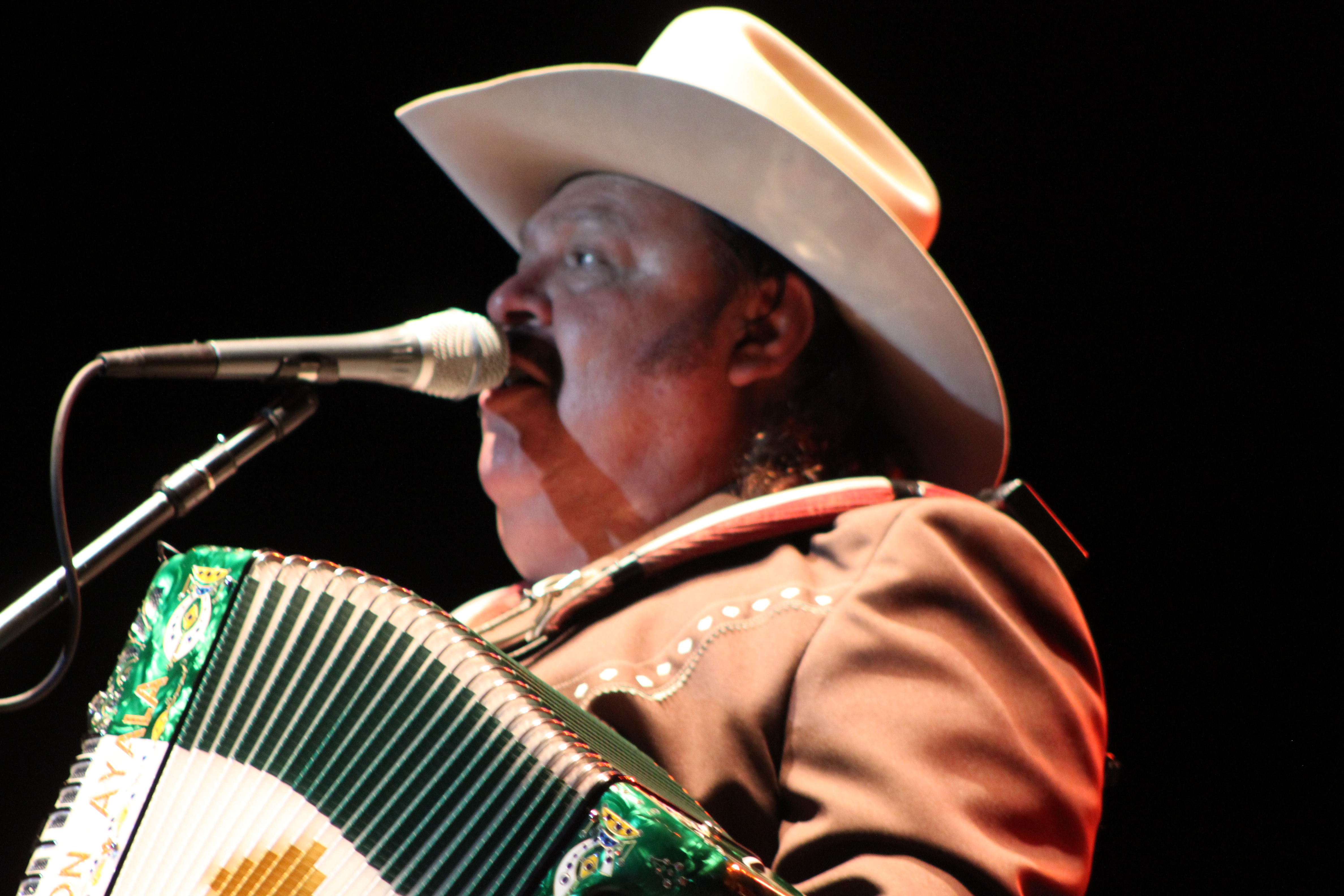 photo: aaronmarkham · cc by 2.0 ↗
Ramón Ayala
sourcesBillboard — "20 Questions With Ramón Ayala" (early life, Cornelio Reyna partnership, 2024 farewell-tour pushback) · La Crónica de Hoy (Notimex) — Ayala names his own predecessors by name (2017) · Strachwitz Frontera Collection (UCLA) — Los Donneños biography (formation, border-crossing success)
Ramón Covarrubias Garza got his first accordion at five, paid for with money from a pig his father sold, and by fourteen was polishing shoes outside a Reynosa cantina, angling for a chance to sit in with the musicians working the bar circuit. They turned him down — until an eighteen-year-old bajo sexto player spoke up: "Give him a shot," said Cornelio Reyna. The two became Los Relámpagos del Norte, and their 1963 debut single, "Ya No Llores," updated norteño with new accordion runs and tighter two-part harmony. When Reyna left for a solo career in 1971, Ayala kept the band on as Los Bravos del Norte, eventually recording over 100 albums and selling more than 35 million records as "El Rey del Acordeón" — a boy who absorbed a regional songbook by ear, then spent six decades rewriting it.
the sound in question
Tragos AmargosRamón Ayala
walk the tributaries ↓
Los Alegres de Terán1950s · Norteño / Corrido
Asked in a 2017 interview who came before him, Ayala didn't equivocate: "Anteriormente eran Los Alegres de Terán, Los Donneños..." — the accordion-and-bajo-sexto duo of Eugenio Ábrego and Tomás Ortiz named first, ahead of every other predecessor. Spanish Wikipedia's account goes further, crediting the pair specifically for shaping the initial repertoire Ayala performed as a young accordionist, not just his general taste. Their format — one accordion, one bajo sexto, two voices harmonizing tight over a corrido's plot — is the exact architecture Ayala and Cornelio Reyna adopted, note for note, on their own debut single fifteen years later.
listen: upstream & heresource: Texas Monthly — "King of the Accordion" (Reynosa cantina origin story, Los Donneños/Los Alegres de Terán predecessors) ↗
1954
Carga BlancaLos Alegres de Terán
1973
El Soldado RazoRamón Ayala
listen forPlay Los Alegres de Terán's "Carga Blanca," one of the era's most-covered smuggling corridos: two voices locked in close harmony over an accordion that answers each vocal line, a bajo sexto keeping a plain, trotting pulse underneath. Ayala's 1973 "El Soldado Razo" keeps that architecture nearly intact two decades on — the accordion still trading phrases with the vocal instead of filling space behind it, the harmony still carrying the story's weight. No cover connects the two songs directly; the debt is in the shared blueprint, not a shared title.
Los Donneños1950s · Norteño / Tejano
In the same 2017 interview, Ayala named Los Donneños second among his predecessors, right after Los Alegres de Terán. Cecilia Ballí's 2004 Texas Monthly profile independently confirms the pairing, noting that "accordion music had been made popular by groups such as Los Donneños de Ramiro Cavazos and Los Alegres de Terán" years before Los Relámpagos del Norte existed. The duo — accordionist Mario Montes trading lines with singer-guitarist Cavazos — had already proven a bare two-man act could cross the border both ways commercially, the exact model Ayala and Reyna followed when they formed their own group in 1959.
listen: upstream & heresource: Texas Monthly — "King of the Accordion" (Reynosa cantina origin story, Los Donneños/Los Alegres de Terán predecessors) ↗
Mataron a la PalomaLos Donneños
1977
Un Rinconcito en el CieloRamón Ayala
listen forLos Donneños' signature "Mataron a la Paloma" is spare: guitar and accordion trading a simple line, two voices carrying a tragic, plainly told story with nothing extra layered on. Ayala's 1977 "Un Rinconcito en el Cielo" keeps that same discipline — accordion answering vocal, harmony doing the emotional lifting, no ornament distracting from the lyric. No source ties the two songs together directly; the connection is the shared duo format both acts built their careers on, not a documented cover.
Tony de la Rosa1950s · Conjunto / Tejano
Ayala names Tony de la Rosa specifically among his Texas-side predecessors in the same 2017 interview — one instrumentalist, not a duo or group, credited by his own name. The Handbook of Texas backs up why: De la Rosa introduced "the use of amplified bajo sexto and bass and the practice of slowing polka tempos down to 110-115 beats per minute," innovations that predate Los Relámpagos' 1963 debut by roughly a decade. Every dancehall polka Ayala's bands played for the next six decades, his own included, sits inside the tempo and volume De la Rosa set first.
listen: upstream & heresource: Handbook of Texas (TSHA) — Tony De La Rosa entry (amplification and tempo innovations) ↗
1976
El CircoTony de la Rosa
1987
La Rama del MezquiteRamón Ayala
listen forDe la Rosa's "El Circo," an accordion polka adapted from the American tune "Alabama Jubilee," rides the amplified, mid-tempo pulse he's credited with establishing as the conjunto standard — loud, danceable, unhurried compared to the faster traditional polka. Ayala's 1987 "La Rama del Mezquite" sits at that same amplified, dancehall tempo, the accordion still the lead voice pushing the rhythm forward. No source documents Ayala performing a De la Rosa composition directly; the link is the tempo and volume template, carried forward rather than covered.