Rahbani Brothers


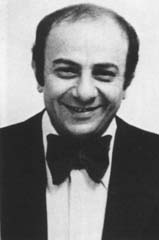 photo: novalib2 (wikimedia commons) · cc by-sa 3.0 ↗
Assi Rahbani (1923–1986) and Mansour Rahbani (1925–2009) were the Lebanese composer-brothers whose radio-station meeting with a young singer named Nouhad Haddad in the early 1950s produced Fairuz and, with her, the sound of modern Lebanese song. Raised on a buzuq-playing father and a grandmother who exposed them early to Cairo's Mohammed Abdel Wahab and Sayed Darwish on record, and steeped from childhood in Byzantine and Maronite liturgical chant, they built a hybrid musical language — Western orchestration and harmony layered over Lebanese folklore, muwashshah, and operetta-scaled storytelling — condensed into the compact "ughniya" song form, in deliberate contrast to the hours-long improvised forms of Cairo tarab. Assi's 1972 stroke ended the creative partnership by the late 1970s, but their operettas and songs remain the bedrock of Fairuz's catalog.
Assi and Mansour's grandmother Ghita raised them on Cairo radio, specifically exposing the brothers early on to Mohammed Abdel Wahab's records alongside Lebanese folklore; when the brothers began composing professionally in the early 1950s, the dominant model for a modern, orchestrated Arabic song was still Abdel Wahab's Cairo sound, which the Rahbanis absorbed and then deliberately localized into a Lebanese idiom.
listen forListen for the orchestral string writing and Western harmonic color under the vocal line in Rahbani arrangements — closer to Abdel Wahab's polished, cinematic Cairo productions than to the older, sparser takht-ensemble sound — even as the melodic material itself turns unmistakably Lebanese.
The same childhood listening sessions exposed the Rahbani brothers to Sayed Darwish's nationalist, theatrically-scaled songs; Darwish's model of using song to narrate collective, often political feeling — rather than only private romance — fed directly into the Rahbanis' own operettas and "homeland" songs decades later, part of the same tradition that produced Fairuz's "Li Beirut."
listen forListen for the choral, march-adjacent passages and the way a Rahbani operetta song can carry an explicitly national or civic subject — a direct descendant of Darwish's turn-of-the-1920s innovation of writing Egyptian popular song about the nation rather than only the beloved.