walking upstream…
Fairuz
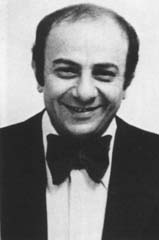


Fairuz (Nouhad Haddad, b. 1934) is the most celebrated singer in Lebanese and Levantine musical history, a national-radio chorus girl whose voice became inseparable from the songwriting of the Rahbani Brothers — her husband Assi and brother-in-law Mansour — from their first hit together, "Itab," in 1952 onward. Trained by the composer Muhammad Flayfel in Qur'anic recitation and the classical Andalusian muwashshah repertoire before she ever sang secular song, she brought a controlled, almost devotional vocal discipline to a catalog that ranged from three-minute Lebanese folk-tinged "ughniya" to elegies for a shattered Beirut. Revered across the Arab world as "Ambassador to the Stars," she is often paired with — and contrasted against — Umm Kulthum as the other pole of twentieth-century Arabic song.
the sound in question
1984
Li BeirutFairuz
walk the tributaries ↓
Rahbani Brothers1950s–70s · Lebanese operetta / Arabic orchestral song / Levantine folk fusion
Assi and Mansour Rahbani composed and arranged nearly the entirety of Fairuz's classic-era catalog, building the "ughniya" — a compact, through-composed song with intro, verses, and instrumental interludes — around her voice, and layering Western string and horn orchestration over Lebanese folk melody, muwashshah form, and later full-scale sung operettas (Bint el-Hares, Petra, and others) that gave her repertoire its narrative, almost theatrical scope.
listen: upstream & heresource: Rahbani brothers — Wikipedia (meeting Fairuz, "Itab" 1952, Assi's 1972 stroke) ↗
Intro Pt. 1 (Instrumental)Rahbani Brothers
1970
Habaytak BisayfFairuz
listen forListen for the elaborate instrumental preludes and interludes — often close to a minute of orchestral scene-setting before she even enters — and for how a song like "Habaytak Bisayf" stays inside one tight melodic idea in the Nahawand maqam rather than spinning out into open-ended improvisation; that concision and orchestral framing is pure Rahbani design.
Muhammad Flayfel1930s–40s · Arab nationalist anthem / Lebanese music pedagogy
As a teenager performing in a radio talent competition, Nouhad Haddad caught Flayfel's ear; he advised her to enroll at the Conservatoire Libanais National Supérieur de Musique where he taught, and personally trained her in Qur'anic tajwid recitation and the classical Andalusian muwashshah repertoire before she ever sang a secular song — the vocal-technique bedrock (breath control, precise ornamentation, text-first phrasing) that she carried into her entire Rahbani-era career.
listen: upstream & here
Qur'anic tajwid recitation and muwashshah instruction (unrecorded pedagogy)Muhammad Flayfel
1966
Lamma Bada YatathannaFairuz
listen forListen to her recording of the muwashshah "Lamma Bada Yatathanna" for the clearest throughline to Flayfel's training — the elaborate, evenly controlled melismatic turns on a single syllable are straight out of the tajwid and muwashshah discipline he drilled into her as a teenager, years before any Rahbani orchestration entered the picture.
Umm Kulthum1940s–60s · Classical Arabic song / Tarab / Qasida / Egyptian music
Umm Kulthum's grandeur and vocal control were a constant reference point for the Rahbani/Fairuz project even as they consciously built something different from her — a shorter, pre-composed "ughniya" rather than the hour-long, endlessly repeated and reworked qasida performances that built Kulthum's tarab intensity. Commentators have long framed Fairuz and Umm Kulthum as the two poles of twentieth-century Arabic song, and Fairuz's own early training absorbed the same qasida/tarab vocal grounding Kulthum embodied, just deployed at far shorter length.
listen: upstream & heresource: "Umm Kulthum and Fairuz" — Ayush's Substack (early influences ↗
1964
Enta OmriUmm Kulthum
1995
Kifak IntaFairuz
listen forListen for the moments where Fairuz holds and slowly reshapes a single note or word rather than moving straight through the melody — audible in the drawn-out opening lines of "Kifak Inta" — a controlled, unhurried vocal placement that's a lighter-voiced echo of the tarab technique Umm Kulthum built entire performances around.