walking upstream…
Mohammed Abdel Wahab
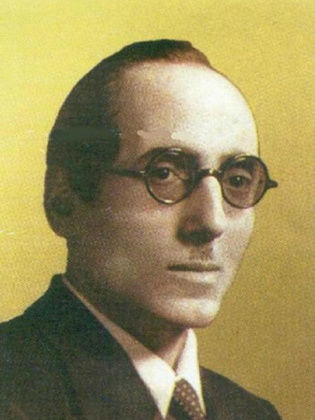


Mohammed Abdel Wahab (1902–1991) was Egypt's most influential twentieth-century composer-singer, a muezzin's son who performed publicly as a child, came under the patronage of the poet Ahmed Shawqi (who helped him obtain music lessons and wrote him neoclassical lyrics), and spent a seven-decade career fusing Arabic maqam with Western orchestration, waltz rhythm, and eventually rock and roll. Biographical accounts describe him studying oud under the virtuoso Mohamed al-Qasabgi and, in his teens, absorbing the modernizing fusion of Sayed Darwish's theater troupe — strands that fed directly into the Cairo sound the young Rahbani brothers grew up listening to on record in Beirut.
the sound in question
1942
Ya Msafer WahdakMohammed Abdel Wahab
walk the tributaries ↓
Muhammad al-Qasabgi1920s–40s · Oud / Taqsim / Egyptian composition
Britannica and other biographical accounts describe the young Abdel Wahab studying oud under Mohamed al-Qasabgi, absorbing both instrumental technique and Qasabgi's own project of blending oriental maqam playing with modern harmonic and orchestral ideas — a template Abdel Wahab then expanded far beyond the oud into full orchestration and eventually Western pop forms.
listen: upstream & here
1925
Taqsim Rast (1924–1926 recording)Muhammad al-Qasabgi
Ana Wel Aazab Wa HawaMohammed Abdel Wahab
listen forListen for harmonically colored, sustained oud taqsim passages in Abdel Wahab's early recordings — an extension of Qasabgi's own melodically adventurous, long-breath improvisational style rather than the more austere older maqam approach.
Sayed Darwish1910s–20s · Egyptian musical theater / Taqtuqa / Nationalist song / Muwashshah
Accounts of Abdel Wahab's youth describe him spending time around Sayed Darwish's theater troupe in his early teens, watching Darwish fuse nationalist lyrics with simplified maqam melody and early Western harmonic touches — a fusion that became a direct model for the modernized, still Arabic-rooted orchestral song Abdel Wahab spent his career building.
listen: upstream & here
Ana HaweetSayed Darwish
La Mosh Ana Elli AbkyMohammed Abdel Wahab
listen forListen for how Abdel Wahab keeps a strong, immediately singable melodic hook — closer to Darwish's popular, memorable tunes than to the more improvisatory, text-driven qasida style of older masters — even inside his more heavily orchestrated later work.
Abdu al-Hamuli1870s–90s · Dawr / Muwashshah / Classical Arabic tarab
Even as a child performing at religious festivals and family gatherings, Abdel Wahab grew up on the reputation and repertoire of earlier tarab masters like Abdu al-Hamuli, whose emotive, long-held qasida and dawr singing for the khedival court set the emotional and technical bar — sustained vocal ornament, dramatic long-form delivery — that later Egyptian singer-composers measured themselves against.
listen: upstream & here
Reconstructed dawr/qasida repertoire (pre-gramophone era; no surviving recording of his voice)Abdu al-Hamuli
1942
Ya Msafer WahdakMohammed Abdel Wahab
listen forListen for the moments Abdel Wahab lets a single line breathe and stretch dramatically before resolving — a much-compressed echo of the extended dawr and qasida forms Abdu al-Hamuli's generation performed live for the khedive's court.