walking upstream…
Pet Shop Boys


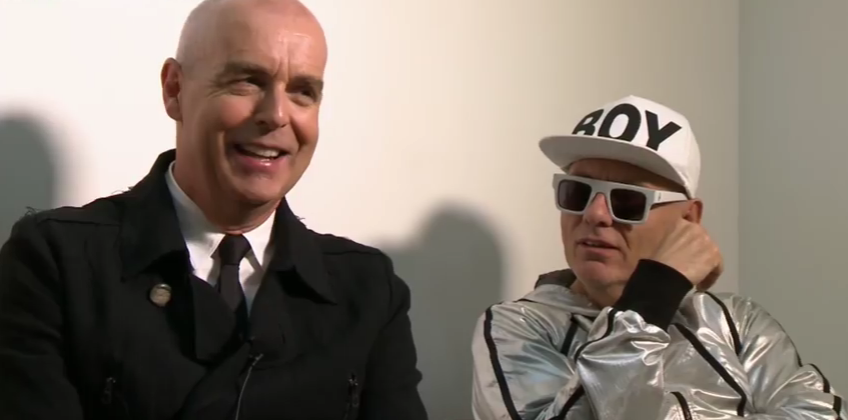 photo: the sound stage · cc by 3.0 ↗
Pet Shop Boys
sourcesThe Guardian — Neil Tennant on West End Girls (Bobby Orlando meeting, Grandmaster Flash influence) · The Quietus — The Sound of the City · Interview Magazine — Pet Shop Man · Mojo — Pet Shop Boys Interviewed (Bowie/Kraftwerk as formative taste, meeting Lowe) · The Quietus — Pop Kid · geowayne.com — A Brief Pre-Fame Biography of the Pet Shop Boys (origin story, Bobby O meeting details) · geowayne.com — Two Divided by Zero annotation (Bobby Orlando co-write backstory) · BBC Radio 2 Sold on Song — West End Girls (Grandmaster Flash influence, corroborating)
On 19 August 1981, Neil Tennant — a Smash Hits-bound magazine writer with a secret drawer of folk songs — and Chris Lowe, an architecture student who'd spent his teens playing trombone in a jazz band, struck up a conversation in a King's Road hi-fi shop while waiting to be served. Within weeks they were writing together on Tennant's synthesizer, trading Bowie records and hi-NRG disco 12-inches. Tennant later used a magazine assignment to track down a New York producer he idolized and talked him into cutting their debut; by 1985, that scavenging — hip-hop cadence, Hi-NRG throb, deadpan English remove — had become 'West End Girls,' the most unlikely rap-inflected number one in British pop.
the sound in question
1985
West End GirlsPet Shop Boys
walk the tributaries ↓
Bobby Orlando1980s · Hi-NRG / Disco / Electronic
Before Bobby Orlando had heard a note of their music, Lowe had worn out his 12-inch of Orlando's 'Passion,' and Tennant was salvaging the producer's singles from the Smash Hits reject pile to rave about in print. 'His records were almost punk, really,' Lowe said — 'simple beats, two, three chords, lo-fidelity production.' In August 1983, Tennant used a magazine trip to New York to track Orlando down over cheeseburgers at a diner; Orlando signed the unheard duo on the spot and produced their debut sessions himself.
listen: upstream & heresource: Magnet Magazine — The Making Of Pet Shop Boys' 'Please' (Bobby Orlando discovery and debut sessions) ↗
1982
PassionBobby Orlando
1984
West End Girls (Bobby O Version)Pet Shop Boys
listen forPlay Orlando's 1982 single 'Passion,' credited to his studio group the Flirts, against the original 1984 cut of 'West End Girls' — the version Orlando himself produced before Pet Shop Boys re-recorded it for radio. Both ride the same clanging cowbell, Emulator synth-bass, and stiff four-on-the-floor pulse Orlando stamped on every record he touched: the 'punk' minimalism Lowe described, just with an English rap laid over the top instead of a disco vocal.
Grandmaster Flash and the Furious Five1980s · hip hop / old-school hip hop / electro
'You were emulating "The Message" by Grandmaster Flash, right?' an interviewer asked in 2010. 'Yes,' Tennant said, 'the rhythm of the rap is exactly the same — but I do it in an English accent.' He'd been collecting Grandmaster Flash and Afrika Bambaataa records on his Smash Hits expense account, and one night at his cousin's house, after watching a James Cagney gangster film, the opening lines of 'West End Girls' arrived in his head, already shaped to that same rap cadence.
listen: upstream & here
1982
The MessageGrandmaster Flash and the Furious Five
1985
West End GirlsPet Shop Boys
listen forCue Grandmaster Flash and the Furious Five's 1982 street-reportage landmark 'The Message,' then Pet Shop Boys' 'West End Girls.' Listen for the shared clipped, conversational rap meter — Tennant's deadpan delivery riding the same rhythmic pocket as Melle Mel's — and, in the original 1984 mix, a sampled shard of breaking glass, a direct nod to the older record's own broken-glass imagery of stairwells and hard city nights.
David Bowie1970s · Art rock / Glam rock
Bowie was the one thing Tennant and Lowe agreed on the day they met. 'He was a happy-go-lucky disco fan,' Tennant said of Lowe, 'but he also liked Bowie, that's where we met.' Tennant later named Bowie, alongside Kraftwerk, as the artist who 'completed' his teenage taste, tracing the spark to a 1972 Old Grey Whistle Test performance of 'Five Years.' Four decades later, the duo recorded their own version of the Bowie-written 'All the Young Dudes,' released as a single with a full orchestral arrangement.
listen: upstream & here
1972
All the Young DudesDavid Bowie
2024
All the Young DudesPet Shop Boys
listen forBowie recorded 'All the Young Dudes' himself in 1972, though he gave the song away to Mott the Hoople before his own version ever surfaced. Set it against Pet Shop Boys' 2024 recording and listen for what survives the fifty-year gap: the same anthemic, slightly weary hook, delivered here without glam swagger — Tennant's plainspoken vocal and a swell of strings standing in for the guitars, turning youth-cult bravado into something closer to elegy.