walking upstream…
Mumford & Sons


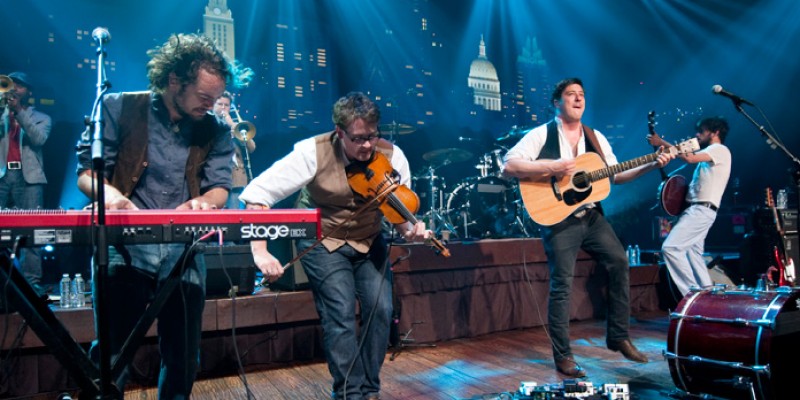 photo: roostertopgun · cc by-sa 4.0 ↗
Mumford & Sons
sourcesWikipedia — Mumford & Sons (band history overview) · NME — Rob Fitzpatrick, "The Roots Of... Mumford & Sons" (formation story, Dylan/Springsteen/Old Crow testimony) · Rolling Stone — Brian Hiatt, "Mumford & Sons · Rolling Stone — "Marcus Mumford on Backing Dylan, Naked Songwriting and Why Arcade Fire Rule His World" (Dylan vinyl/Grammy quotes) · Saving Country Music — Trigger (Kyle Coroneos), "The Music That Paved The Way For Mumford & Sons" (Old Crow discovery quote, Ketch Secor quote) · Jambase — Scott Bernstein, "Mumford & Sons Fit 'Wagon Wheel' Cover Into Red Rocks Setlist" (live-cover history 2009–2012, 2025 revival)
By late 2006, four university friends were rehearsing bluegrass on the pavement outside Bosun's Locker, a country night Winston Marshall ran in a since-shuttered King's Road basement bar. Marcus Mumford, who'd met keyboardist Ben Lovett at school in Wimbledon and bassist Ted Dwane in Edinburgh, folded the group into London's tight-knit folk circuit alongside Laura Marling and Noah and the Whale — "it wasn't really a scene at all," he said, "they were just our friends." Two independent EPs led producer Markus Dravs to sign on after hearing, in his own words, "amazing dance music." His real trick was structural: take a banjo-and-stand-up-bass lineup and, as Dravs put it, "make [bluegrass] sound as fat sonically as hip hop, then you can fill an arena, easy." Sigh No More, released in 2009, did exactly that.
the sound in question
2009
Little Lion ManMumford & Sons
walk the tributaries ↓
Bob Dylan1960s · Folk / Folk rock / Rock
Mumford's mother wasn't a record collector, but she owned Bob Dylan's born-again album Slow Train Coming, and it became, he said, "pretty much the first vinyl I ever listened to." That early accident hardened into declared debt: by 2011, when his band's manager called to say the Grammys wanted them backing Dylan and the Avett Brothers on "Maggie's Farm," Mumford bolted out of bed and ran outside. Asked about it afterward, he put it plainly: "You can imagine the reaction of someone who probably wouldn't be playing music at all if it wasn't for Dylan."
listen: upstream & heresource: American Songwriter — "Hear Mumford And Sons Cover Bob Dylan, Bruce Springsteen" (Daytrotter session credits/details) ↗
1961
I Was Young When I Left HomeBob Dylan
listen forDylan cut "I Was Young When I Left Home" alone in a Minneapolis apartment in 1961 — twenty years old, guitar and harmonica, a talking-blues drawl that barely rises above conversation, each verse trailing into silence before the next. Mumford's 2012 cover, recorded on the band's tour bus with Dawes's Taylor Goldsmith, keeps that hushed pacing and the same wandering fingerpicked figure, but lets a second voice creep in under the melody — the harmony Dylan never had, layered onto phrasing borrowed wholesale from him.
Bruce Springsteen1970s-80s · Heartland rock / Rock / Folk rock
Springsteen's Seeger Sessions Band — the banjo-driven folk ensemble captured on his live album Live in Dublin — is what Mumford names as a direct model for his own band's sound: "Springsteen found a way to make acoustic instruments sound big." The connection got personal in February 2013, when Mumford & Sons played a gala for the music-industry charity MusiCares honoring Springsteen at Brooklyn's Barclays Center, gathering around a single microphone for "I'm on Fire." "We wanted to do it around one microphone, because we enjoy being able to do that at our gigs," Mumford explained — and backstage afterward, Springsteen sought the band out himself.
listen: upstream & heresource: Rolling Stone — Patrick Doyle, "When Mumford & Sons Met Bruce Springsteen" (MusiCares gala quotes) ↗
1982
Atlantic CityBruce Springsteen
2012
Atlantic CityMumford & Sons
listen forSpringsteen's "Atlantic City" is barely there — just his voice and an acoustic guitar picking out a spare, circling figure, the mix so dry it sounds recorded in an empty room. Marcus Mumford and Dawes's Taylor Goldsmith cut their 2012 cover on the band's tour bus rather than in a studio, keeping that same bare arrangement — two guitars, no drums, no swell — but adding a second voice in close harmony on the chorus, filling out the empty space Springsteen's original leaves alone. It's the deliberate opposite of Mumford & Sons' usual stomp-and-holler arena sound.
Old Crow Medicine Show2000s–10s · Old-time / Bluegrass / Country
At sixteen or seventeen, Mumford heard Old Crow Medicine Show for the first time and it rerouted him: "I'd listened to a lot of Dylan, but I hadn't really ventured into the country world so much," he said. "So Old Crow were the band that made me fall in love with country music." He'd later call them one of the band's biggest influences outright. Old Crow's Ketch Secor, watching what grew from that seed, returned the compliment: "Those boys took the message and ran with it."
listen: upstream & heresource: Wikipedia — Old Crow Medicine Show (band history, Wagon Wheel background) ↗
2004
Wagon WheelOld Crow Medicine Show
2012
Wagon WheelMumford & Sons
listen forOld Crow's "Wagon Wheel," credited to Ketch Secor and Bob Dylan and eventually platinum-certified, builds around a chorus simple enough for a crowd to shout back before the first verse even ends, fiddle and banjo racing underneath. Mumford & Sons covered it live more than a dozen times between 2009 and 2012 — including stops on their Gentlemen of the Road tour — and revived it as recently as a 2025 Red Rocks show, the same singalong trick scaled up: banjo drops from lead instrument to one voice in a bigger, stomping chorus, the crowd doing the same job Old Crow's fiddle used to do.