walking upstream…
Moon Mullican

Moon Mullican
In 1917, on his family's eighty-seven-acre farm near Corrigan, Texas, eight-year-old Aubrey Mullican got his hands on the pump organ his devout father had bought so the girls could learn hymns — and started sneaking blues out of it instead. By his teens he'd traded organ for guitar and worked up a two-fisted piano style built for dances, not church; his father called it sin, and Mullican, who'd go by "Moon," judged music by whether it could "make the bottles bounce on the table." He left the farm at sixteen for Houston's rougher rooms, spent a decade in western swing bands, then signed with King Records in 1947 and became, in critic Bruce Eder's words, "a legend twice over, in country music and rock & roll" — a hillbilly bandleader whose two-finger boogie Jerry Lee Lewis would study note for note.
the sound in question
1950
I'll Sail My Ship AloneMoon Mullican
walk the tributaries ↓
Joe JonesBlues
On the Mullican family's farm near Corrigan, Texas, before Aubrey turned thirteen, a Black sharecropper named Joe Jones taught the preacher's son to play blues guitar. It was, AllMusic's Bruce Eder writes, "an act of rebellion" in a household where the father drove to church three times a week and treated the blues as sin walking. Jones left no record of his own — no interview, no 78, no photograph — but the debt survived in Mullican's hands: the boogie holler and two-fisted attack he carried out of Polk County and never set down, on record or off, for the rest of his life.
listen: upstream & heresource: AllMusic — Moon Mullican Biography by Bruce Eder (Joe Jones influence) ↗
1920
No known recordingJoe Jones
1951
Cherokee Boogie (Eh-Oh-Aleena)Moon Mullican
listen forThere's no Joe Jones record to cue up — he never made one. What survives is audible only in Mullican's own playing: on "Cherokee Boogie," listen to the rolling, two-fisted piano figure under the hollered vocal, a boogie-woogie left hand worked loose from any hymnal cadence. That rhythmic drive, learned by ear on a Texas farm decades before King Records ever put a microphone in front of him, is the whole inheritance — unrecorded at the source, audible only downstream.
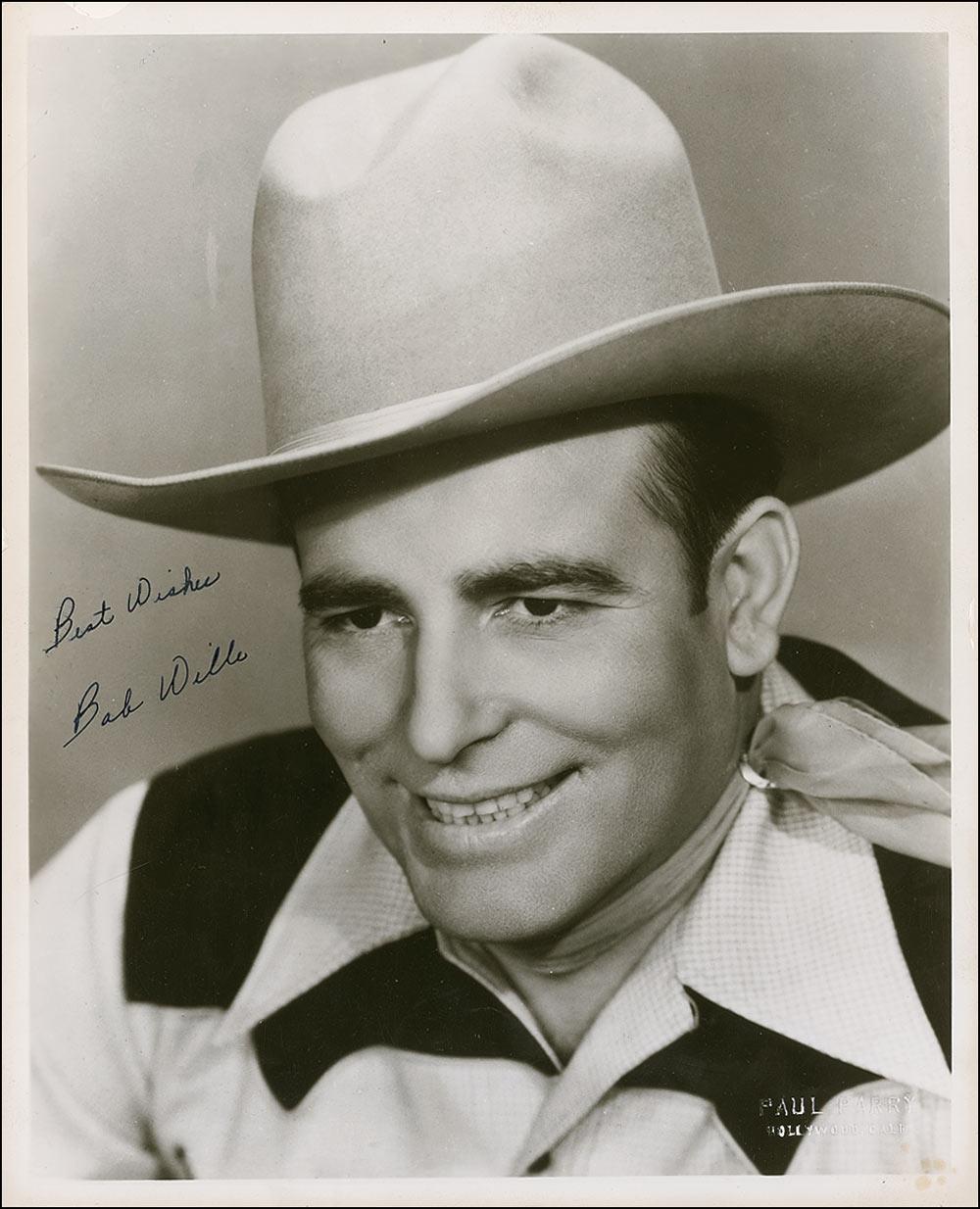
Bob Wills1930s–40s · Western swing / Country
Mullican spent the late 1930s and early '40s playing piano inside bands built on Bob Wills's western swing sound — first the Blue Ridge Playboys, then Cliff Bruner's Texas Wanderers, outfits the Handbook of Texas calls part of "the western swing music made famous by Bob Wills." The debt shows up in black and white on a record label: when Mullican cut "A Maiden's Prayer" in Beaumont in December 1947, King Records' own composer credit reads simply "Wills" — Bob Wills's western swing standard, carried whole into Mullican's solo catalog.
listen: upstream & heresource: Handbook of Texas Online — Mullican, Aubrey Wilson [Moon] (biography, Bob Wills/western swing years) ↗
1936
Maiden's PrayerBob Wills
1947
A Maiden's PrayerMoon Mullican
listen forCompare Bob Wills and His Texas Playboys' "Maiden's Prayer" — the fiddle-led waltz-time melody that made it a dancehall standard — against Mullican's 1947 "A Maiden's Prayer" for King. The tune and structure are identical; what changes is the lead voice, fiddle swapped for Mullican's rolling right hand and smooth, honky-tonk-inflected vocal. It's the clearest place on record to hear exactly what Mullican carried over from the western swing bands he'd spent a decade playing in.
Bessie Smith1920s · Blues / Classic female blues / Vaudeville
Long before Mullican stepped into a studio, he was learning from Bessie Smith's records — an early history of his career names "Sister Kate" and "Old Joe Turner Blues" as the proof. As a teenager playing organ for his father's church, he once opened Sunday service with Smith's "St. Louis Blues" instead of a hymn; "the preacher wasn't all that impressed," the same account records. He kept playing it for decades: a 1950s Grand Ole Opry broadcast, later collected on the LP The Great Moon Mullican, still finds him performing Smith's signature song, blues phrasing carried from a Corrigan pump organ all the way to Nashville.
listen: upstream & heresource: Webspawner (archived) — Moon Mullican fan page (Bessie Smith influence anecdote) ↗
1925
St. Louis BluesBessie Smith
St. Louis Blues (Grand Ole Opry live broadcast)Moon Mullican
listen forCue up Smith's 1925 Columbia side first — Louis Armstrong's cornet answering her voice line for line, the tempo a slow, heartbroken drag. Then find Mullican's own Grand Ole Opry performance of the same song: same melody, same lyric, but pushed through a barrelhouse piano and a hillbilly band's brisker beat. The blue notes and the vocal moan Mullican leans into are Smith's, transplanted whole from a 1920s recording studio to a Nashville radio stage a quarter-century later.