Mississippi John Hurt
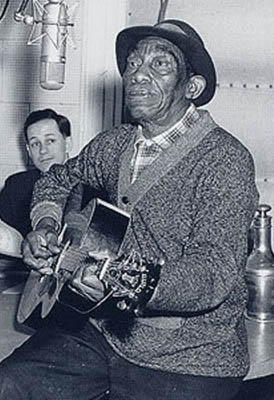 photo: library of congress photo · public domain ↗
In February 1963, collector Dick Spottswood ran his finger over a line from a forgotten 1928 record — "Avalon, my home town, always on my mind" — and realized it was an address. It sent Tom Hoskins to a real Avalon, Mississippi, where John Hurt, born 1893 in nearby Teoc, was still living three mailboxes up from the Valley Store. Self-taught on guitar at nine, Hurt had spent his teens playing local dances — including simple backup chords behind fiddler Willie Narmour, work he always called plainer than the fingerpicking he'd built on his own — before a fluke 1928 Okeh session sold nothing and he went back to farming for thirty-five years. What Hoskins found in 1963 was a voice the scholar Ted Gioia called "almost the opposite of the Delta tradition" — precise, restrained, unhurried. Three Vanguard albums and a Newport triumph later, Hurt died in 1966.
Carson was a guitar-playing boarder who kept turning up at the Hurt family home around 1902. When he fell asleep, nine-year-old John crept in and worked out pieces from his repertoire by ear — starting, the family's own account says, with a tune called 'Hop Joint.' Hurt confirmed the same handful of first songs decades later: 'I was playing guitar and learning songs like Good Morning Miss Carey, Satisfied, Hot Joint,' he told an interviewer. He got good enough that his mother mistook his playing for Carson's and scraped together $1.50 for his own guitar, which he named Black Annie.
listen forCarson never recorded, so there's no tape to set beside Hurt's — only the tune itself, handed down and eventually captured decades later. Hurt finally cut 'Hop Joint' himself at the Library of Congress in 1963, and it's worth hearing as the oldest layer in his catalogue rather than the newest: a spare, rocking dance tune built on the same alternating-thumb bass and light off-beat snap that runs through everything he played by 1928, evidence of a style already set by boyhood rather than invented in a studio.