walking upstream…
Joseph Haydn


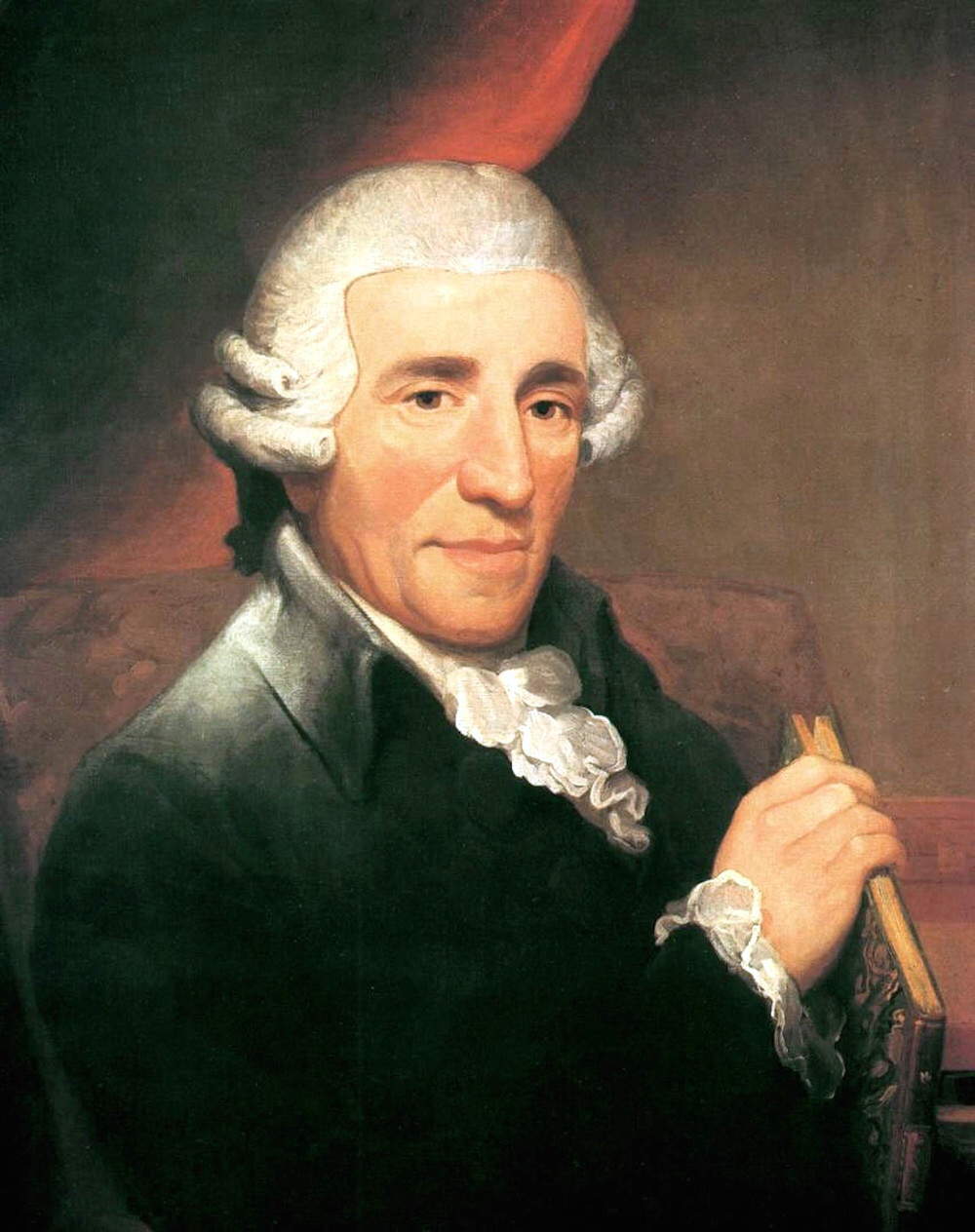 photo: thomas hardy · public domain ↗
Joseph Haydn
sourcesWikipedia — Joseph Haydn (overview) · CPEB · haydnbio.org — A Haydn Diary / Biography Chronicle (Porpora arrangement and Fux recommendation, citing HBA Nr. 21) · Louis Nohl — Life of Haydn, 1883 Eng. trans. (Griesinger/Dies/Rochlitz testimony on Porpora and C.P.E. Bach) · Interlude — Georg Predota, "Gradus ad Parnassum" (Haydn's direct study of Fux's treatise)
Franz Joseph Haydn was born in 1732 to a wheelwright in the Austrian village of Rohrau, and by eight was a treble chorister at Vienna's St. Stephen's Cathedral, dismissed nine years later when his voice broke. What followed was a decade of freelance poverty in Vienna, then nearly three decades as Kapellmeister to the Esterhazy court, then two late, triumphant tours of London. Haydn had almost no formal teacher; his biographer Georg Griesinger, who interviewed him in old age, records a composer who built his own technique out of employment and self-study - playing valet to a demanding old singing master, working alone through a counterpoint textbook, wearing out a stack of borrowed sonatas. He mentored the young Beethoven and befriended Mozart, who called Haydn his teacher. Haydn, characteristically, called himself only an honest man.
the sound in question
1791
Symphony No. 94 in G major 'Surprise'Joseph Haydn
walk the tributaries ↓
Carl Philipp Emanuel Bach1760s–80s · Classical / Empfindsamer Stil
In the late 1750s, freelancing in Vienna, Haydn got hold of the six "Prussian" sonatas C.P.E. Bach had written for the Prussian court more than a decade earlier, and did not let go. "I did not come away from my clavier till I had played through them," he told his biographer Georg Griesinger in old age, "and whoever knows me thoroughly must discover that I owe a great deal to Emanuel Bach, that I understood him and studied him diligently." The two never met - Haydn didn't even learn Bach had died until years after the fact. The debt ran entirely through print.
listen: upstream & here
1742
Sonata in C minor, Wq. 48 No. 4 ("Prussian" Sonatas)Carl Philipp Emanuel Bach
1771
Piano Sonata in C minor, Hob. XVI:20Joseph Haydn
listen forBach's Sonata in C minor, Wq 48 No. 4, and Haydn's own Piano Sonata in C minor, Hob. XVI:20, share the same lurch: inside a single phrase, a hushed, halting figure snaps without warning into a fortissimo outburst, the silence just before the jolt doing as much work as the notes. Haydn later told the writer Friedrich Rochlitz that playing Bach's sonatas through always left him "refreshed and in cheerful spirits" - the same volatile, mood-swinging keyboard voice, minor-key and unpredictable, that he spent the rest of his career chasing.
Nicola Porpora1730s · Baroque / Opera seria
Around 1752, Haydn - twenty, freelancing, and broke in Vienna - took work as valet and keyboard accompanist to Nicola Porpora, the elderly Neapolitan singing master then teaching in the city, blacking his employer's shoes and enduring insults in exchange for correction of his own composition exercises. What he got from it, Haydn wrote later in his own hand, was "die ächten Fundamenta der sezkunst zu erlehrnen" - the true fundamentals of composition. He put it more plainly to his biographer Albert Christoph Dies decades on: "I improved in singing, in composition and in Italian very much."
listen: upstream & here
No known recordingNicola Porpora
1767
Stabat Mater, Hob. XXbisJoseph Haydn
listen forNo specific Porpora piece survives as the "text" Haydn echoed - the debt was paid in corrected exercises, not a composition to hold up against his own. What's audible instead is the training's result: the long, ornamented, voice-like phrases Haydn gives his soloists in the 1767 Stabat Mater, a work he later named among his proudest of the decade, still moving in the florid Italian vocal manner a singing master had drilled into him at the keyboard.
Johann Joseph Fux1720s · Baroque
Porpora, unable to give Haydn a systematic grounding in counterpoint himself, pointed him to a book instead: Johann Joseph Fux's "Gradus ad Parnassum" (1725), the era's standard primer on strict voice-leading, the same one Leopold Mozart later used to train his own son. Fux had died in 1741, when Haydn was nine - there was no meeting, no correction, only the text. "We also know that Joseph Haydn meticulously worked through all the exercises," the music historian Georg Predota writes of that self-study; no teacher, only a workbook and Haydn's own discipline.
listen: upstream & here
No known recordingJohann Joseph Fux
1772
String Quartet in F minor, Op. 20 No. 5, finale (Fuga a due Soggetti)Joseph Haydn
listen forThere's no Fux composition to hold against this - the link is the treatise itself, not a piece - but its effect is unmistakable in the finale of Haydn's String Quartet Op. 20 No. 5: a full four-voice fugue on two subjects, each instrument entering in strict turn and later stacking on top of the others, exactly the rigorous species counterpoint Fux's textbook drilled into generations of composers. It's the sound of homework becoming a compositional voice.