walking upstream…
John Lennon


After the Beatles dissolved in 1970, John Lennon spent the decade before his 1980 murder making music far more nakedly personal than anything he'd released as a Beatle — primal-scream confession on 'Plastic Ono Band,' anthemic idealism on 'Imagine,' and, on 1975's covers album 'Rock 'n' Roll,' a deliberate return to the pre-fame rock and roll that had made him want to pick up a guitar in the first place. Alongside Yoko Ono he became rock's most visible peace activist, staging bed-ins and writing protest songs, before stepping away from music in the mid-'70s to raise his son Sean. He was shot and killed outside his New York apartment building in December 1980, at 40, shortly after releasing his comeback album 'Double Fantasy.'
the sound in question
1971
ImagineJohn Lennon
walk the tributaries ↓
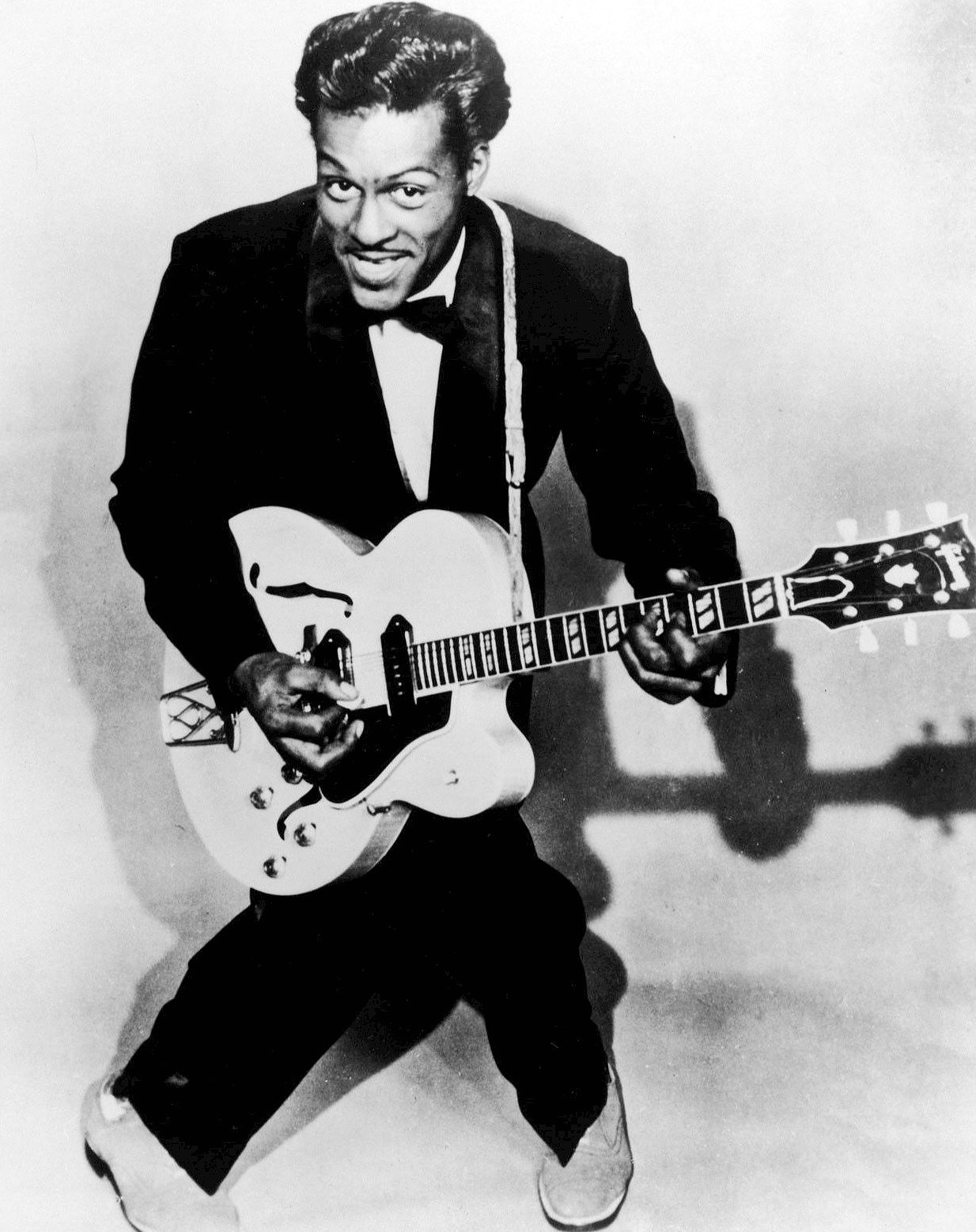
Chuck Berry1950s · Rock and roll / Rhythm and blues
Chuck Berry's publisher sued Lennon in the early 1970s, arguing the melody of the Beatles' 'Come Together' was lifted from Berry's 1956 'You Can't Catch Me'; the suit was settled with Lennon agreeing to record several Morris Levy-published songs, and he covered 'You Can't Catch Me' itself on 'Rock 'n' Roll' — as direct and literal an acknowledgment of a debt as a musician can make.
listen: upstream & here
1956
You Can't Catch MeChuck Berry
1975
You Can't Catch MeJohn Lennon
listen forPlay Berry's original 'You Can't Catch Me' back to back with Lennon's 1975 cover of the same song — the loping, chugging rhythm-guitar figure survives almost unchanged, Berry's blueprint audible underneath Lennon's rougher, looser vocal.
Elvis Presley1950s–70s · Rock and roll / Rockabilly / Pop / Gospel
Lennon said hearing Presley's 'Heartbreak Hotel' as a teenager changed his life — 'me whole life changed from then on, I was just completely shaken by it' — and credited Presley, more than anyone, with pulling him toward rock and roll in the first place. Two decades later, working through a mid-'70s marital separation, Lennon returned to that raw rockabilly well on his covers album 'Rock 'n' Roll.'
listen: upstream & heresource: Elvis Australia ↗
1956
Heartbreak HotelElvis Presley
1975
Stand by MeJohn Lennon
listen forCompare the reverb-heavy, hiccuping vocal on Presley's 'Heartbreak Hotel' with Lennon's own echo-drenched, loose-jointed reading of 'Stand by Me' — both let a slapback-echoed voice do most of the emotional work over a spare, walking arrangement.
Little Richard1950s · Rock and roll / Rhythm and blues / Gospel
The Beatles covered Little Richard's 'Long Tall Sally' and 'Rip It Up' in their earliest live sets, and Lennon named Richard's shrieking, gospel-charged delivery among the sounds that first hooked him on rock and roll. On 'Rock 'n' Roll,' Lennon paid that debt directly, recording a medley of Richard's 'Rip It Up' and 'Ready Teddy' back to back.
listen: upstream & here
1956
Rip It UpLittle Richard
1975
Rip It Up/Ready TeddyJohn Lennon
listen forSet Little Richard's original 'Rip It Up' against Lennon's 1975 'Rip It Up/Ready Teddy' medley — the same breathless, shouted-not-sung urgency, Lennon straining to match a vocal attack he spent two decades admiring.