walking upstream…
John Cage


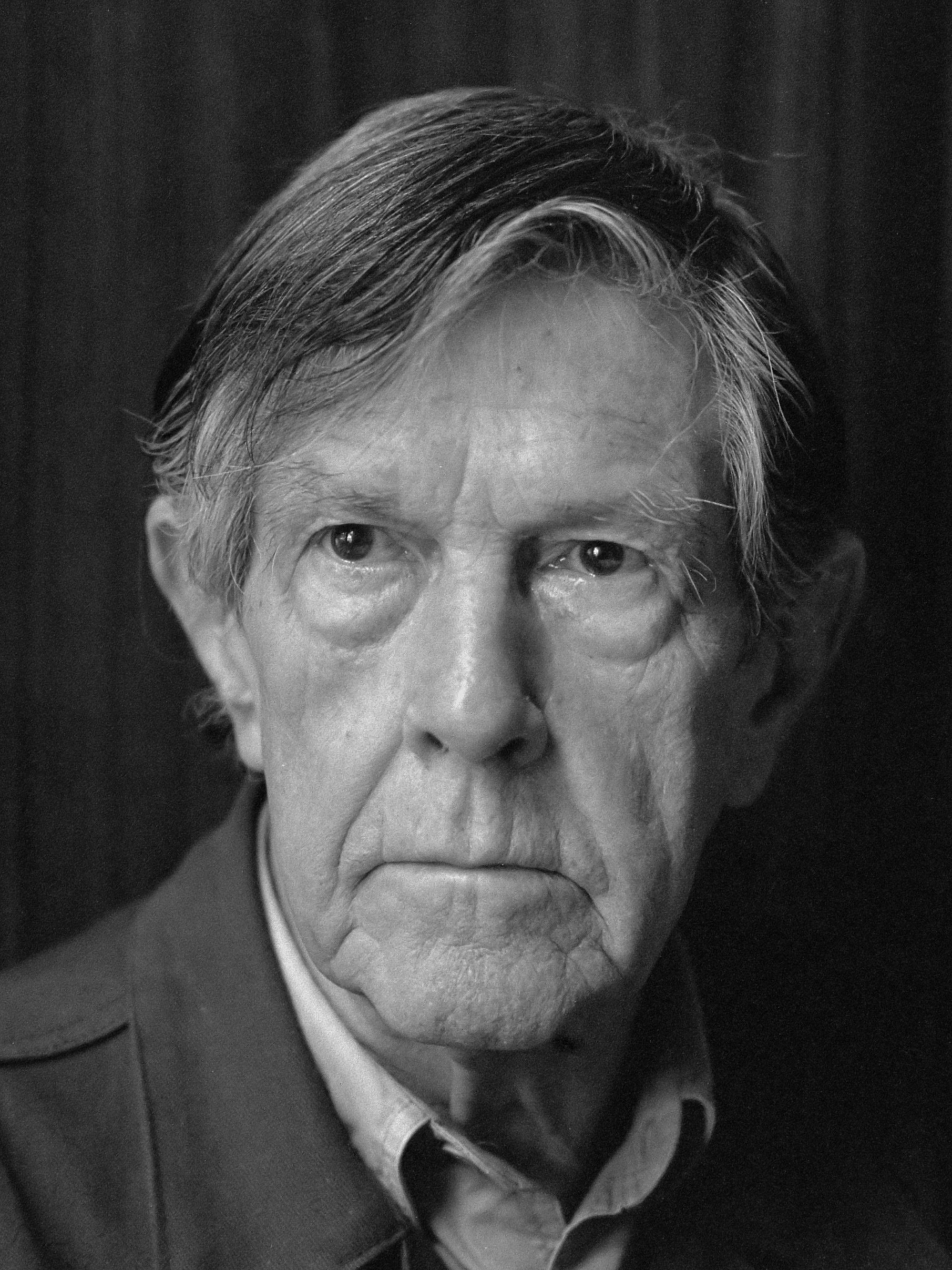 photo: rob bogaerts / anefo · cc0 ↗
John Cage
sourcesJohn Cage — Silence · PBS American Masters — John Cage biography (corroborates the Schoenberg "wall" anecdote) · Histories of The New School — John Cage (backs the Cowell mentorship at the New School) · Matthew Shlomowitz — Cage's Place in the Reception of Satie, 1999 (backs the Satie festival, letters, and Cheap Imitation lineage) · Inquiring Mind — 1986 Cage interview (backs the D. T. Suzuki bio detail) · Wikipedia
In a UCLA composition class in the mid-1930s, Arnold Schoenberg warned his young pupil John Cage that a musician with no ear for harmony would eventually hit a wall he couldn't pass. Cage took it as a dare, and kept at it for six decades. He moved from Schoenberg's rigor through Henry Cowell's inside-the-piano technique into a lifelong crusade on Erik Satie's behalf, then further still: two years of D. T. Suzuki's Zen lectures at Columbia helped strip his own taste out of the process entirely, clearing the way for the near-silent 4'33" (1952) and the chance-driven scores that followed. Cage's real subject was never harmony but permission — what happens to music once the composer stops choosing.
the sound in question
1952
4'33"John Cage
walk the tributaries ↓
Arnold Schoenberg1910s–20s · Contemporary classical / Atonal / Twelve-tone
Cage arrived in Schoenberg's classroom in 1935 already having promised, in his own words, to "devote my life to music." Two years in, Schoenberg delivered his verdict: no feeling for harmony meant Cage would hit a wall he couldn't pass through. Cage's answer, recorded in his book Silence, was that he'd "devote my life to beating my head against that wall." He never mastered Schoenberg's harmonic language, but the drilling in strict, self-imposed systems stuck — Cage would spend the rest of his career building his own, first a tone row, later the throw of a coin.
listen: upstream & here
1923
Suite for Piano, Op. 25Arnold Schoenberg
1938
MetamorphosisJohn Cage
listen forSchoenberg's Suite for Piano, Op. 25 runs entirely on his twelve-tone method: a fixed row of pitches reordered and transposed across dance-form movements, with no note repeating until all twelve have sounded. Cage's 1938 Metamorphosis, written soon after his Schoenberg study ended, borrows that same discipline — a single row cycled and transposed through the keyboard — but drops the dance forms for bare, insistent repetition. Listen for the mechanical, almost stubborn recurrence of pitch in both pieces: Cage's inherited rigor, minus Schoenberg's harmonic cushioning.
Erik Satie1910s · Contemporary classical / Impressionist / Avant-garde
Cage's Satie advocacy ran for decades: a 25-concert festival at Black Mountain College in 1948, a public feud fought out in Musical America's letters pages, and the 1963 premiere of Satie's 18-hour Vexations, seventy years after it was written. "It's not a question of Satie's relevance," Cage wrote in his 1958 essay on the composer. "He's indispensable." That devotion turned into material in 1969: denied permission to finish an arrangement of Satie's Socrate, Cage instead wrote Cheap Imitation, keeping Socrate's exact phrase lengths and rhythms and running chance operations only over the pitches.
listen: upstream & here
1918
SocrateErik Satie
1969
Cheap ImitationJohn Cage
listen forSatie's Socrate moves in flat, unhurried vocal phrases, deliberately withholding the drama a symphonic scene on the death of a philosopher would seem to demand. Cage's Cheap Imitation follows the identical phrase lengths and rhythmic contour almost step for step, but every pitch has been replaced by a throw of the I Ching. Listen for the shared breath and pacing underneath both recordings — the shape of Satie's original phrasing surviving intact inside music that no longer resembles it note by note.
Henry Cowell1920s · Contemporary classical / Experimental / Avant-garde
Cage moved to New York in 1933 specifically to study with Cowell, sitting in on his New School courses on world music and serving as his assistant. "That was very important to me," Cage said of hearing non-Western music through Cowell, "sound became important to me — and noise is so rich in terms of sound." In Silence, Cage credited Cowell's own piano pieces — built from tone clusters and playing directly on the strings — with pointing "towards noise and a continuum of timbre," the exact direction his own prepared piano would take a few years later.
listen: upstream & here
1925
The BansheeHenry Cowell
1940
BacchanaleJohn Cage
listen forOn The Banshee, Cowell never touches a key — he sweeps and plucks the piano's exposed strings by hand, drawing out moans and shivers no hammer could produce. Cage's Bacchanale (1940), his first prepared-piano piece, reaches a related effect by a different route: bolts and rubber wedged between the strings turn the instrument into a muted, gong-like percussion set before anyone strikes a key. Listen for how both pieces refuse the piano's ordinary tone — Cowell working from outside the keyboard, Cage from inside its mechanism.