walking upstream…
Eminem


sourcesRolling Stone — Eminem Talks Beastie Boys, Tupac and Biggie (2009; bio's 'hip-hop saved my life' quote and Tupac's beat/word-placement quote) · Rolling Stone — Eminem Honors the Hip-Hop Village That Raised Him in Rock Hall Induction Speech (2022; bio's closing 'teachers' framing) · Eminem.Pro — Eminem Explains What He Learned From LL Cool J in New Documentary (MTV Behind the Music, 2021; the 'Radio' tape and swagger quote) · Eminem.Pro — Eminem Talks About Tupac's Death and Legacy (Dear Mama docuseries, 2023; the restaurant/death-day and 'made you cry' quotes)
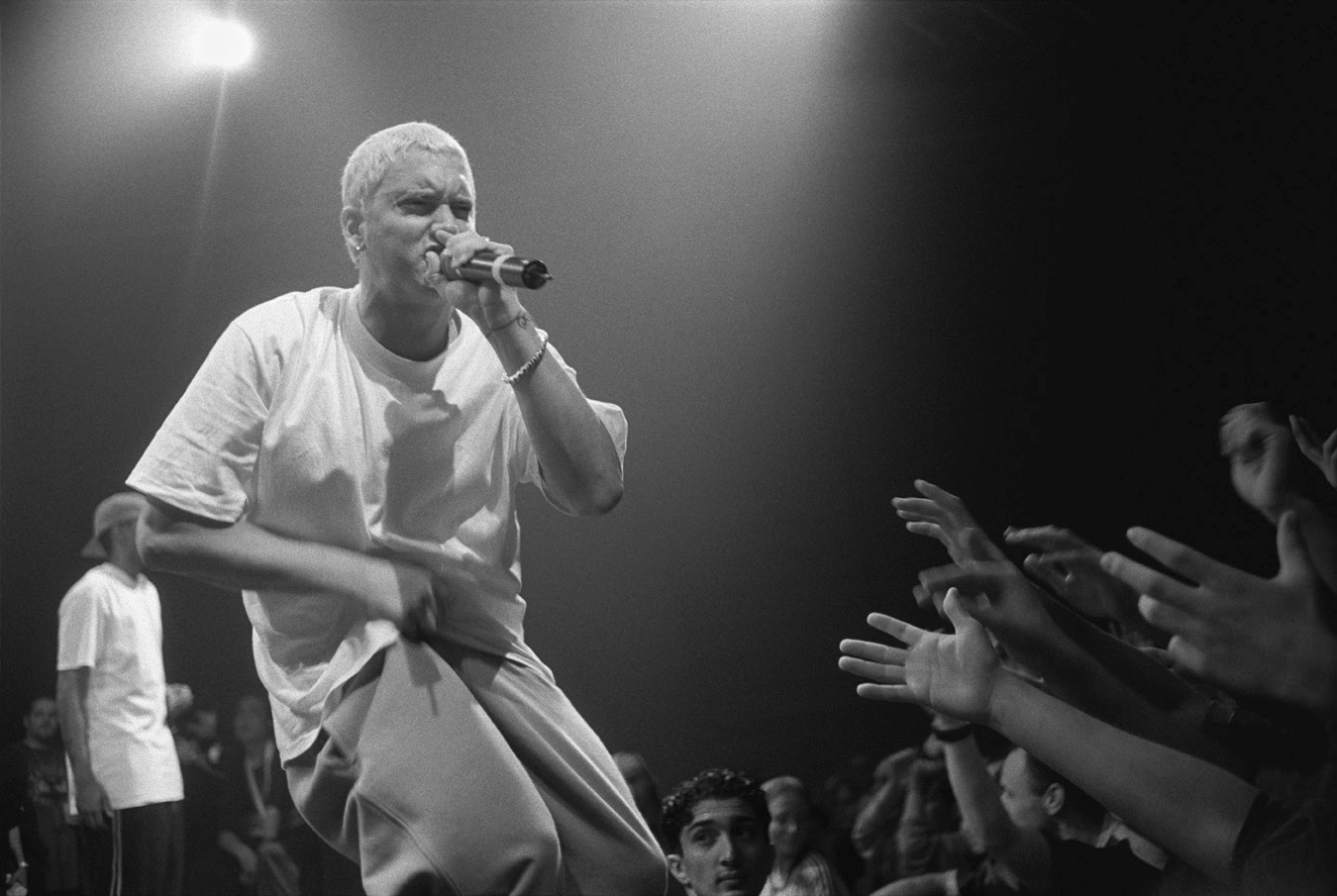
In February 1997, 24-year-old Marshall Mathers finished second at the Rap Olympics freestyle battle in Los Angeles — and lost anyway, because his demo tape had already reached Dr. Dre. Detroit had given him nothing easy: a high-school dropout battling for cash in a scene where a white rapper had to out-rap everyone twice over just to get heard. "Hip-hop saved my life, man," he told Rolling Stone. "It's the only thing I've ever been even decent at." What followed — The Slim Shady LP, The Marshall Mathers LP, a persona split between comic villain and confessional diarist — built the best-selling catalog in rap history out of a decade spent listening hard to everyone who came before him. At his 2022 Rock Hall induction, he turned the microphone on his teachers instead of himself.
the sound in question
2002
Lose YourselfEminem
walk the tributaries ↓
Tupac Shakur1990s · West Coast hip-hop / Conscious hip-hop
When Tupac Shakur died in September 1996, Eminem was working a griddle at a Detroit-area restaurant. "When I heard that Tupac died, I was cooking in the restaurant and tickets were piling up," he recalled decades later, describing a devotion that went past fandom. "Tupac was the first rapper to me that could make you cry," he said in the 2023 docuseries Dear Mama. "I felt him that much." What Eminem took from him wasn't swagger but structure: the discovery, repeated on "Stan" and "Cleanin' Out My Closet," that a rap song could carry a plot instead of just a boast.
listen: upstream & here
1991
Brenda's Got a BabyTupac Shakur
2000
StanEminem
listen forBoth records tell someone else's story instead of the rapper's own, and both time their gut-punch details to the beat rather than around it. Tupac lets a piano-driven murk build under him before flatly stating the plot's cruelest turn; Eminem borrows the same trick on "Stan," delaying his narrator's darkest line until the exact bar where Dido's sampled hook falls away. As Eminem put it about Tupac's method, "the way he chose which words to say with which beat was genius — it's like he knew what part of the beat and what chord change was the right place to hit these certain words."
Dr. Dre1990s · West Coast hip-hop / G-funk / Gangsta rap
In 1997 an intern picked up a cassette at the Rap Olympics and got it to Interscope co-founder Jimmy Iovine, who played it for Dr. Dre. Dre didn't hesitate. "The only person that I ever heard on a demo tape that I really liked and really fucked with in the studio was Eminem," he told Kevin Hart on Hart to Heart in 2023 — a striking admission from a producer who'd built N.W.A and The Chronic without ever needing an unsolicited tape. Within weeks the two were in the studio together; within two years Dre had produced and mixed The Slim Shady LP around him.
listen: upstream & heresource: Eminem.Pro — Dr. Dre Heard Only One Demo Tape He Really Liked (Kevin Hart's Hart to Heart, 2023; Dre's demo-tape quote) ↗
1992
Nuthin' but a 'G' ThangDr. Dre
1999
My Name IsEminem
listen forDre produced both tracks seven years apart, and the fingerprint survives the gap: a whining, minor-key synth lead over a loping, live-sounding bassline, with drums that hit like a real kit rather than a machine. "Nuthin' but a 'G' Thang" sets that G-funk template behind Snoop's laid-back cadence; "My Name Is" rebuilds the same architecture — swapping in a riff interpolated from Labi Siffre's "I Got The..." — into a cartoonish bounce, trading gangsta cool for Eminem's manic delivery over Dre's identical bass-heavy blueprint.
LL Cool J1980s · Hip-hop / Old-school hip-hop
LL Cool J was Eminem's entry point, full stop. On air together on Rock The Bells Radio in 2018, Eminem told him, "I absolutely wanted to be like you as a kid. I wanted to be like Run-DMC." The specific object was a cassette: for his eleventh birthday he got LL's Radio, and in a later MTV documentary he traced his whole persona back to it: "The swagger that he had! ... If I can portray that swagger, I can go to school, and kids might think I'm cool." A shy white kid in Detroit borrowed his confidence from a Queens teenager rapping about his own boombox.
listen: upstream & heresource: Billboard — LL Cool J Nabs Eminem as First Guest on Rock the Bells Radio (2018 interview, 'I wanted to be like you...Run-DMC') ↗
1987
I'm BadLL Cool J
2000
The Real Slim ShadyEminem
listen forPlay LL Cool J's 1987 "I'm Bad" against Eminem's 2000 breakout "The Real Slim Shady" and the shared move is the direct-address boast — both open by naming and dismissing every doubter in the room before the beat even settles, daring the listener to disagree. LL's clipped, staccato flow rides a siren-sampling groove built to sound tougher than the room; Eminem trades the siren for a synth-pop bounce but keeps the same swagger-as-argument structure, spelling out his own name like a challenge nobody asked for.