walking upstream…
Wayne Shorter


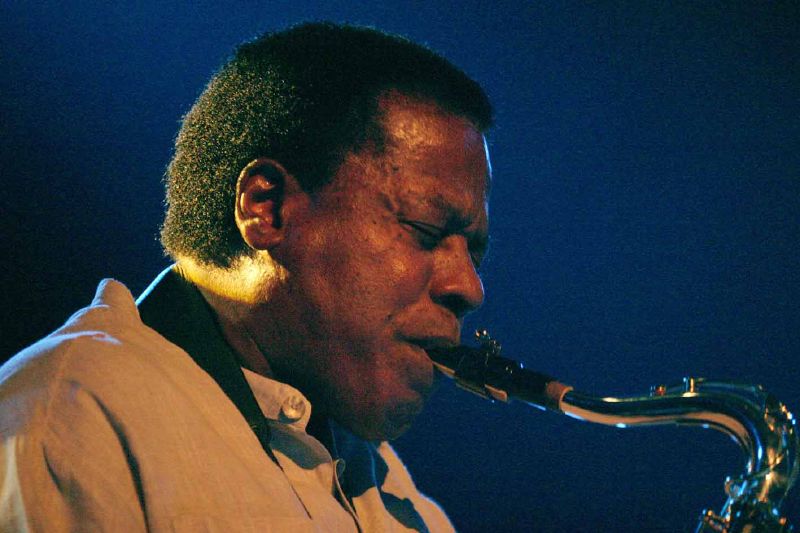 photo: tom beetz · cc by 2.0 ↗
Wayne Shorter
sourcesWikipedia234 · WBGO · All About Jazz · uDiscover Music
Wayne Shorter grew up in Newark, New Jersey, absorbing bebop off his father's late-night radio — Monk, then Bird, then Bud Powell under the new word 'bebop' — before a high-school teacher held up a Charlie Parker record and predicted where music was headed. He apprenticed as Art Blakey's musical director in the Jazz Messengers, then spent the back half of the 1960s as Miles Davis's in-house composer, writing the knotty, understated tunes ('Footprints,' 'Nefertiti') that defined the Second Great Quintet, while cutting a run of Blue Note albums as leader now regarded as some of the richest composing in jazz. In 1970 he co-founded Weather Report with Joe Zawinul, steering jazz fusion for over a decade, and later led a long-running acoustic quartet into his eighties.
the sound in question
1966
FootprintsWayne Shorter
walk the tributaries ↓
John Coltrane1960s · Jazz / Modal jazz / Spiritual jazz
Shorter and Coltrane were close friends who jammed and practiced together in the years before Coltrane joined Miles Davis, and it was reportedly Coltrane who suggested Shorter as his own replacement when he left Davis's band in 1960. Four years later, once Shorter finally got that call himself, he leaned into the debt: for his 1964 Blue Note session 'JuJu' he hired Coltrane's own working rhythm section — McCoy Tyner, Reggie Workman, and Elvin Jones — and wrote a set of moody, vamp-based modal tunes squarely in Coltrane's idiom, even as some critics accused him of being 'a mere acolyte of John Coltrane.'
listen: upstream & here
1961
ImpressionsJohn Coltrane
1964
JuJuWayne Shorter
listen forPut Coltrane's 'Impressions' next to Shorter's 'JuJu' — both ride a hypnotic, repeating minor-key vamp under rolling piano and churning polyrhythmic drumming, the tenor blowing long, searching phrases rather than tidy bebop lines.
Sonny Rollins1950s · Hard bop / Jazz
As a teenager Shorter cut his teeth in saxophone 'cutting contests' against Sonny Rollins and Sonny Stitt, and after his Army discharge in 1959 he kept jamming with Rollins at an intensity he later credited as a hands-on foundation for his own composing and improvising. Rollins, for his part, told biographer Michelle Mercer that Shorter 'never struck me as an imitator' — he 'liked Trane and maybe me a little, but Wayne was an innovative guy himself, and that would come out in the way he put things together.' What carried over from Rollins wasn't vocabulary so much as an approach: building a solo, or a whole tune, out of one compact motif, worked and reworked, rather than a string of borrowed licks.
listen: upstream & here
1956
Blue 7Sonny Rollins
1964
Witch HuntWayne Shorter
listen forRollins's 'Blue 7' is the recording famously analyzed for its 'thematic improvisation' — a single blues cell developed across an entire solo. Shorter's own 'Witch Hunt' works the same trick from the composing side: a terse fanfare figure that keeps resurfacing as the melodic and harmonic anchor of the whole piece.
Charlie Parker1940s · Bebop / Jazz
Shorter's turn toward jazz began with his father's radio — a late-night broadcast that played Thelonious Monk, then Charlie Parker, then Bud Powell under the new word 'bebop' — and it hardened into obsession after a high-school music teacher held up a Parker record (alongside Stravinsky's 'The Rite of Spring') and told the class this was where music was going. Growing up in Newark, Shorter could also catch Parker live at the Adams Theater and at Norman Granz's Jazz at the Philharmonic shows. Parker's harmonic vocabulary and rhythmic daring became the common language that every bebop-schooled saxophonist, Shorter included, had to absorb before finding an individual voice.
listen: upstream & here
1953
ConfirmationCharlie Parker
1964
Free for AllWayne Shorter
listen forSet Parker's 'Confirmation,' with its long, chromatically slippery melody built from short bebop cells, against 'Free for All,' the blistering Shorter original written for Art Blakey's Jazz Messengers — the same density of notes and headlong rhythmic attack, before Shorter's later, more spacious and motif-driven style took over.