walking upstream…
Todd Edwards
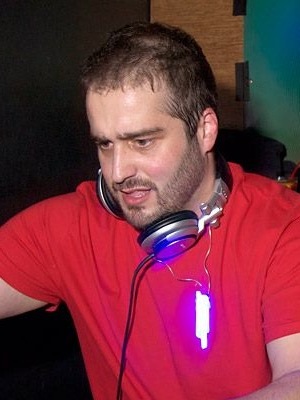 photo: rohrm · cc by-sa 3.0 ↗
Todd Edwards
sourcesRansom Note — "New Jersey To Old Kent Road · Pitchfork — "The 30 Best House Tracks of the '90s" (critic Ben Cardew traces MK's vocal cut-up technique to Edwards's Alabama Blues remix) · DJ Mag — "The rebirth of Todd Edwards" (Masters at Work, Todd Terry, and MK named as the producers whose signature sounds shaped his own) · DJ Mag — "Todd Edwards Talks His Top 10 Garage Weapons" (names the Masters at Work remix of Neneh Cherry's "Buddy X" and praises Kenny Dope's drum work) · Little White Earbuds — "LWE Interviews Todd Edwards" (sampling-bank method in his own words; MK's vocal cut-up and Enya both named as influences)
In 2003, grainy cameraphone footage surfaced of a DJ working an Essex club floor in a homemade T-shirt reading "Jesus Loves UK Garage" — a scene UK garage heads recognized instantly, because the man behind the decks, New Jersey's Todd Edwards, had already become "Todd the God" to them. His technique: chop vocal syllables into sample banks — "a minimum of 25 samples" each — then rebuild them into stuttering, harmonic phrases that function as instruments rather than lyrics. Records like "Saved My Life" (1995) helped invent the UK garage sound years before most of Britain had heard his name; Daft Punk sought him out before Homework, named him among their "Teachers," and later brought him in to sing on Discovery and Random Access Memories. A devout Christian who nearly disappeared from music during years of depression, Edwards built a sound entirely from other people's voices and made it unmistakably his own.
the sound in question
1995
Saved My LifeTodd Edwards
walk the tributaries ↓
Marc Kinchen1990s · House / Garage house
Before Edwards had a style of his own, he had a teacher: producer Marc Kinchen, who records as MK and had turned vocal samples into stutter-cut confetti on his remix of Nightcrawlers' "Push the Feeling On." "I loved the way that MK cut up vocals so I started to emulate that and then I started to branch out," Edwards told the dance-music site Ransom Note — the branching-out being his denser, syllable-level version of the same idea. Critics have since drawn a direct line from Kinchen's chop to Edwards's, most explicitly around his 1995 remix of St Germain's "Alabama Blues," which Pitchfork credits as the technique "refined — and arguably perfected."
listen: upstream & here
1992
Push the Feeling On (The Dub of Doom)Marc Kinchen
1995
Alabama Blues (Todd Edwards Dub Mix)Todd Edwards
listen forOn Nightcrawlers' 1992 "Push the Feeling On (The Dub of Doom)," MK slices the vocal into single, unintelligible syllables and fires them off in a rapid, off-kilter pattern that functions more like a percussion part than singing. Edwards's 1995 dub of St Germain's "Alabama Blues" takes that same idea further: entire vocal lines are shredded into two- and three-note stabs, stacked into cascading runs that build the whole groove rather than decorate it. Both tracks make the human voice unrecognizable as language and undeniable as rhythm — Kinchen's blueprint, run through Edwards's denser, more melodic filter.
Masters at Work1990s · House / Garage house / Latin house
Edwards traces UK garage's signature "shuffle" — its off-grid, triplet-swung drums — to one source: the New York production duo Masters at Work, Kenny Dope Gonzalez and Louie Vega. "I always tried to emulate Kenny Dope's drum programming," he told Ransom Note, describing hours spent on an Ensoniq EPS sampler chasing "the triplet swing on the quantise." The debt runs deep enough that Edwards has called it the origin of the whole UK garage rhythm: "If any of that shuffle in garage came from my inspiration, my inspiration came from Masters at Work," he told Pitchfork — crediting one duo's drum programming with a genre's foundational groove.
listen: upstream & heresource: Pitchfork — "Todd Edwards" (5-10-15-20) (Masters at Work credited directly as the source of the UK garage shuffle; childhood and biography) ↗
1992
Photograph of Mary (Masters at Work Dub)Masters at Work
1993
As I Am (Todd Edwards Mix)Todd Edwards
listen forTrey Lorenz's 1992 "Photograph of Mary (Masters at Work Dub)" opens with almost nothing — a stark, syncopated kick and hi-hat pattern that swings like a drummer's inflection more than a machine's grid — before the bassline and vocal ease in underneath. Edwards's own 1993 dub, "As I Am" by Sound of One, builds its groove the same patient way: drums first, chopped vocal fragments layered in afterward as texture, the beat swung into the same rolling triplet feel Edwards has credited directly to Kenny Dope's programming. Listen for the space Edwards leaves around each drum hit — that's the Masters at Work habit he never dropped.
Enya1980s–90s · New-age / Celtic
In the early 1990s, at the gym, Edwards needed a break from house and disco and reached for something unlikely instead: an Enya album. What he heard reshaped his whole method: "she uses her voice for instruments, she's harmonising and her voice is blending in the background... What if I start sampling up the vocals as the instruments as well?" he told the Guardian. The new-age singer's layered, wordless harmonies gave him permission to treat vocal samples as texture rather than lyric — the technique of chopping voices into stuttering, unintelligible fragments that would define UK garage. He has named her, unprompted, as one of his direct influences ever since.
listen: upstream & heresource: The Guardian — "'I've ridden the storm' ↗
1988
Orinoco FlowEnya
1995
Saved My LifeTodd Edwards
listen forEdwards never named a specific Enya song as the trigger, so play her breakout single "Orinoco Flow" against his "Saved My Life": Enya buries her own voice in overlapping, wordless harmonies until it functions like a synth pad, texture more than statement. Edwards does the same trick with other people's voices — a phrase clipped down to a syllable, looped and stacked until it reads as a rhythm part, not a lyric. Where Enya layers one singer with herself, Edwards layers strangers' vocal scraps into the same kind of harmonic wash, the debt audible in the impulse rather than in any one song.