walking upstream…
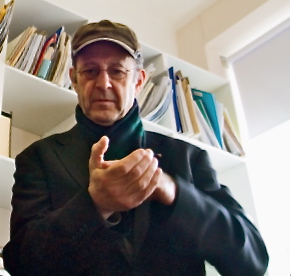
Steve Reich


sourcesstevereich.com — Jonathan Cott interview, 1996 (age-14 discovery, phasing discovery, Bach/Stravinsky/jazz pulse) · Pitchfork — Interview · The Guardian — Steve Reich on Schoenberg, Coltrane and Radiohead, Mar 2013 (Coltrane's Africa/Brass, "I've learned something") · NPR — Steve Reich At 80 · Bruce Duffie — Two Conversations with Steve Reich, 1985 & 1995 (Coltrane vs. Juilliard teachers, Bach/Stravinsky records before live) · Adventures in Music — Christopher M. Wright interview, 2005 (Stravinsky/Bartok on percussion; Ghana as confirmation, not origin) · Wikipedia — Steve Reich (lead only; education, career timeline)
In 1950, fourteen years old, Reich heard three records within months of each other and, he later said, "I became a composer because I'd heard the Rite of Spring of Stravinsky, I'd heard Bach's Fifth Brandenburg, I'd heard bebop — Charlie Parker, Miles Davis." He set the piano aside for a snare drum, studied philosophy at Cornell, then composition at Juilliard and Mills College under Luciano Berio and Darius Milhaud, whose serialism withheld the pulse those three records shared. In 1964, splicing two identical tape loops of a Pentecostal preacher he'd recorded in San Francisco, he watched them drift out of sync by accident — the discovery that became phasing, his signature technique, first heard on "It's Gonna Rain" and built out into ensemble works like "Drumming" and "Music for 18 Musicians." "Different Trains" later won a Grammy. Three teenage records became a career-long technique.
the sound in question
1976
Music for 18 MusiciansSteve Reich
walk the tributaries ↓
Johann Sebastian Bach1720s · Baroque / Classical
Reich names Bach, alongside Stravinsky and bebop, as one of the three records that formed him at fourteen, drawn to a device buried in Bach's counterpoint: the strict canon, an identical line entering after a fixed delay. "You can apply that to the rules of four-part harmony, which is basically taken from Bach's chorales," he told Pitchfork in 2006, describing how an old technique keeps generating new rules. His own phase pieces run the same canon, but let the delay itself drift, turning a fixed structure into a process unfolding in real time.
listen: upstream & here
1721
Brandenburg Concerto No. 3 in G major, BWV 1048Johann Sebastian Bach
1967
Piano PhaseSteve Reich
listen forIn the Brandenburg Concerto No. 3, three violins, three violas, and three cellos trade the same phrases in tight canonic imitation, entering a beat or two apart and holding that offset steady throughout. "Piano Phase" does the identical trick with two pianos playing one repeating figure — except the offset itself keeps creeping forward, the second piano sliding almost imperceptibly ahead of the first until the two lines swap places entirely. Where Bach fixes the delay, Reich turns it loose.
Igor Stravinsky1910s · Modernism / Ballet / Classical
Reich names The Rite of Spring, heard on a Columbia record at fourteen, as one of three pieces that "basically form who I am" — and the debt runs deeper than nostalgia. "I remember, when I first heard Stravinsky conducting Rite of Spring on Columbia records, way, way back in the 50s, I just said, this is it," he told Pitchfork in 2006. What he heard was rhythm treated as the main event: layered, repeating cells driving forward without the harmonic resolution classical form usually demands — the same principle Reich later built entire pieces around.
listen: upstream & here
1913
The Rite of SpringIgor Stravinsky
1971
Drumming: Pt. ISteve Reich
listen forStravinsky's Rite of Spring stacks small, asymmetrical rhythmic cells — stamping strings, jabbing brass — into pounding, non-developing blocks that never resolve into a conventional melody. Reich's "Drumming," scored for tuned drums, marimbas, and voices, does the same thing with far gentler material: short interlocking patterns repeat and mutate by degrees over more than an hour, the pulse constant while the surface texture keeps reshuffling. Neither piece is going anywhere in particular; both trust that staying in place, loudly or quietly, is enough.
John Coltrane1960s · Jazz / Modal jazz / Spiritual jazz
Reich has said he "got as much, or more" from John Coltrane as from his teachers at Juilliard, and singles out one record: hearing Coltrane's 1961 Africa/Brass was, in his words, a moment of "Wow, thank you very much, I've learned something" — something rock and roll, he added, never gave him. What he heard was a single chord held far past where a conventional arrangement would resolve it, with everything interesting happening inside that one sustained harmony rather than by moving away from it.
listen: upstream & here
1961
AfricaJohn Coltrane
1970
Four OrgansSteve Reich
listen forOn "Africa," Coltrane's ensemble camps on one modal center for the length of a side, letting internal motion — call-and-response horns, rising intensity, subtle harmonic shading — do the work a chord change would normally do. Reich's "Four Organs" does something starker with the same idea: a single dominant-seventh chord, played by four electric organs, simply gets stretched longer and longer over roughly twenty minutes, note by note, until the harmony itself becomes the whole event.