walking upstream…
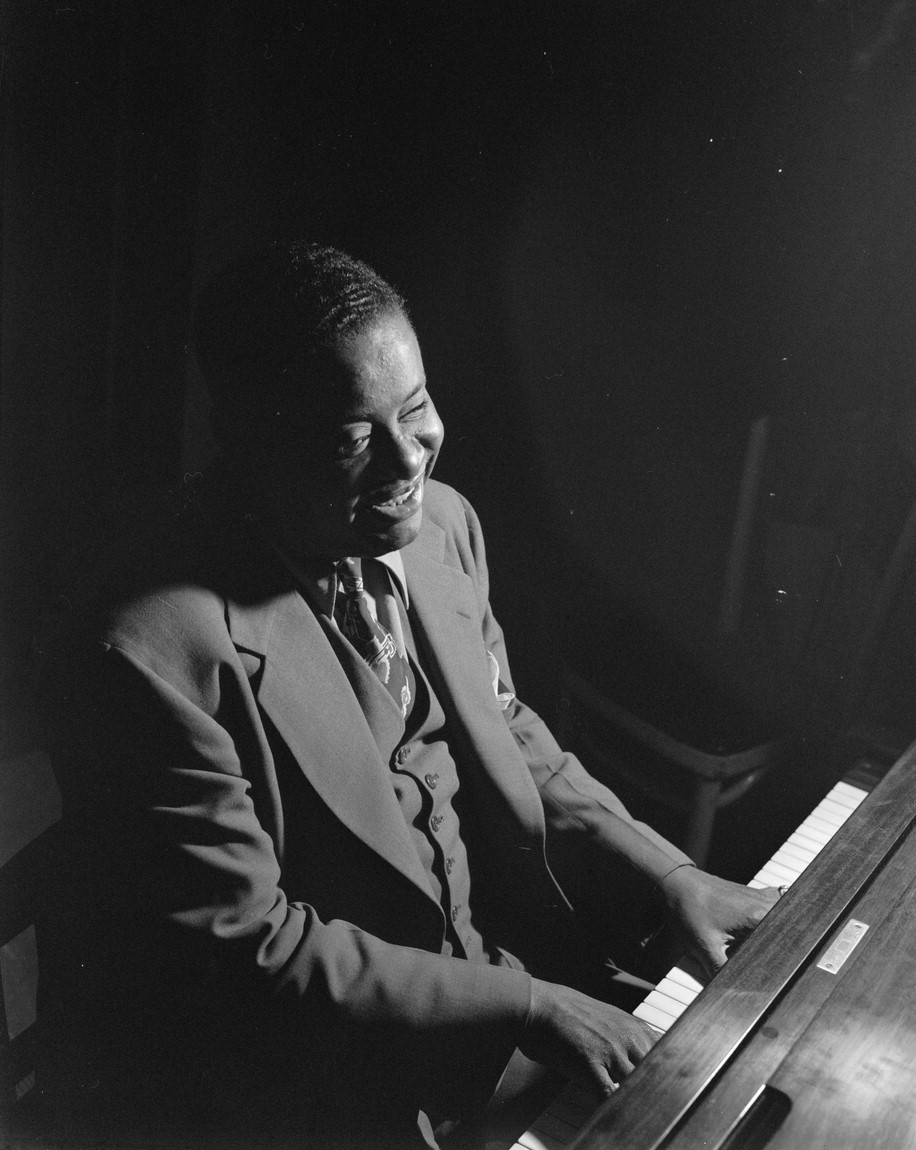
Oscar Peterson


sourcesWFMT Studs Terkel Radio Archive — "Oscar Peterson plays and discusses jazz" (Tatum, Cole, and de Marky influence testimony, 1961) · Jazz Professional — "Oscar Peterson · The Independent — obituary, "Oscar Peterson · JazzProfiles blog — Richard Palmer, Oscar Peterson (Continuum, 2005) excerpt (Tatum "never copied" quote, Ill Wind tribute pairing) · CBC Radio — "Oscar Peterson on his sister Daisy Sweeney" (bio background) · Wikipedia
When Oscar Peterson was about ten, his father brought home a friend carrying a stack of Art Tatum records, hoping to take his son down a peg. It backfired: hearing what sounded like two pianists at once, Peterson didn't touch the keys for a month. "No one plays like Art Tatum," he told a reporter decades later, and the remark set the terms for the rest of his career. He'd already been drilled in classical technique — piano at five, trumpet ended by childhood tuberculosis, then years under a Hungarian teacher in Montreal — before Norman Granz pulled him, unannounced, onto the Carnegie Hall stage in 1949. What followed was a half-century turning Tatum's harmonic reach and Nat King Cole's trio restraint into an argument that technique should serve swing, never replace it.
the sound in question
1962
Night TrainOscar Peterson
walk the tributaries ↓
Art Tatum1930s–40s · Jazz / Stride piano / Swing
Asked point-blank about his influences on a 1961 broadcast, Peterson didn't hedge: "Art Tatum has been my biggest influence, my major influence, still is and I believe will be for the duration of my lifetime." A year later he told a British interviewer, "I'm about the Number One Art Tatum fan." But reverence wasn't imitation. Peterson later explained to the pianist André Previn why he kept his distance stylistically: watching another young pianist copy Tatum note-for-note convinced him the habit was a trap. "That's why I never copied Tatum," he said — admiration was the lesson, not the license.
listen: upstream & here
Ill WindArt Tatum
1961
Ill WindOscar Peterson
listen forTatum's 1950s solo reading of "Ill Wind," cut for producer Norman Granz and later collected on Solo Masterpieces, buries the melody under cascading runs and constant tempo shifts — a virtuoso talking mostly to himself. Peterson's 1961 trio version, recorded live at Chicago's London House, is his acknowledged answer: the liner notes call it "a musical reminder of the way [Art] would handle this type of thing." Listen for the shared harmonic density up top, then the split — where Tatum stays alone, his bassist Ray Brown surges in underneath, trading isolation for the group swing Peterson made his own.
Nat King Cole1940s–50s · Traditional pop / Jazz / Vocal jazz
Peterson placed Cole right beside Tatum when Studs Terkel asked about his influences in 1961: "Another great influence on my life was Nat Cole." The debt went past the keyboard — Peterson's singing voice tracked Cole's so closely that in 1953, after Peterson's first vocal album, Cole cornered him with a deal: "You don't sing and I won't play the piano." Peterson mostly kept it. After Cole died in 1965, Peterson made the tribute explicit, recording an entire album, With Respect to Nat, remaking Cole's own signature songs.
listen: upstream & here
1940
Sweet LorraineNat King Cole
1965
Sweet LorraineOscar Peterson
listen forPeterson's own yardstick was the King Cole Trio's spare 1940 breakthrough recording of "Sweet Lorraine," the trio sound he singled out for "a basic simplicity and directness and a beautiful sense of taste." His 1965 remake, from the tribute album With Respect to Nat, keeps that same restraint — a small combo behind an unhurried, low-pitched vocal, none of the cascading right-hand runs he built his reputation on elsewhere. The restraint itself, not the technique, is the tribute.
Paul de Marky1920s–30s · Classical piano
Peterson's classical teacher in Montreal, a Hungarian pianist named Paul de Marky, refused to ever play for him — so Peterson timed his practice hours and started arriving an hour and a half early to sit on the stoop and listen. After each lesson, de Marky asked what he'd been doing "in the other vein," meaning jazz, and pushed him toward it outright. "He said, the way you take selections and you change them around and you improvise on them... I think that you should play modern music," Peterson recalled — a classical teacher talking his own student out of a concert career.
listen: upstream & here
No known recordingPaul de Marky
1962
Hymn to FreedomOscar Peterson
listen forDe Marky left no recordings of his own; his imprint survives only in what Peterson carried out of the lessons. "Hymn to Freedom," Peterson's 1962 civil-rights-era instrumental, is built on the same rigorous voicing and formal harmonic control de Marky drilled into him — full block chords and a deliberate, hymn-like arc, with none of the fast right-hand runs of Peterson's jazz showpieces. The conservatory discipline shows through in a tune that has nothing else to do with the conservatory.