walking upstream…
Orchestral Manoeuvres in the Dark

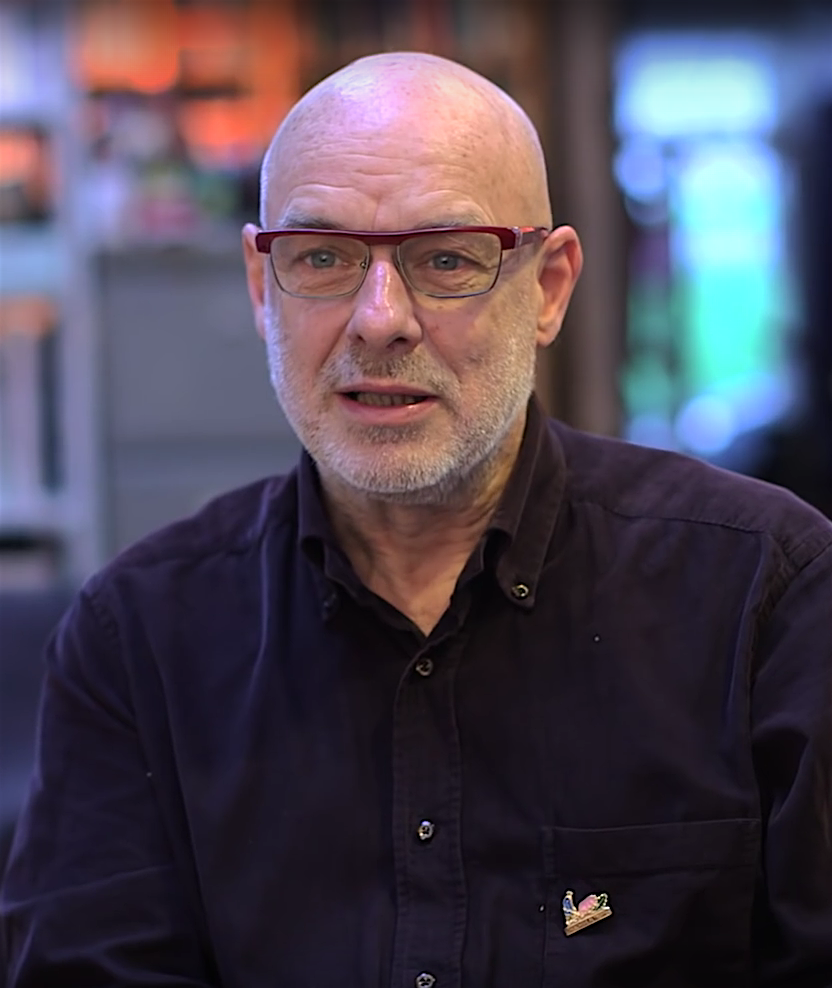
 photo: distributed by a&m records · public domain ↗
Orchestral Manoeuvres in the Dark
sourcesWikipedia — Orchestral Manoeuvres in the Dark (overview, formation) · The New York Times Magazine — O.M.D.'s Plot Against Rock (formation, career arc) · The Independent — Our friends electric (Radio-Activity as 'our Bible') · Gigwise — OMD on making instruments from scraps (DIY gear origins) · Classic Pop — 'Stockhausen or ABBA? Can't we be both?' (Autobahn, Dazzle Ships history) · The Quietus — Simple Minds & OMD to cover Kraftwerk's 'Neon Lights' (cover, McCluskey quote) · SuperDeluxeEdition — OMD / Dazzle Ships reviewed (Neu!/Kraftwerk synthesis quote, '4-Neu') · ELECTRICITYCLUB.CO.UK — 50
In 1978, two Wirral schoolfriends walked out of a Kraftwerk show at the Liverpool Empire having "decided then and there that they'd seen the future," and built Orchestral Manoeuvres in the Dark around a left-handed bass, salvaged circuit boards, and a tape machine they nicknamed Winston. Andy McCluskey and Paul Humphreys turned that homemade minimalism into hits like "Enola Gay" and "Maid of Orleans," then torched their own momentum with 1983's Dazzle Ships, an album of shortwave radio noise and Speak & Spell voices that sank sales from three million to under 300,000. They rebuilt through "If You Leave," split in 1989, and reunited in 2005. McCluskey called the whole enterprise "a geeky art project that accidentally turned into a pop group" — and never really stopped being both.
the sound in question
1980
Enola GayOrchestral Manoeuvres in the Dark
walk the tributaries ↓
Kraftwerk1970s–80s · Electronic / Krautrock / Synth-pop
McCluskey has never softened the debt: "Kraftwerk was the reason why we formed OMD," he told The Quietus in 2009, recalling how the band's early songs "explored electronic soundscapes and minimalism" straight out of that catalogue. Decades later he and Humphreys made the tribute literal, cutting a studio cover of Kraftwerk's "Neon Lights" for 1991's Sugar Tax and performing it live alongside Simple Minds on a joint UK tour — a direct, credited repayment, not just a family resemblance in the songwriting.
listen: upstream & heresource: The Quietus — Baker's Dozen ↗
1978
Neon LightsKraftwerk
1991
Neon LightsOrchestral Manoeuvres in the Dark
listen forKraftwerk's original rides a glassy synth pulse under a robotic, three-word title hook, sung with deadpan detachment. OMD's 1991 cover keeps that pulse almost intact but hands the vocal to guest singer Christine Mellor, warming the machine original into a breathier, more human read — the clearest possible demonstration of which parts of Kraftwerk's sound OMD absorbed as engineering, and which parts still, decades later, felt like they needed a human voice.
Neu!1970s · Krautrock / Experimental rock
McCluskey draws a sharper line than most fans bother to: "Neu! are essentially the tangential twins of Kraftwerk," he told The Quietus, "and probably if you look at the music of Orchestral Manoeuvres In The Dark, Neu! are the other side of the Kraftwerkian influence. Kraftwerk distilled themselves into this cubist minimal electro sound and Neu! were the noisy, emotional, human element." OMD made the debt literal with "4-Neu," a B-side the music site ELECTRICITYCLUB has documented as built on the plaintive piano of Neu! '75's "Leb Wohl."
listen: upstream & here
1975
Leb WohlNeu!
1983
4-NeuOrchestral Manoeuvres in the Dark
listen forNeu!'s "Leb Wohl" rests on a slow, plaintive piano figure under Klaus Dinger's anguished, half-sung farewell — grief turned into a proto-synth hymn. OMD's tribute "4-Neu" borrows that same unhurried, piano-led mourning, swapping Dinger's ragged voice for a cooler, more processed melancholy: the noisy, human ache Neu! brought to Kraftwerk's cubist blueprint, filtered a second time through OMD's own layered synthesizers and studio polish.
Brian Eno1970s · Ambient / Art rock / Electronic / Experimental
Poverty, not aesthetics, first bonded OMD to Eno. McCluskey has said one of their "great mantras" in the broke, synth-less early days was something Eno once said: "If you've got a collection of rubbish instruments, then you're the only person who has got those rubbish instruments, so that's your sound. Celebrate it." It gave a cheap organ and a homemade drum kit permission — and later became an explicit method: torturing ordinary gear, the way Eno's own records did, until it yielded a new sound.
listen: upstream & here
1974
Third UncleBrian Eno
1983
Genetic EngineeringOrchestral Manoeuvres in the Dark
listen forEno's "Third Uncle" worries a simple guitar figure into a jittery, motorik clatter, treating an ordinary instrument like broken machinery. OMD's "Genetic Engineering" runs the same trick with its own junk-shop arsenal — a Speak & Spell toy, a typewriter, a scratchy guitar line — turning cheap, everyday tools into the same kind of purposeful racket, the DIY ethos McCluskey credited to Eno made audible rather than just quoted.