walking upstream…
Lana Del Rey
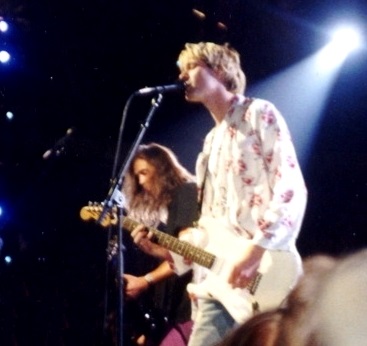


 photo: raph_ph · cc by 2.0 ↗
Lana Del Rey
sourcesNME — Lana Del Rey on Kurt Cobain, 2011 ("stopped me dead in my tracks," primary-inspiration quote) · Music Feeds — Lana Del Rey on her "masters" · Rolling Stone — Lana Del Rey covers Leonard Cohen's "Chelsea Hotel No. 2" (2013) · MuuMuse — "Mariners Apartment Complex" and its Leonard Cohen reference · Diffuser.fm — Lana Del Rey covers Nirvana's "Heart-Shaped Box" live, Sydney 2012 · Wikipedia — "Video Games" (2011, self-edited music video)
"I knew Elvis' songs would be the soundtrack to my life as soon as I laid eyes on his photograph," Lana Del Rey said in an early interview, naming The Beach Boys and The Flamingos as her other "constant companions" growing up. That taste for glamorous, mid-century Americana widened at nineteen, when a move to New York introduced her to Bob Dylan, Frank Sinatra, Jeff Buckley and Leonard Cohen, artists she called her "masters." Out of that canon she built Lana Del Rey: Old Hollywood iconography, doomed romance, and a downshifted, behind-the-beat croon laid over hip-hop-slow tempos. She edited the self-made video for 2011's "Video Games" herself, splicing webcam footage of her singing into old film clips, and it made her an overnight phenomenon; Born to Die made the blueprint inescapable a year later. She has spent the years since refining that world rather than replacing it.
the sound in question
2011
Video GamesLana Del Rey
walk the tributaries ↓
Nirvana1990s · Grunge / Alternative rock
At eleven, Del Rey saw Kurt Cobain sing "Heart-Shaped Box" on MTV: "it really stopped me dead in my tracks," she told NME. "I thought he was the most beautiful person I had ever seen. Even at a young age, I really related to his sadness." She stayed away from Nirvana for years, then returned to it at seventeen or eighteen and never left again: Cobain's refusal to soften his sound became, in her words, "my primary inspiration — in terms of not wanting to compromise lyrically or sonically," a phrase she has repeated about her own records ever since.
listen: upstream & heresource: Repeat Fanzine — early interview and press blurb (Elvis, Beach Boys, Flamingos, Nirvana quotes) ↗
1993
Heart-Shaped BoxNirvana
2012
Heart-Shaped Box (Nirvana cover, live)Lana Del Rey
listen forDel Rey began covering "Heart-Shaped Box" live on the Born to Die tour in 2012, trading Cobain's guitar eruptions for a hushed arrangement of electric guitar and bowed strings. She sings it in a throaty approximation of grunge rather than her usual cool restraint — proof of how deep the identification runs — but the tempo drops and the dynamics flatten into a torch song, turning loud-quiet-loud catharsis into the same aching, downshifted delivery she uses everywhere else.
Leonard Cohen1960s–70s · Folk / Singer-songwriter
When Leonard Cohen died in November 2016, Del Rey marked it with a video of herself singing his "Chelsea Hotel No. 2" — his song about a night with Janis Joplin — and a message ranking him above every other hero: "I'd be lying if I said it didn't kind of break my heart that I never got to tell you how much you changed me," she wrote. "Other than Bob and Joan you were the only person I ever really felt spoke my language." The debt runs through her writing too: critics hear Norman F***ing Rockwell's "Mariners Apartment Complex" borrowing its refrain, "I'm your man," from Cohen's title track.
listen: upstream & heresource: NME — Lana Del Rey's Instagram tribute to Leonard Cohen, full text reprint ↗
1974
Chelsea Hotel No. 2Leonard Cohen
2013
Chelsea Hotel No. 2 (cover)Lana Del Rey
listen forDel Rey posted her cover of "Chelsea Hotel No. 2" in 2013, keeping Cohen's hushed, half-spoken delivery and unhurried acoustic guitar almost entirely intact — critics called it "a faithful version" that "strikes the same spare, wistful tone" as the original. Listen for how both versions let a plainly stated line sit alone in silence rather than build toward a chorus. Six years later she performed the song live again, this time with Cohen's own son Adam beside her.
Bob Dylan1960s · Folk / Folk rock / Rock
At nineteen, newly arrived in New York, Del Rey assembled a private canon: "That's when I found Bob Dylan, Frank Sinatra, Jeff Buckley, Leonard Cohen — my masters — and I've never really listened to anything else since," she said. Dylan sits first in that list, and the debt shows up in her writing as much as her sound — she folds his 1965 landmark directly into her own lyrics, singing "the way I roll like a rolling stone" on "Off to the Races," repurposing his portrait of someone cut loose from every certainty into her own outlaw romance.
listen: upstream & here
1965
Like a Rolling StoneBob Dylan
2011
Off to the RacesLana Del Rey
listen for"Like a Rolling Stone" unspools as one sprawling accusation aimed at a fallen socialite, Dylan sneering through verse after verse with no hook to rest on. "Off to the Races" borrows that sprawl and turns the sneer inward: Del Rey narrates her own precarious romance in long, run-on lines that resist the beat, cataloguing designer names and threats the way Dylan catalogued a stranger's comedown. Both trust a story to carry the song without a chorus to lean on.