walking upstream…
Kamasi Washington

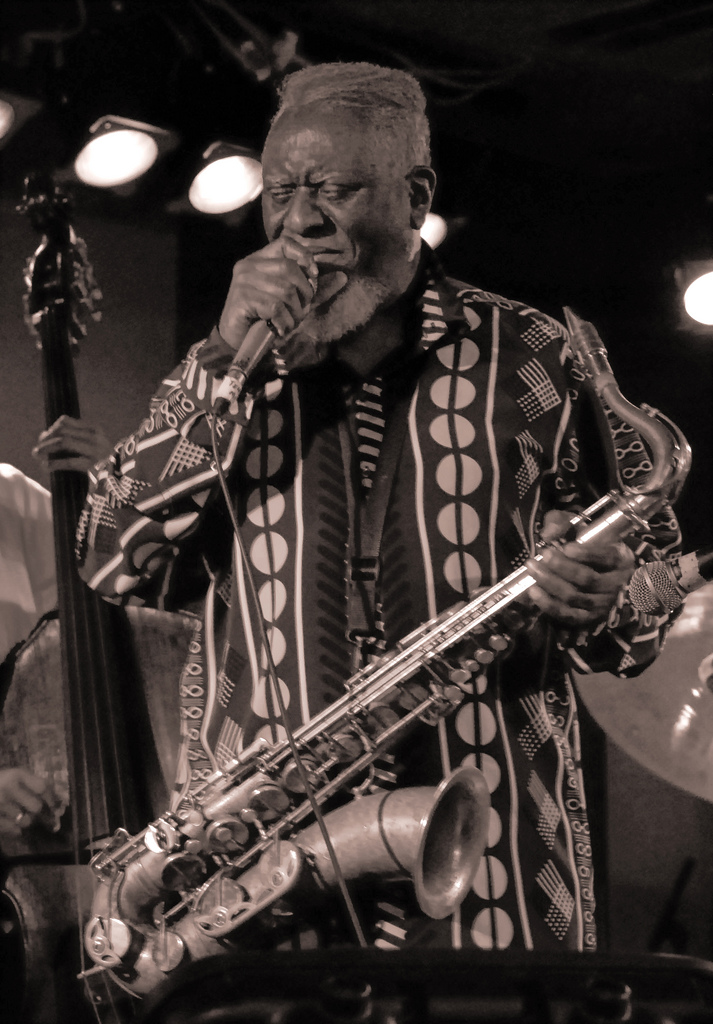

 photo: krists luhaers · cc by 2.0 ↗
Kamasi Washington
Kamasi Washington grew up in South Central Los Angeles steeped in jazz by his saxophonist father Rickey Washington, and broke out in 2015 with the three-hour double album The Epic, reintroducing choir-and-orchestra-scaled spiritual jazz to a generation raised on hip-hop. A member of the West Coast Get Down collective alongside Thundercat and Terrace Martin, he built his rhythmic vocabulary as a teenage touring saxophonist with Snoop Dogg before returning to acoustic jazz as a bandleader. His playing carries John Coltrane's intensity and Pharoah Sanders' overtone-rich tone into arena-scale, genre-blurring performance.
the sound in question
2015
Change of the GuardKamasi Washington
walk the tributaries ↓
John Coltrane1960s · Jazz / Modal jazz / Spiritual jazz
Washington has called Coltrane “a really bright light” who “changed my musical brain” — the totalizing intensity, modal vamps, and searching spiritual bent of Coltrane's 1960s quartet became the grammar Washington builds his own long-form pieces around.
listen: upstream & here
1965
A Love Supreme, Pt. I – AcknowledgementJohn Coltrane
2017
TruthKamasi Washington
listen forCue up Coltrane's “A Love Supreme, Pt. I – Acknowledgement” and then Washington's own “Truth” — both ride a simple incantatory phrase for minutes at a stretch, building intensity through repetition and testimony rather than chord changes.
Pharoah Sanders1970s · Spiritual jazz / Free jazz / Jazz
Washington first heard Sanders live at the tiny World Stage club in Leimert Park and has said “I always loved that sound that Pharoah put out” — the thick, overtone-saturated tenor tone and the practice of stretching a single vamp into a meditative trance runs straight through Washington's own writing.
listen: upstream & here
1969
The Creator Has a Master PlanPharoah Sanders
2018
The Space Travelers LullabyKamasi Washington
listen forPut on Sanders' side-long “The Creator Has a Master Plan” next to Washington's “The Space Travelers Lullaby” — both hover over a slow, repeating figure and let the horns wander into overblown, keening textures rather than tight melodic statements.
Kendrick Lamar2010s · West Coast hip-hop / Conscious hip-hop / Jazz rap
Washington arranged strings for “Mortal Man” and played tenor saxophone on “u,” spending early 2015 embedded in the hip-hop production world of To Pimp a Butterfly at the same time he was finishing his own debut The Epic — a shared West Coast circle, with Thundercat and Terrace Martin, that left its drum-forward, groove-conscious fingerprints on his solo work.
listen: upstream & here
2015
2018
Fists of FuryKamasi Washington
listen forListen to Kendrick Lamar's “u,” where Washington's own saxophone winds through the beat, then his “Fists of Fury” — the same unrelenting low-end pocket and hip-hop-schooled sense of rhythmic placement drives both.