walking upstream…
Joe Hill
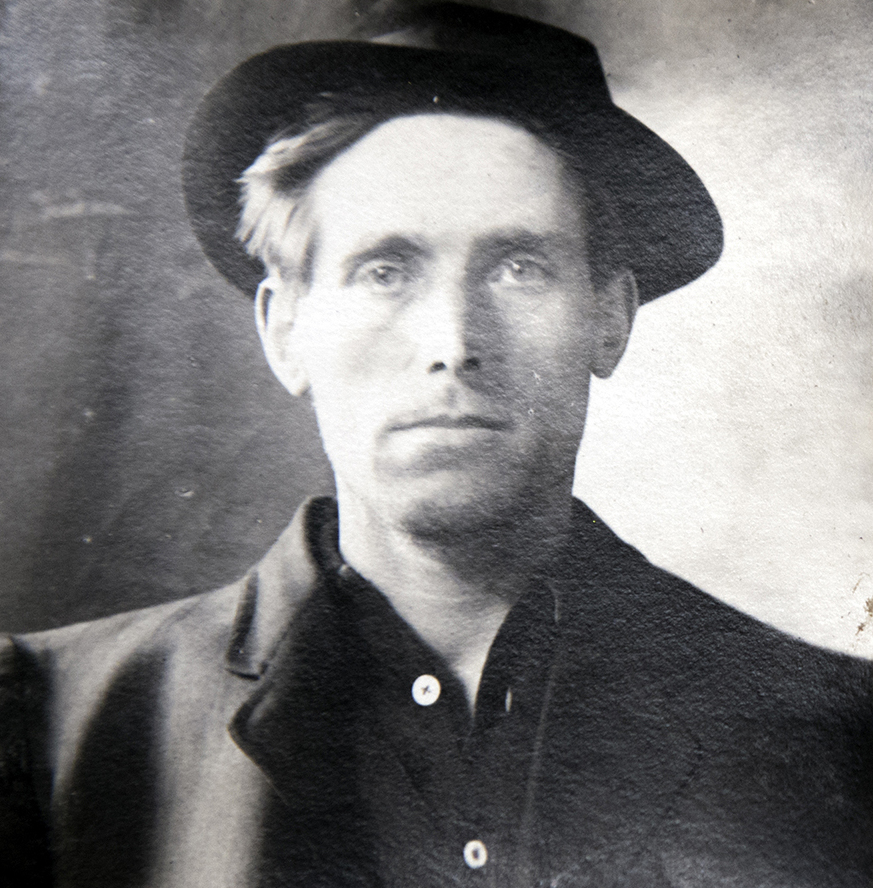 photo: public domain ↗
Joe Hill
sourcesThe Joe Hill Project — Joe's Bio (childhood, family, immigration) · Joe Hill SLC — Joe Hill Biography (Salt Lake Telegram letter, final wire to Haywood) · Labor Notes — Joe Hill's Last Will (execution scene, final words) · The New York Times — Examining a Labor Hero's Death (biographical overview) · The Economist — Songwriter Shot Dead (The Preacher and the Slave, Wobbly reputation) · Joe Hill SLC — The Preacher and the Slave (tune attribution, lyrics, McClintock account) · Joe Hill SLC — Casey Jones—the Union Scab (tune attribution, strike context, lyrics) · Joe Hill SLC — There Is Power in a Union (tune attribution, MacKay anecdote, full lyrics)
Joel Hägglund was born in Gävle, Sweden, on October 7, 1879, the son of a railway conductor who built the family organ and led nightly hymn-singing for nine children. Joel learned violin, guitar, accordion, and piano before he ever crossed an ocean. Orphaned in 1902, he and a brother sailed for America chasing rumors of gold, found blacklisting and boxcars instead, and by 1910 he had renamed himself Joe Hill and joined the Industrial Workers of the World in San Pedro, California. His songwriting method was practical, not romantic: take a tune a strike crowd or a street-corner congregation already knew by heart, and nail new words to it. Convicted of a Salt Lake City murder on contested evidence, he wired the union the night before his 1915 firing squad: "Don't waste any time in mourning — organize." The songs outlived the trial.
walk the tributaries ↓
Joseph P. Webster1860s · Hymns / Parlor ballads / Civil War songs
Webster wrote the tune under duress. His songwriting partner S. Fillmore Bennett recalled Webster shuffling into his shop one afternoon, "of an exceedingly nervous and sensitive nature," muttering only "it will be all right by and by" — four words Bennett turned into a hymn title within the half hour, Webster picking out the melody on his violin as they went. By 1910 that melody was standard equipment for the street-corner brass bands the Salvation Army fielded in Portland, Oregon, drowning out Wobbly soapbox speakers before they finished a sentence. Hill's answer wasn't a new song — it was Webster's, verse for verse, with the tune doing the recruiting.
listen: upstream & here
1868
In the Sweet By-and-ByJoseph P. Webster
listen forNo period recording survives of either camp singing at full volume, so the comparison has to run through the words themselves, sung to memory. Webster's chorus lands on "we shall meet on that beautiful shore," the melody stretching to fit an unhurried promise. Hill's chorus rides the identical notes into "you'll get pie in the sky when you die (that's a lie)" — same syllable count, same rise into the last word — so the tune a congregation already carried in its ear delivers the punchline before anyone registers it as a joke.
Eddie Newton1900s–10s · Vaudeville / Novelty song
By 1909, Eddie Newton and lyricist T. Lawrence Seibert turned a work song first sung by Black engine-wiper Wallace Saunders into a vaudeville hit sold nationwide as sheet music, "Casey Jones, The Brave Engineer." Two years later, 40,000 Illinois Central shopmen walked off the job, and Hill rewrote Newton's already-famous tune line for line in San Pedro, turning the celebrated engineer into a strikebreaker sent shovelling coal in Hell. Sold at a dime apiece on cards the size of a playing card, the parody, the history site joehillslc.org records, "caught on quickly" until "workers passed the songcards around the country — and to union halls across the ocean."
listen: upstream & here
1909
Casey Jones, The Brave EngineerEddie Newton
listen forNeither Newton's original nor Hill's rewrite has a period recording to hold up side by side, but the shared skeleton is exact: the same "Casey Jones" name-hook landing on the same beat at the top of every chorus, the same rolling narrative-ballad meter built to carry a story in plain, singable lines. Newton and Seibert's version mourns a hero who dies at the throttle; Hill's chorus keeps the hook — "Casey Jones, got a wooden medal" — and runs it to a different verdict, ending with the engineer told to "get busy shovelling sulphur" for scabbing his way into heaven.
Lewis E. Jones1890s–1900s · Gospel hymns
By early 1913, Hill was living in a tar-paper shack on the San Pedro docks during a strike. A Wobbly, Alexander MacKay, described watching him work: "Suddenly his face would light up and he'd dash into the shack... we'd hear the plunk-plunk of a guitar... His joy when he hit the jackpot of a jingle was a joy to behold." That year's shack produced "There Is Power in a Union," built on Lewis E. Jones's 1899 revival hymn "There Is Power in the Blood" — familiar enough that Hill could answer it directly: "If you've had enough of the 'blood of the lamb,' then join in the grand industrial band."
listen: upstream & heresource: Timeless Truths Free Online Library — There Is Power in the Blood (Lewis E. Jones authorship, refrain text) ↗
1899
There Is Power in the BloodLewis E. Jones
listen forNo recording preserves Jones's hymn as its own congregation first sang it, or Hill's rewrite as he first strummed it in the shack, but the refrains scan as one. Jones's chorus repeats "there is pow'r, pow'r, wonder-working pow'r" before naming its source, "in the blood of the Lamb." Hill's answering chorus keeps the same triple-hammered phrase — "there is power, there is power" — before naming a different source, "in a band of workingmen." Sing one over the other and the fit is immediate: Hill didn't write a new tune, he re-addressed one.