walking upstream…
Jimmy Eat World

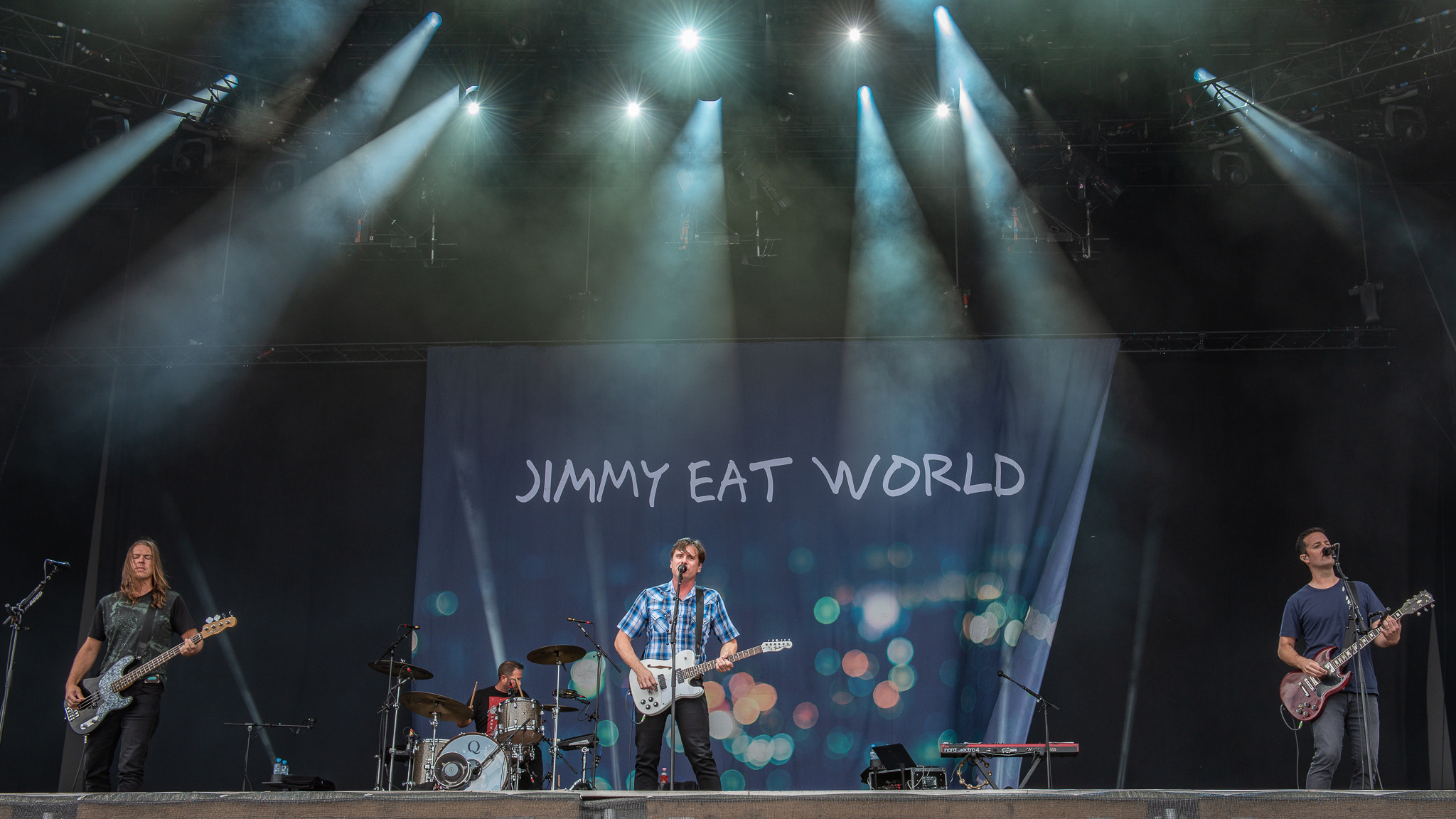 photo: stefan brending (2eight) · cc by-sa 4.0 ↗
Jimmy Eat World
sourcesPhoenix New Times — Givin' Us Static (early band history, Capitol signing) · Boulder Weekly — Something Loud (Adkins on the Christie Front Drive/Denver-Boulder circuit) · Zach Lind via Wayback Machine — Static Prevails 25th-anniversary track notes ("Seventeen" drum intro as Trombino/Jehu homage)
Jimmy Eat World formed in late 1993 in Mesa, Arizona, when preschool friends Jim Adkins and Zach Lind fell in with guitarist Tom Linton — "the first time two really great guitarists... were playing together," Lind said. A 1994 split single with Denver's Christie Front Drive drew a Capitol Records scout who had actually come to see the Denver band; Jimmy Eat World signed instead, still teenagers. Their pop-punk debut gave way to Static Prevails (1996) and Clarity (1999), the melodic post-hardcore records that built their reputation but sold poorly, prompting Capitol to drop them. Broke and self-funded, they released Bleed American in 2001; its single "The Middle" became a top-five hit, turning four Arizona kids who had been driving car-dealership lots into mainstream rock radio fixtures.
the sound in question
2001
The MiddleJimmy Eat World
walk the tributaries ↓
Christie Front Drive1990s · Emo / Post-hardcore
Denver's Christie Front Drive were labelmates before they were legends: the two bands split a 1995 single on Wooden Blue Records, then toured the same Rocky Mountain circuit, crashing at Denver's Arapahoe Warehouse. Asked point-blank about outside influences, Lind didn't hedge: "The one band that influenced us the most is a band called Christie Front Drive... I think that band changed our outlook on guitar music." He credited the encounter with pulling the band off the NOFX/J Church pop-punk track toward something "really melodic but still very powerful" — the shift that defined Static Prevails.
listen: upstream & heresource: Modern Drummer — Zach Lind of Jimmy Eat World (Christie Front Drive as formative influence) ↗
1995
SlideChristie Front Drive
1996
DigitsJimmy Eat World
listen for"Slide," Christie Front Drive's half of that 1995 split single, stretches a simple riff into a long, gathering swell instead of a hook. Jimmy Eat World's "Digits" — the song built from that same connection, later re-cut with Christie Front Drive singer Eric Richter on backing vocals — borrows that patience: verses that hold back before the chorus finally opens the guitars up. Listen for how both tracks let a single chord ring rather than rushing to the next line, the "melodic but powerful" balance Lind singled out as the influence.
Sunny Day Real Estate1990s · Emo / Post-hardcore / Alternative rock
Lind still remembers driving to Tucson to catch a barely known Seattle band open for Shudder to Think: "One of the concerts that was really inspiring to me... Those bands, in our mind, forever will be above us." Decades later, Sunny Day Real Estate still opens the band's pre-show mix. Guitarist Tom Linton went further, naming their 1994 track "In Circles" as the direct spark for Static Prevails' "Claire" — part of the same pivot away from pop-punk that Christie Front Drive triggered, toward longer, more dynamically-built songs.
listen: upstream & heresource: Ticketmaster Discover — Jimmy Eat World's worst gig was also their best (Sunny Day Real Estate influence) ↗
1994
In CirclesSunny Day Real Estate
1996
ClaireJimmy Eat World
listen for"In Circles" rides one chiming guitar figure through nearly six minutes, letting Jeremy Enigk's voice crack and swell rather than land on a tidy chorus. "Claire" takes the same patience: a hushed verse keeps circling before the band lets the volume climb, Adkins holding back the release the way Enigk does. Neither song hurries toward its loud moment — both trust the tension of waiting for it, the quality Linton pointed to when he named "In Circles" as the song's direct model.
Drive Like Jehu1990s · Post-hardcore / Noise rock / Math rock
Adkins calls Drive Like Jehu, flatly, his "all-time favourite guitar band" — not for flash, he told the magazine Louder, but because guitarists John Reis and Rick Froberg turned "confrontation" into something "cerebral." The debt became literal: when Static Prevails needed a producer, Adkins sought out Mark Trombino, Drive Like Jehu's own drummer. Trombino went on to shape Static Prevails, Clarity, and Bleed American — the band's defining run — and Lind later admitted online that the drum intro to "Seventeen" was "a direct Mark Trombino Jehu rip off. Awkward in the studio."
listen: upstream & heresource: Louder — The 13 best guitarists according to Jimmy Eat World's Jim Adkins (Drive Like Jehu as "all-time favourite guitar band") ↗
1994
Here Come the Rome PlowsDrive Like Jehu
1996
SeventeenJimmy Eat World
listen forLind's confession points at Trombino's playing in general rather than one specific Drive Like Jehu song, so hear "Here Come the Rome Plows" as the clearest example of that drumming on Yank Crime (1994): tumbling, off-the-beat fills that refuse to settle into a straight backbeat. "Seventeen" opens with that same restless, syncopated pattern before the song locks into its chorus — the producer's old band still audible in the player's hands, even without a note-for-note match.