walking upstream…
Jerry Lee Lewis

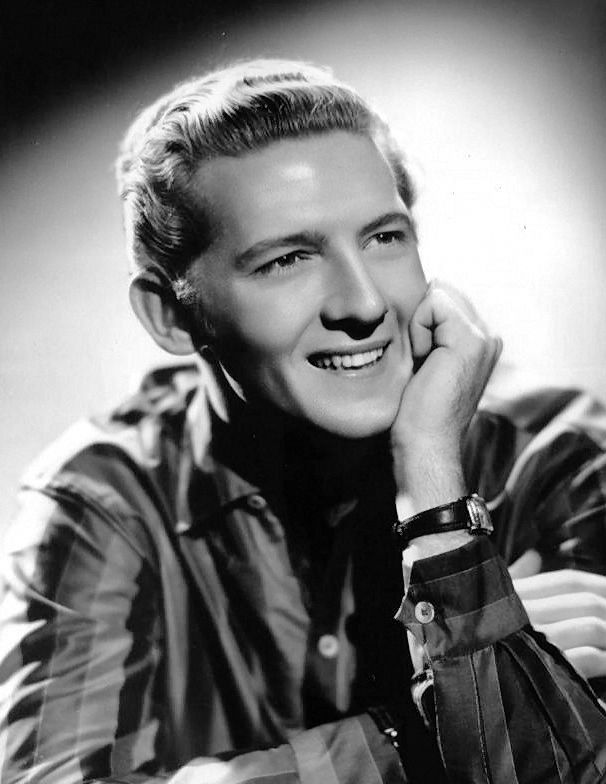 photo: maurice seymour, chicago · public domain ↗
Jerry Lee Lewis
sourcesRolling Stone — “The Devil and Jerry Lee Lewis” by Robert Palmer, 1979 (bio, Mullican contradiction, Jolson naming) · Explore Pine Bluff — “Carl McVoy, Jerry Lee Lewis, & Boogie-Woogie Music” by Ninfa O. Barnard, 2024 (McVoy's 1945 teaching visit) · Garden & Gun — “Jerry Lee and Me” by Rick Bragg, 2014 (bio, formation background) · Jerry Lee Lewis — Wikipedia (identity, bio)
In Ferriday, Louisiana, an eight-year-old wandered into his aunt’s front room, sat at a piano he’d never touched, and picked out “Silent Night” on the black keys alone; his parents mortgaged the farm for one of his own. By his teens he was sneaking under the tables at Haney’s Big House, the local Black roadhouse, to hear Fats Domino and Big Joe Turner — music he later called “wilder than my music.” That restless, absorb-everything hunger became “Whole Lotta Shakin’ Goin’ On” and “Great Balls of Fire,” the Sun Records sides that made him rock and roll’s first true wild man. Ask him who taught him, though, and the story turns combative: pressed once about pianist Moon Mullican, he snapped that the man “couldn’t influence a toilet bowl” — even as another account has him naming Mullican, on his own record, as an inspiration.
the sound in question
1957
Great Balls of FireJerry Lee Lewis
walk the tributaries ↓
Carl McVoy1950s · Rockabilly / Blues
In the summer of 1945, Jerry Lee Lewis’s older cousin Carl McVoy came to visit, fresh off a stretch in New York with his minister father, where he’d picked up boogie-woogie piano. Nine-year-old Jerry Lee had a piano at home but no one to show him what to do with it. McVoy did: a local Arkansas history piece records that he simply “taught him everything he knew on the piano.” McVoy wouldn’t cut a record of his own for another twelve years — by then, at Sun’s sister label Hi, the very style he’d handed his younger cousin had already carried Lewis to Sun Records and national fame.
listen: upstream & heresource: A History of Rock Music in Five Hundred Songs — Episode 59 transcript by Andrew Hickey, 2019 (Carl McVoy, Paul Whitehead, Al Jolson anecdote) ↗
1945
No known recording — McVoy taught young Lewis piano in person during a summer 1945 visit to Ferriday/Pine Bluff, per Explore Pine Bluff (2024) and Cunningham & Cunningham's Delta Music and Film (2015)Carl McVoy
1957
Great Balls of FireJerry Lee Lewis
listen forNo recording survives of that 1945 piano lesson. What does survive is McVoy’s own belated 1957 single, and a music-history podcast drawing on Lewis’s authorized biography called it “spooky how much it sounds like Jerry Lee himself.” Listen for that same rolling, two-fisted boogie-woogie left hand driving under a right hand that never sits still on “Great Balls of Fire” — the piano vocabulary a teenage cousin poured into a nine-year-old, years before either man had a record contract.
Al Jolson1920s–30s · Vaudeville / Popular
As a teenager on a date at the Ferriday movie house, Jerry Lee Lewis heard a record playing before the newsreel: Al Jolson belting “Toot, Toot, Tootsie (Goo’bye).” He told his girlfriend he needed the restroom, pedaled home, worked the song out on the piano by ear, pedaled back, and slid into his seat, claiming he’d only stopped for popcorn. Robert Palmer’s 1979 Rolling Stone profile independently found Lewis still naming Jolson, unprompted, among his favorite singers — the one vocalist he’d credit freely, without the prickliness he showed about naming piano influences.
listen: upstream & heresource: A History of Rock Music in Five Hundred Songs — Episode 59 transcript by Andrew Hickey, 2019 (Carl McVoy, Paul Whitehead, Al Jolson anecdote) ↗
1922
Toot, Toot, Tootsie! (Goo'bye)Al Jolson
1958
High School ConfidentialJerry Lee Lewis
listen forJolson’s 1922 “Toot, Toot, Tootsie” is vaudeville belting built to reach the last row without a microphone — notes bent for maximum drama, then snapped off with a theatrical yelp. Listen for that same instinct, transposed to a Sun Records studio, in the wailing, note-stretching vocal on “High School Confidential”: Lewis doesn’t just sing the words, he performs them, milking every held note the way a stage singer plays to a back balcony rather than a boom mic.
Paul Whitehead1950s
By the early 1950s, Jerry Lee Lewis was touring Louisiana and Mississippi clubs alongside a blind multi-instrumentalist everyone called “Mr. Paul” — Paul Whitehead, who played violin, accordion, and piano well enough that the two swapped instruments onstage: Lewis on piano while Whitehead sawed the fiddle, then Lewis moving to drums when Whitehead sat down to play. It was nightly, hands-on training in a trade Lewis hadn’t yet mastered alone, delivered on club stages years before any Sun Records contract existed. Whitehead left almost nothing on record himself.
listen: upstream & heresource: A History of Rock Music in Five Hundred Songs — Episode 59 transcript by Andrew Hickey, 2019 (Carl McVoy, Paul Whitehead, Al Jolson anecdote) ↗
1951
No known recording — Whitehead ("Mr. Paul"), a blind multi-instrumentalist, toured and performed with young Lewis directly (fiddle/piano/drums instrument-swapping duo) on the early-1950s Louisiana/Mississippi club circuit, per Andrew Hickey's 500songs.com podcast (2019, drawing on Rick Bragg's authorized biography)Paul Whitehead
1957
Whole Lotta Shakin' Goin' OnJerry Lee Lewis
listen forWhitehead’s only surviving trace on record is an uncredited piano part behind singer Gray Montgomery — the mentorship itself was never captured on tape. What is audible is what it produced: on “Whole Lotta Shakin’ Goin’ On,” listen for how Lewis attacks the piano like a second rhythm section, pounding the beat with his whole body rather than just his hands — the instinct of a performer who spent his teenage nights learning to cover for a bandmate on drums, fiddle, or keys, whichever the song required.