walking upstream…
Deftones
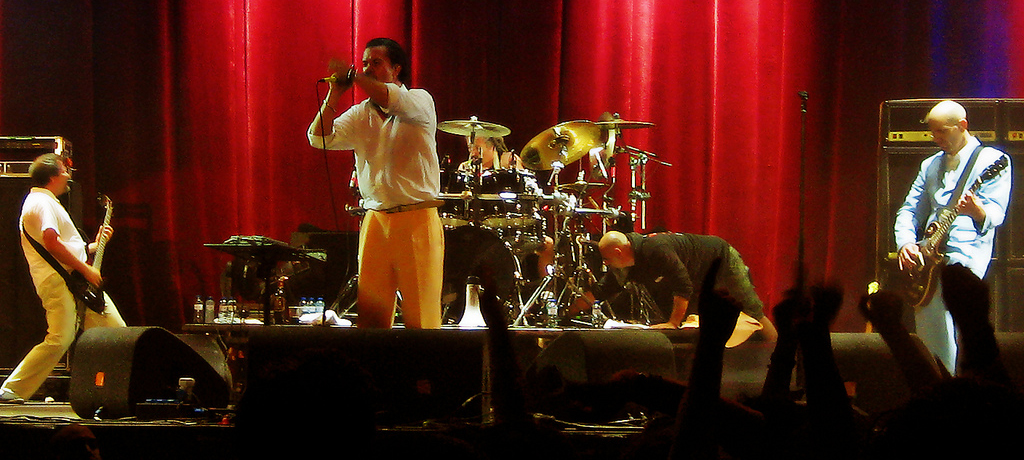


 photo: benjgibbs · cc by 2.0 ↗
Deftones
sourcesLos Angeles Times — "The Bleaker Side of Metal" (Moreno and Carpenter on White Pony's shift toward atmosphere) · NPR — Chino Moreno interview on Gore (band's refusal to repeat itself, Morrissey's influence surfacing on the record) · Blabbermouth.net — Moreno on Faith No More's Angel Dust and Mike Patton · Revolver — Deftones perform "Right Brigade" with Bad Brains' H.R. in Baltimore, 2012 · Far Out Magazine — how a Smiths cover attempt disrupted the Adrenaline sessions
Four childhood friends and skateboarders from Sacramento’s Oak Park neighborhood, Deftones formed in 1988 around guitarist Stephen Carpenter and singer Chino Moreno, later joined by bassist Chi Cheng and turntablist Frank Delgado. Their 1995 debut, Adrenaline, arrived amid the nu-metal boom their rap-inflected riffing seemed to invite, but 2000’s White Pony — home to the Grammy-winning single “Elite” — pulled them away from it entirely, trading aggression for atmosphere and finally separating them from peers like Korn and Limp Bizkit. The band kept moving through tragedy: bassist Chi Cheng’s death in 2013, after years in a coma following a 2008 car accident, never stopped the catalogue’s drift. “We’re a band who decides not to do things,” Moreno told NPR in 2016 — a stubbornness that has kept Deftones, three decades on, still refusing to repeat themselves.
the sound in question
2000
Change (In the House of Flies)Deftones
walk the tributaries ↓
Faith No More1990s · Alternative metal / Funk metal / Experimental rock
Reviewers kept reaching for Nirvana and Rage Against the Machine to explain the young Deftones’ sound; bassist Chi Cheng waved them off. “Being so close to the Bay Area, Faith No More and Primus were a lot bigger influences,” he told the Washington Post in 1998. For Moreno the debt had a specific address: 1992’s Angel Dust, the record that made Faith No More sound dangerous. “It sounded way more like a Mike Patton record,” he said in 2010. “I feel like he had a lot more influence on it.” That record taught him a voice could whisper and detonate in the same verse.
listen: upstream & heresource: The Washington Post — "Deftones' Deft Diversity" (Chi Cheng on Faith No More/Primus/Bad Brains, band's Sacramento origins) ↗
1992
Midlife CrisisFaith No More
1995
7 WordsDeftones
listen forFaith No More's "Midlife Crisis" spends its verses in a flat, almost spoken deadpan before singer Mike Patton's chorus rips open into a full-throated wail — the same architecture Deftones borrowed wholesale for "7 Words," their first-ever single. Listen for how both songs refuse to build gradually: the quiet parts stay genuinely quiet, so the scream, when it arrives, lands as a jump cut rather than a crescendo.
Bad Brains1980s · Hardcore punk / Reggae / Jazz fusion
“The Bad Brains were a huge influence on us,” Chi Cheng told the Washington Post in 1998, describing how the young band had even chased the D.C. hardcore group's reggae-dub side: “We experimented a little bit with reggae and ska, but it wasn't really where we were heading.” Moreno's fandom outlasted the experiment — he later formed the side project Saudade with Bad Brains members Dr. Know and Mackie Jayson, and on October 26, 2012, in Baltimore, the two bands finally shared a stage: Deftones brought out singer H.R. himself for a performance of "Right Brigade," a dream Moreno had been chasing since he was a teenager.
listen: upstream & heresource: The Washington Post — "Deftones' Deft Diversity" (Chi Cheng on Faith No More/Primus/Bad Brains, band's Sacramento origins) ↗
1982
Right BrigadeBad Brains
2012
Right Brigade (live with H.R., Baltimore)Deftones
listen forBad Brains' "Right Brigade" is built on a stop-start hardcore riff punched out at breakneck tempo, H.R.'s vocal snapping between a bark and a rasp. In the Baltimore recording of Deftones performing the same song with H.R. on the mic, listen for how the two singers trade that bark back and forth almost as one voice — Moreno matching H.R.'s phrasing rather than smoothing it into his own register, the tribute audible in real time.
The Smiths1980s · Jangle pop / Post-punk / Alternative rock
“When I was young, I used to hold a broom handle like a microphone and stand and sing Morrissey songs,” Moreno told Metal Hammer in 2020. That fandom nearly derailed Deftones’ 1995 debut: the band tried recording a cover of “Please, Please, Please, Let Me Get What I Want” with producer Terry Date, who found it so out of character that he stood up mid-session and said, “I don’t really want anything to do with this.” The band shelved the cover, then revived it a decade later on B-Sides & Rarities — and it was still turning up in their 2024 festival sets.
listen: upstream & heresource: Louder/Metal Hammer — Moreno on Deftones' cover versions, including Bad Brains and the Smiths ↗
1984
Please, Please, Please, Let Me Get What I WantThe Smiths
2005
Please, Please, Please, Let Me Get What I Want (cover)Deftones
listen forThe Smiths’ original rides a waltz-time shuffle under Morrissey’s plaintive, almost deadpan delivery, guitarist Johnny Marr chiming lightly behind him. Deftones’ version keeps that same lilting three-count and melody line intact but thickens the guitars into a wall of distortion and lets Moreno’s voice crack and strain toward the top of his range where Morrissey stays cool and detached — the tune note-for-note, the temperature entirely different, a metal band admitting how much of its tenderness came from a jangle-pop record.