walking upstream…
Crosby, Stills, Nash & Young


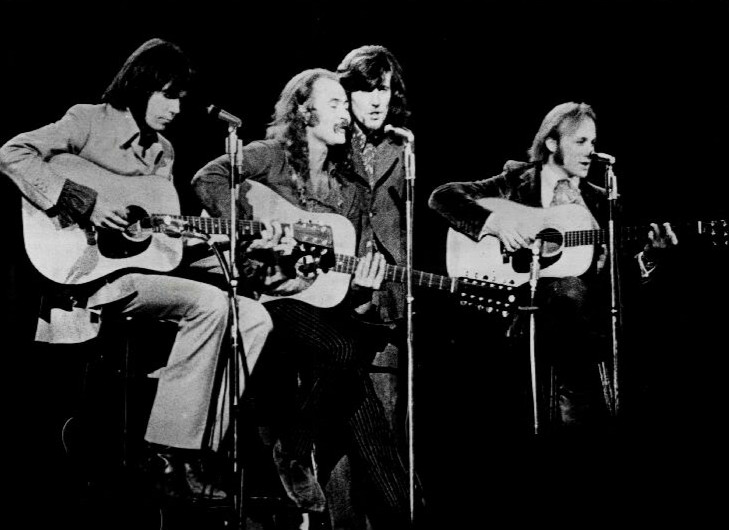 photo: cma-creative management associates/atlantic records · public domain ↗
Crosby, Stills, Nash & Young
Formed when David Crosby (freshly fired from the Byrds), Stephen Stills (late of the just-dissolved Buffalo Springfield), and Graham Nash (recently decamped from the Hollies) stumbled onto a three-way vocal blend at a Laurel Canyon living-room singalong that none of them had heard before, Crosby, Stills & Nash turned layered harmony and confessional folk-rock into a genre unto itself. Neil Young, Stills's old sparring partner from Buffalo Springfield, joined within the year, adding a rawer electric edge and a fourth voice that let the group swing between hushed acoustic filigree ("Helplessly Hoping," "Our House") and blunt protest ("Ohio," written the day National Guardsmen killed four students at Kent State). Chronic infighting -- mostly between Stills and Young -- fractured the lineup almost as often as it reunited, but the quartet's original run through Déjà Vu (1970) set the template for harmony-driven soft rock for the next decade.
the sound in question
1970
OhioCrosby, Stills, Nash & Young
walk the tributaries ↓
The Everly Brothers1950s · Rock and roll / Country / Pop
Both Crosby and Nash separately name the Everly Brothers as the reason they can hear a harmony part before anyone sings it. Nash has described a teenage encounter with "Bye Bye Love" at a dance that stopped him cold and set a standard he chased for the rest of his career, while Crosby has called them flatly "a huge influence -- huge -- they just rang my bell." When the three voices first locked together at a Laurel Canyon party in 1968, it was that close, brother-duo blend -- scaled up from two voices to three -- that convinced them they had something new.
listen: upstream & heresource: Fretboard Journal -- David Crosby on the Everly Brothers as "a huge influence -- huge -- they just rang my bell" ↗
1957
Bye Bye LoveThe Everly Brothers
1969
Helplessly HopingCrosby, Stills, Nash & Young
listen forThe Everlys stack two nearly identical voices a tight interval apart over a plain country-pop melody, with barely a hair of vibrato between them; CSN's own three-way weave keeps that same glassy, blended tone but splits into contrapuntal lines that answer each other rather than just doubling the tune.
Buffalo Springfield1960s · Folk rock / Country rock / Rock
Stephen Stills and Neil Young's previous band, Buffalo Springfield, broke up in 1968 without finishing an idea Stills had been chasing: his song "Questions," from the group's final album Last Time Around, supplied the literal back half of "Carry On," which Stills spliced together with a separate jam in a single eight-hour session to give Déjà Vu its opening track.
listen: upstream & heresource: Wikipedia -- "Carry On," on Stephen Stills incorporating Buffalo Springfield's unfinished "Questions" into the Déjà Vu opener ↗
1968
QuestionsBuffalo Springfield
1970
Carry OnCrosby, Stills, Nash & Young
listen for"Questions" rides a nervy, unresolved acoustic-guitar figure through Stills's own restless self-interrogation; "Carry On" opens with an entirely new song, then drops -- about two minutes in -- straight into that same "Questions" verse and melody, now thickened with CSNY's four-part harmony and stretched out into a longer electric guitar coda.
The Byrds1960s · Folk rock / Rock
David Crosby's four years in the Byrds ended in an October 1967 firing, but not before he wrote "Everybody's Been Burned" -- a jazzy, harmonically unusual ballad he later called "the first actually passable song that I wrote" and one that showed "pretty changes, an unusual feel and flavor." The open tunings and unresolved, jazz-tinged chord voicings he began exploring there, over bandmates' objections that it was too odd for a pop single, became his songwriting signature once he had his own group willing to indulge them.
listen: upstream & heresource: Rolling Stone -- David Crosby's essential songs, including his own account of writing "Everybody's Been Burned" with the Byrds and "Guinnevere" with CSN ↗
1967
Everybody's Been BurnedThe Byrds
1969
GuinnevereCrosby, Stills, Nash & Young
listen for"Everybody's Been Burned" moves through spare, half-lit jazz changes under a hushed, unhurried vocal; "Guinnevere," written after Crosby left the Byrds, stretches that same modal drift and open-tuned guitar even further, trading a full band arrangement for two entwined voices over an unresolved, dreamlike chord progression.