walking upstream…
Weather Report


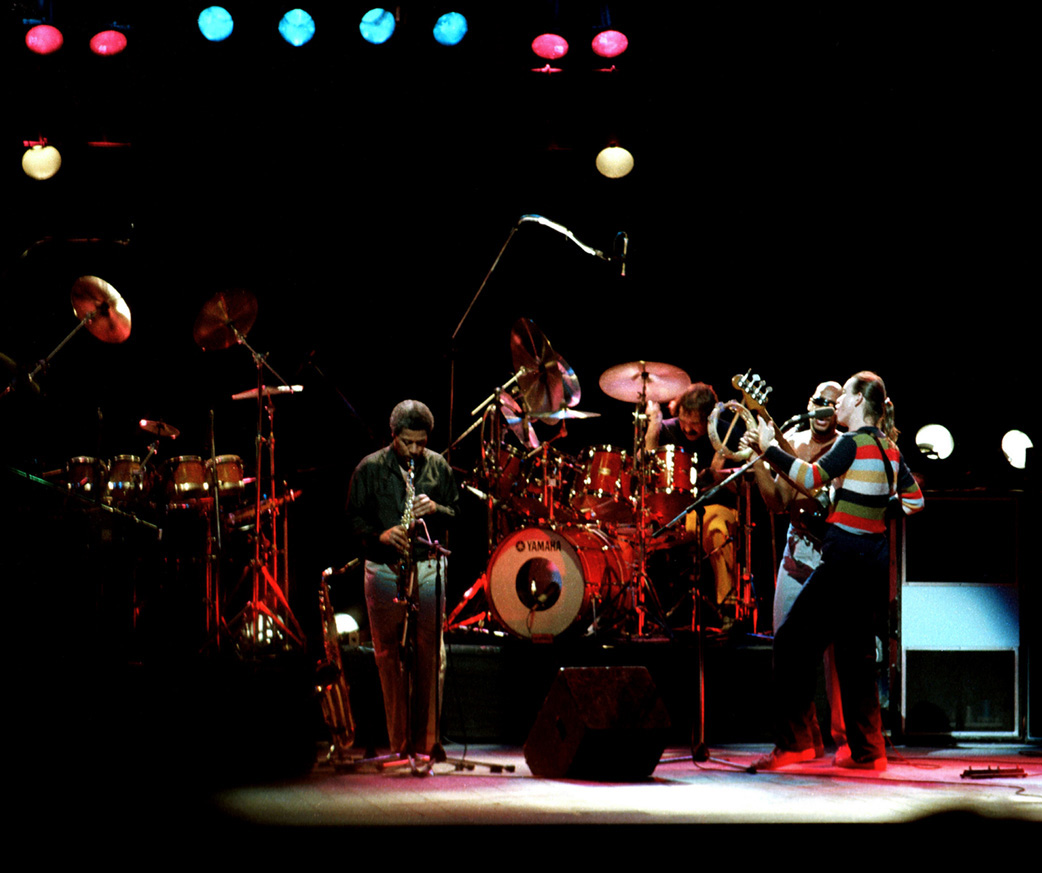 photo: jun tendo · public domain ↗
Weather Report
sourcesWikipedia23 · All About Jazz
Weather Report formed in 1970 out of the electric ferment Miles Davis had ignited on 'In a Silent Way' and 'Bitches Brew,' with two of that ferment's key voices — Austrian keyboardist Joe Zawinul and saxophonist Wayne Shorter — striking out as co-leaders alongside bassist Miroslav Vitouš. Early albums favored loose, atmospheric group improvisation, but as the decade wore on Zawinul steered the band toward tighter, funkier compositions steeped in R&B and music from across the globe, refracted through his growing arsenal of synthesizers. The arrival of virtuoso bassist Jaco Pastorius in 1976 pushed the band to its commercial and creative peak on 'Heavy Weather,' whose 'Birdland' became a fusion standard. Weather Report disbanded in 1986, having redefined how far 'jazz' could stretch without breaking.
the sound in question
1977
BirdlandWeather Report
walk the tributaries ↓
Miles Davis1950s–70s · Jazz / Modal jazz / Jazz fusion
Both Zawinul and Shorter were in the studio bands that made Davis's 'In a Silent Way' (1969) and 'Bitches Brew' (1970) — the sessions that first married jazz improvisation to rock rhythm, electric keyboards, and open-ended studio editing. Weather Report picked up directly where those sessions left off: a working band built from the same electric-fusion premise, with Zawinul carrying over the mood-painting keyboard washes and Shorter the spacious, unhurried tenor and soprano lines he'd developed at Davis's side.
listen: upstream & here
1969
In a Silent WayMiles Davis
1971
Milky WayWeather Report
listen forCompare the hovering, keyboard-washed calm of 'In a Silent Way' with the interstellar drift that opens Weather Report's own debut in 'Milky Way' — both let a single chord bloom and decay rather than resolve, trading bebop's forward motion for pure atmosphere.
Cannonball Adderley1960s · Hard bop / Soul jazz / Modal jazz / Jazz
Zawinul spent nearly a decade, from 1961 to 1970, as the pianist in Cannonball Adderley's band, writing the group's biggest hit, 'Mercy, Mercy, Mercy' — proof that a gospel-inflected, riff-based groove could sit comfortably inside a jazz combo. That grounding in soul jazz's backbeat and vamp-driven forms resurfaces once Weather Report pivoted, on 1973's 'Sweetnighter,' away from free improvisation and toward the heavy, funk-rooted ostinatos Zawinul had helped popularize with Adderley.
listen: upstream & heresource: uDiscover Music ↗
1966
Mercy, Mercy, MercyCannonball Adderley
1973
Boogie Woogie WaltzWeather Report
listen forHear how the churchy electric-piano vamp of 'Mercy, Mercy, Mercy' reappears, stretched and electrified, in the driving, waltz-time groove of 'Boogie Woogie Waltz' — both ride a hypnotic, repeating riff meant to make a room move rather than to showcase virtuosic soloing.
John Coltrane1960s · Jazz / Modal jazz / Spiritual jazz
Coltrane took a young Wayne Shorter under his wing in the late 1950s, inviting him to his home and later steering him toward Miles Davis's band; Shorter has said Coltrane was 'the only one that was on to something musically that was moving.' Coltrane's modal, spiritually searching quartet music — extended pieces built on shifting scales rather than fast chord changes — shaped Shorter's preference, carried into Weather Report, for long, patient melodic lines floating over a static or slowly shifting harmonic bed.
listen: upstream & here
1965
A Love Supreme, Pt. I – AcknowledgementJohn Coltrane
1971
Orange LadyWeather Report
listen forSet 'Acknowledgement,' the incantatory opening movement of 'A Love Supreme,' against the unhurried soprano melody of Weather Report's 'Orange Lady' — both circle a simple melodic cell for minutes, building intensity through repetition and tone rather than harmonic movement.