walking upstream…
S.D. Burman
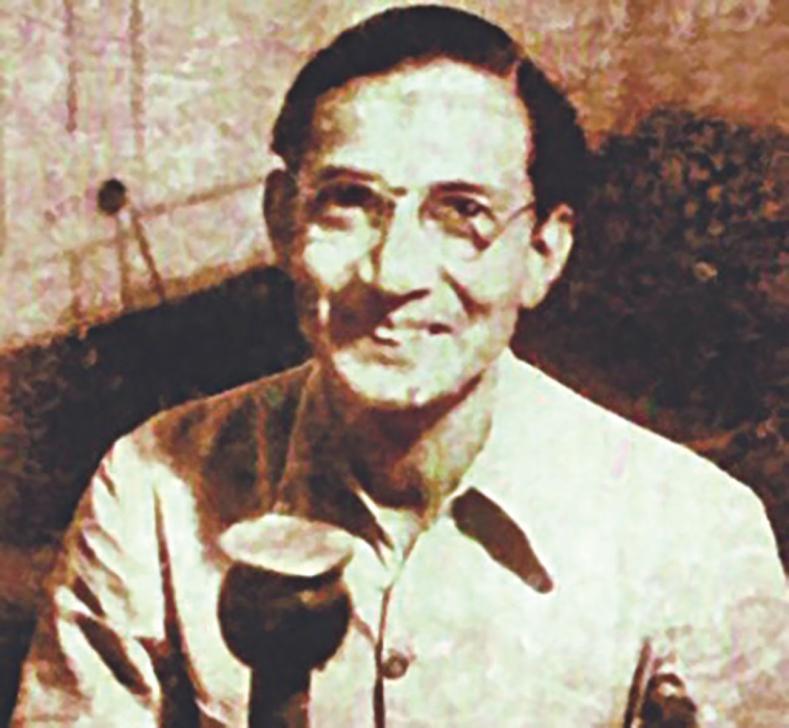


 photo: public domain ↗
S.D. Burman
sourcesWikipedia — S. D. Burman · Scroll.in — book excerpt, Incomparable Sachin Dev Burman by HQ Chowdhury (Abbasuddin Ahmed quote, gurus) · The Daily Star — "Sachin Dev Burman · Cinemaazi — "S D Burman, Music Director" (guru list, career timeline) · The Hindu — "The magic in the music" (guru sequence, autobiography quote) · The New Indian Express — "Master who learnt from beggar, baul" (bio quote) · The Quint — "Give me Lata and a harmonium and I'll make music" (bio quote) · The Daily Star — "Abbasuddin Ahmed
Sachin Dev Burman was born in 1906 into the royal house of Tripura in Comilla, the youngest of nine children of a sitarist father who gave him his first lessons. What followed was an unusually long apprenticeship: formal training under K.C. Dey, then Bhishmadev Chattopadhyay, sarangi master Badal Khan and Ustad Allauddin Khan, layered over a childhood steeped in the Bhatiali boat songs of rural East Bengal. He carried that folk-classical hybrid to Bombay in 1944, and across three decades of films, including Pyaasa, Guide, Aradhana, Abhimaan and Mili, built a sound Hindi film music still measures itself against. "My music is the wealth of all Indians," he wrote in his autobiography, "my tune is a symbol of India" — and the sensibility passed directly to his son, R.D. Burman.
the sound in question
1959
Waqt Ne Kiya Kya Haseen SitamS.D. Burman
walk the tributaries ↓
Abbasuddin Ahmed1930s–1940s · Bhawaiya / Bengali folk
In Calcutta, Burman studied under Abbasuddin Ahmed, the Bhawaiya singer whose "voice breaking" technique — a deliberate crack mid-phrase — Burman absorbed and later carried into his own Hindi film singing. He knew better than to compete with it outright: his biographer HQ Chowdhury notes he "never sang Bhawaiya because he knew that in this genre of folk music, Abbasuddin Ahmed was the master," saving the technique for his own modern songs instead. One debt survives whole: Ahmed's drought-prayer "Allah Megh De" resurfaces, title and all, in the 1965 film Guide two decades later.
listen: upstream & heresource: Scroll.in — "From Karbala to Dev Anand ↗
Allah Megh DeAbbasuddin Ahmed
1965
Allah Megh De Paani De (Guide)S.D. Burman
listen forAhmed's original "Allah Megh De" is a Bengali Jaari Gaan lament, cried out during the Battle of Karbala for rain-bearing clouds. Burman's "Allah Megh De Paani De," which he sings himself in Guide, keeps the title, the melody and the same skyward cry, but widens the prayer from one battle's grief to a drought-stricken village invoking Ram, Shyam and Allah at once. Listen for the same rising, keening vowel on "megh" (cloud) in both versions, and for the vocal crack Ahmed taught him breaking the line open.
Kazi Nazrul Islam1920s–1940s · Nazrul Geeti / Bengali music
Kazi Nazrul Islam, the poet who would become Bangladesh's national poet, was a frequent guest at the Burman family's Comilla house, and the association lasted for years. Burman was famously guarded about lending his voice to other composers — his biographer HQ Chowdhury counts that "he had only sung to Himangsu Dutta (8 songs), RC Boral (1 song), Nazrul Islam (4 songs) and Sailesh Das Gupta (2 songs), who were his all good friends" — Nazrul among the rare few granted that trust, on top of directly shaping one of Burman's biggest Hindi hits decades later.
listen: upstream & here
Arun Kanti Ke Go Jogi BhikariKazi Nazrul Islam
1963
Poochho Na Kaise Maine (Meri Surat Teri Aankhen)S.D. Burman
listen forIn 1963, for the film Meri Surat Teri Aankhen, Burman set Manna Dey's "Poochho Na Kaise Maine" in raga Ahir Bhairav, the same raga frame as Nazrul's own Bengali composition "Arun Kanti Ke Go Jogi Bhikari," which the film song is explicitly based on. Listen for the same grave, devotional Ahir Bhairav shape carried in Nazrul's Bengali original by a bare solo voice, and in Burman's Hindi version by Manna Dey's fuller, more orchestrated arrangement built around the identical melodic climb.
Allauddin Khan1920s–50s · Hindustani classical / Sarod
Alongside vocal training from K.C. Dey and Bhishmadev Chattopadhyay, Burman studied flute and orchestration under Ustad Allauddin Khan, the sarod master then building the Maihar gharana that would soon produce Ravi Shankar. Burman's biographer HQ Chowdhury calls Khan "the orchestra king" and points readers straight at the evidence, urging them to "go back to the songs Pawane Diwane or Tere Naina Talaash and note the orchestra" — Khan's feel for large-ensemble color, applied years later to a Hindi film score.
listen: upstream & heresource: sdburman.net — "Sachin Karta" by HQ Chowdhury (Allauddin Khan song titles, personal quotes) ↗
Sarod – Raga Hem (All India Radio recording)Allauddin Khan
1969
Tere Naina Talaash Karen (Talash)S.D. Burman
listen forKhan's own All India Radio recordings of Raga Hem show his instinct for filling out a raga with layered instrumental color rather than one bare solo line. That same instinct for a thick, structured orchestral bed, strings and rhythm built up around the melody, carries into "Tere Naina Talaash Karen," Manna Dey's 1969 song for the film Talash, the very track Burman's biographer names as proof of Khan's orchestral stamp.