walking upstream…
Pinetop Smith

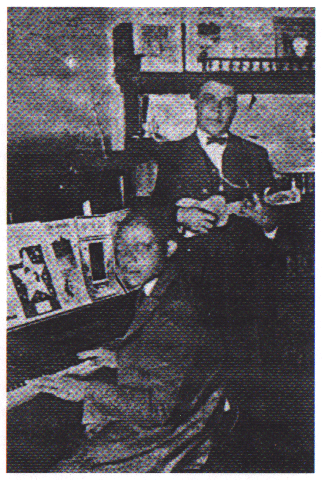

Pinetop Smith
sourcesEncyclopedia of Alabama — Clarence "Pine Top" Smith (biography, Davenport discovery, death) · Pittsburgh Music History — Pine Top Smith (Chicago Tribune Davenport interview, Sarah Horton Smith on origin of the song) · Riverwalk Jazz (Stanford Archive of Recorded Sound) — Honky Tonk Train · Blues Foundation
In the mid-1920s, a barrelhouse pianist and Vocalion talent scout heard a young house-party regular in Pittsburgh and decided he was worth a ticket to Chicago. Clarence "Pinetop" Smith — born in Orion, Alabama, in 1904, nicknamed for a boyhood spent climbing trees — had already crossed the South on the Black vaudeville circuit backing Ma Rainey and Butterbeans and Susie, talking over his own left hand between verses to keep dancers moving. The scout's tip got him to Chicago by summer 1928, and one December session for Vocalion, "Pine Top's Boogie Woogie," put a genre's future name on a record label for the first time. He never heard it become a hit: five months later he was shot dead at a Chicago dance, a day before a scheduled follow-up session. What he cut that afternoon still names a style two generations of piano players inherited without ever meeting him.
the sound in question
1928
Pine Top's Boogie WoogiePinetop Smith
walk the tributaries ↓
Cow Cow Davenport1920s · Barrelhouse piano / Boogie-woogie
Davenport was a working barrelhouse pianist and a scout for Brunswick/Vocalion, and by his own account he found Smith mid-set at a hall off Pittsburgh's Sachem Alley. "Boy, look here," he told him, "you have got a mean boogie-woogie" — and pointed him toward Chicago and a recording contract. It was Davenport who walked Smith into Vocalion's office and introduced him to producer Mayo Williams, the connection that put a rent-party performer in front of a microphone at all. Without that specific introduction, the December 1928 session that named the genre may never have happened.
listen: upstream & here
1928
Cow Cow BluesCow Cow Davenport
1929
Jump Steady BluesPinetop Smith
listen forPlay Davenport's "Cow Cow Blues" against Smith's "Jump Steady Blues" and you can hear the toolkit Davenport was scouting for: a steady rolling left hand keeping eight beats to the bar under a right hand free to noodle and answer itself, the same barrelhouse engine both men were selling to Chicago's rent-party crowds. Smith adds what Davenport didn't discover fully formed — a running spoken patter calling out dance moves between phrases, the showman's habit picked up on the road, layered onto that same insistent bass.
Hersal Thomas1920s · Blues piano / Boogie-woogie
There's no record of Smith and Thomas ever meeting, and Smith left no interview to ask him. What's documented is proximity: when Smith reached Chicago in 1928 he took a room on South Parkway already shared by pianists Albert Ammons and Meade "Lux" Lewis, both of whom said they'd been "excited and inspired" hearing Hersal Thomas play his signature bass patterns at house-rent parties years earlier. Historian Paul Oliver, tracing that same circuit, wrote that Smith's own "Pine Top's Boogie Woogie... clearly shows some elements used by the Thomas brothers" — a claim built on the room, not on Smith's own testimony.
listen: upstream & heresource: John Tennison — History of Boogie Woogie (Paul Oliver on Hersal Thomas, Sammy Price on Blind Lemon Jefferson's bass figures) ↗
1925
Suitcase BluesHersal Thomas
1929
Pine Top BluesPinetop Smith
listen forCue up Thomas's "Suitcase Blues" next to Smith's "Pine Top Blues" and listen for the walking, broken-octave bass line Thomas and his brother George had already worked out in "The Fives" years earlier — a left hand that strides rather than merely rocks, breaking the beat into eighth notes instead of just thumping the root. Smith's left hand follows that same stride-into-shuffle logic under a lighter, more conversational right hand, the family resemblance historians point to even without a documented meeting between the two men.
Blind Lemon Jefferson1920s · Texas blues / Country blues
Jefferson never played piano, but on guitar he'd worked out a rolling, alternating bass line he called "booga rooga," recording it as "Booger Rooger Blues" in Chicago in 1926 — two years before Smith cut anything. Pianist and bandleader Sammy Price, who worked the same Texas-to-Chicago circuit, later said Jefferson's guitar figures were "the same bass figures" Smith used on piano in "Pine Top's Boogie Woogie." Historian John Tennison argues the two could have crossed paths on the T.O.B.A. circuit's regular stop in Dallas's Deep Ellum district, where Jefferson busked for years — a plausible route, though no source places them in the same room.
listen: upstream & heresource: John Tennison — History of Boogie Woogie (Paul Oliver on Hersal Thomas, Sammy Price on Blind Lemon Jefferson's bass figures) ↗
1926
Booger Rooger BluesBlind Lemon Jefferson
1928
Pine Top's Boogie WoogiePinetop Smith
listen forJefferson's guitar on "Booger Rooger Blues" alternates a low string against a higher one in a rolling, near-unbroken pulse — a guitarist's approximation of a boogie bass, years before pianists claimed the term. Smith's left hand on "Pine Top's Boogie Woogie" plays what is essentially the same figure transposed to piano, an octave bass rocking steadily under his spoken dance calls, the exact pattern Price identified across the two instruments.