walking upstream…
Coleman Hawkins

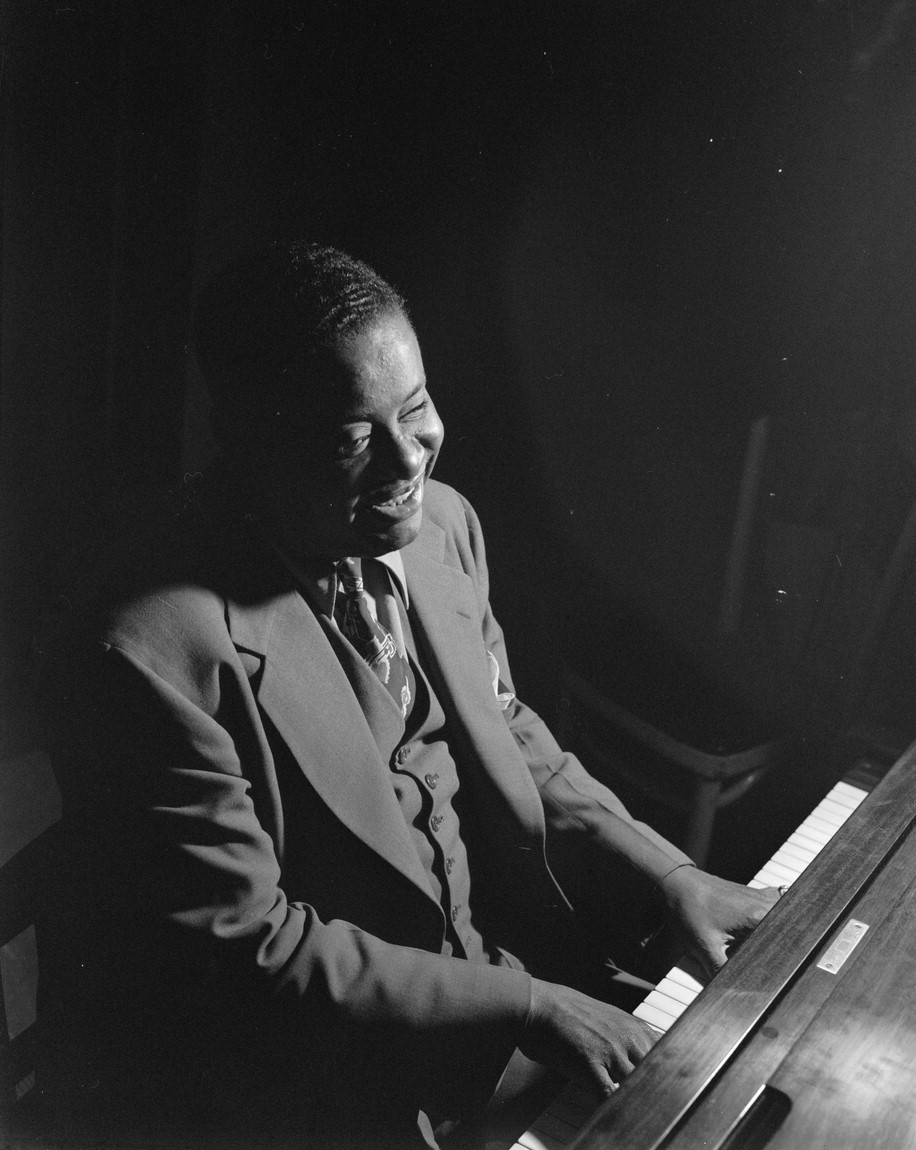

 photo: william p. gottlieb · public domain ↗
Coleman Hawkins
sourcesState Historical Society of Missouri — Coleman Hawkins (early life, career overview) · The Syncopated Times — Profiles in Jazz · The Syncopated Times — Coleman Randolph Hawkins (Andy Senior; pre-Armstrong tenor sax context, Henderson years) · Swing and Beyond — "Body and Soul" (1939) Coleman Hawkins (Mike Zirpolo; the 1939 session) · Mosaic Records — Coleman Hawkins essay (Loren Schoenberg, incl. Harry Lim/Metronome 1944 material on the Casals ambition) · JazzProfiles — Coleman Hawkins and The Jazz Tradition (quoting critic Martin Williams on the Armstrong and Tatum turning points)
Coleman Randolph Hawkins was born November 21, 1904, in St. Joseph, Missouri, the son of a pianist and organist who started him on piano at five, cello at seven, and a C-melody saxophone at nine — he practiced so hard he "often forgot to come in at mealtime." At sixteen he joined blues singer Mamie Smith's Jazz Hounds, then Fletcher Henderson's orchestra in New York, where a new arrival in 1924 would remake his playing entirely. By 1926 Hawkins had cut jazz's first major tenor solo; by 1939, on "Body and Soul," he'd turned the horn into a purely harmonic instrument, barely touching the melody across two rhapsodic choruses built from nothing but chord changes. He kept adapting through bebop and beyond until his death in New York on May 19, 1969 — the man, critics agree, who invented the tenor saxophone's entire jazz vocabulary.
the sound in question
1939
Body and SoulColeman Hawkins
walk the tributaries ↓
Louis Armstrong1920s–30s · Jazz
No Hawkins interview names Louis Armstrong as an influence — the case is scholarly consensus, built from what changed in the recordings themselves. Before October 1924, when Armstrong joined Fletcher Henderson's orchestra alongside him, Hawkins was, in critic Martin Williams's blunt verdict, "a slap-tongue tenor player with little more than shallow irreverence to recommend him." Within months, musicologist Jeffrey Magee writes, "Armstrong's influence left a profound mark on Hawkins. He was stunned by the strength of Armstrong's music and strove to adapt this style to the tenor saxophone." By 1926 the transformation was on record.
listen: upstream & heresource: The Logical Place — The early influence of Louis Armstrong on Coleman Hawkins (quoting Jeffrey Magee, Humphrey Lyttelton) ↗
1925
Sugar Foot StompLouis Armstrong
1926
The StampedeColeman Hawkins
listen forOn "Sugar Foot Stomp," cut in May 1925 with Armstrong newly in the band, listen for his cornet breaking from the ensemble in long, unhurried, syncopated phrases nothing else in the arrangement matches. A year later, on "The Stampede," Hawkins opens his own solo the same way — a syncopated phrase resolving into a three-note figure that musicologist Jeffrey Magee calls a direct "cue from Armstrong's openings." Where Hawkins once slap-tongued through solos, he now floats loosely over the beat: the same rhythmic unbuttoning, one instrument later.
Art Tatum1930s–40s · Jazz / Stride piano / Swing
Like the Armstrong connection, this one rests on musicological record-reading, not a Hawkins quote. In 1929, still with Henderson's band, Hawkins heard the young Art Tatum at a small Toledo club; by one account he "immediately incorporated the pianist's harmonic ideas into his playing." Critic Martin Williams calls the encounter "a turning point in Hawkins's development," the moment his "exact and growing knowledge of chords, and... spreads of arpeggios" began to deepen. A decade later, Mosaic Records essayist Loren Schoenberg would count Tatum among the voices audibly "culminating" in Hawkins's "Body and Soul."
listen: upstream & heresource: Encyclopedia.com — Art Tatum (the 1929 Toledo club encounter with Hawkins) ↗
1933
Tiger RagArt Tatum
1939
Body and SoulColeman Hawkins
listen forTatum's 1933 "Tiger Rag" turns a Dixieland warhorse into a torrent of reharmonization, chord after chord slipped under the melody, arpeggios spilling past where the tune "should" resolve. Hawkins's 1939 "Body and Soul" does the harmonic equivalent on saxophone: across two 32-bar choruses he barely states the melody, building instead from the chord changes themselves — a "vertical" approach critic Martin Williams traces straight back to that Toledo club. Listen for both men treating a tune's harmony, not its melody, as the real material.
Pablo Casals1900s–30s · Classical / Cello
Hawkins grew up on cello before saxophone and, by critic Harry Lim's 1944 account of a conversation — not a direct quotation — stayed "an ardent classical music fan" with "a fine personal music library of classical discs." Lim wrote that Hawkins "confided to me that he would like to make an unaccompanied solo record, on the order of the cello records of Pablo Casals." Hawkins scholar James T. Maher called the two men "the same kind of musical temperament." In 1948 Hawkins made that ambition literal, recording "Picasso" — its title nodding to the painter, though for Hawkins, Maher noted, "the Pablo who beguiled him was the great cellist."
listen: upstream & heresource: On An Overgrown Path — Pablo Casals and all that jazz (James T. Maher and John Chilton on the Casals/"Picasso" connection) ↗
1936
Cello Suite No. 1 in G major, BWV 1007 (Prélude)Pablo Casals
1948
PicassoColeman Hawkins
listen forCasals's 1936 recording of Bach's G major Cello Suite prelude is entirely unaccompanied — one instrument working through a full harmonic argument alone, its rubato pulling against the notated rhythm. Hawkins's "Picasso" (1948), his only unaccompanied studio recording, does the same on tenor: no rhythm section, no melody to lean on, just Hawkins working through chord changes in real time, stretching and compressing the beat the way a solo cellist does. It's the clearest evidence on record of what Casals's example gave him.