walking upstream…
Cab Calloway

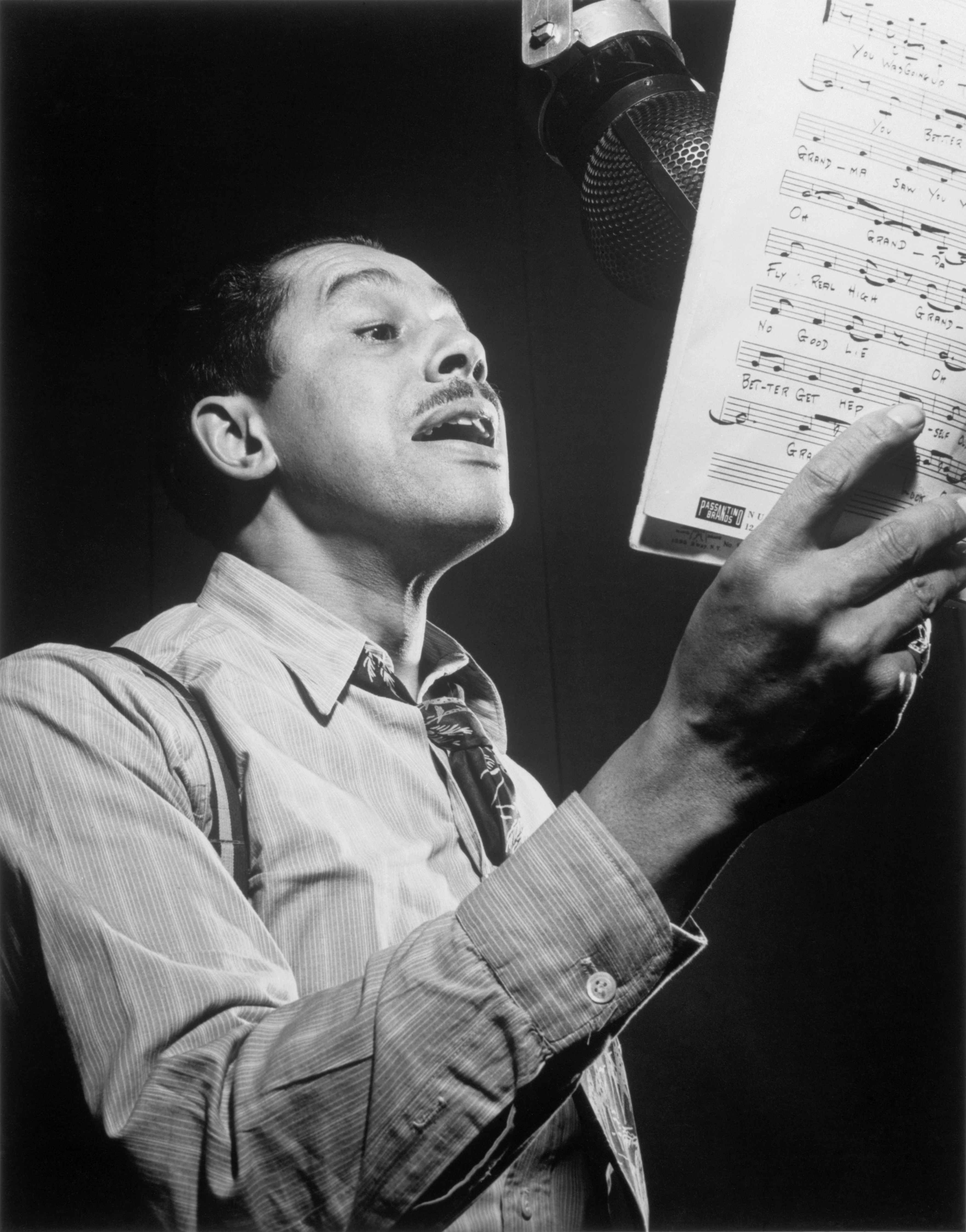 photo: william p. gottlieb · public domain ↗
Cab Calloway
sourcesBaltimore Sun — Cab Calloway's memoirs tell story of growing up in a segregated Baltimore (bio, Baltimore childhood) · New York Times — Cab Calloway Is Dead at 86; 'Hi-de-hi-de-ho' Jazz Man (bio, scat-singing origin story) · Washington Post — Jonathan Yardley review of Alyn Shipton's Hi-De-Ho (bio, Minnie the Moocher's history) · KNKX Public Radio — Black History Month · The Syncopated Times — Cab Calloway
On a night in 1931, broadcasting live from Harlem's Cotton Club, Cab Calloway forgot the words to his new theme song. "I couldn't leave a blank there," he wrote in his 1976 autobiography, Of Minnie the Moocher and Me, "so I started to scat-sing the first thing that came into my mind." The ad lib became "Minnie the Moocher," the first million-selling record by a Black artist and the source of his "Hi-de-ho" nickname. Calloway had grown up middle-class in segregated Baltimore — "we had status in the Negro community, but that didn't mean we had money," he recalled — and left law school for the Chicago revue circuit his older sister steered him into. He spent six more decades onstage, on film, and eventually as Sportin' Life in Porgy and Bess, never losing the audience-baiting showmanship built in that one broadcast.
the sound in question
1931
Minnie the MoocherCab Calloway
walk the tributaries ↓
Louis Armstrong1920s–30s · Jazz
The popular version has Louis Armstrong personally teaching Calloway to scat at Chicago's Sunset Cafe in the late 1920s. Calloway's biographer Alyn Shipton is more careful: the two "did overlap for a few weeks" at the club, he said, though "neither of whom really coincided with Cab for very long." What Calloway took wasn't a lesson but a slow absorption — on his 1930 "St. Louis Blues," Shipton writes, Calloway was "consolidating Armstrong's scatting, timing and phrasing" into an idiom of his own, one that also reached for cantors and street slang Armstrong never touched.
listen: upstream & heresource: Jerry Jazz Musician — 2011 interview with Alyn Shipton (Louis Armstrong influence; Blanche Calloway influence) ↗
1926
Heebie JeebiesLouis Armstrong
1930
St. Louis BluesCab Calloway
listen forArmstrong's 1926 "Heebie Jeebies" is the record most credited with popularizing wordless, syllable-scat singing — a loose, behind-the-beat looseness that treats the voice as another horn in the ensemble. Cue up Calloway's 1930 "St. Louis Blues" and listen for that same rhythmic looseness reappearing inside his patter, stretched into the layered, character-voiced allusions — cantorial runs, street slang, mock conversation — that made Calloway's scat feel like storytelling rather than mimicry.
Blanche Calloway1920s–30s · Jazz / Swing
His biographer Alyn Shipton found the proof in the discography, not in anyone's memory: Blanche Calloway's "Just a Crazy Song," cut for Victor on March 27, 1931, was recorded — as he put it — before she "could have possibly heard" Cab's "Minnie the Moocher," waxed three weeks earlier, back when pressing and shipping a record took longer than that gap. "She was doing an act — which included 'Hi-De-Hoing' and shout-backing and many of the things that we hear in Cab — way before he was," Shipton said. Cab absorbed the flamboyance; it did not run the other way.
listen: upstream & heresource: NPR — Cab Calloway ↗
1931
Just a Crazy Song (Hi-Hi-Hi)Blanche Calloway
1931
Minnie the MoocherCab Calloway
listen forBlanche's "Just a Crazy Song" carries the parenthetical subtitle "(Hi-Hi-Hi)" for a reason — listen for her shouted hook and the band answering the call, the same shout-back structure Cab would build a career on. Set it against "Minnie the Moocher" and the "hi-de-ho" chorus he made famous is the identical trick at bandleader scale: a nonsense phrase tossed to the room, and the room throwing it back.