walking upstream…
Beny Moré


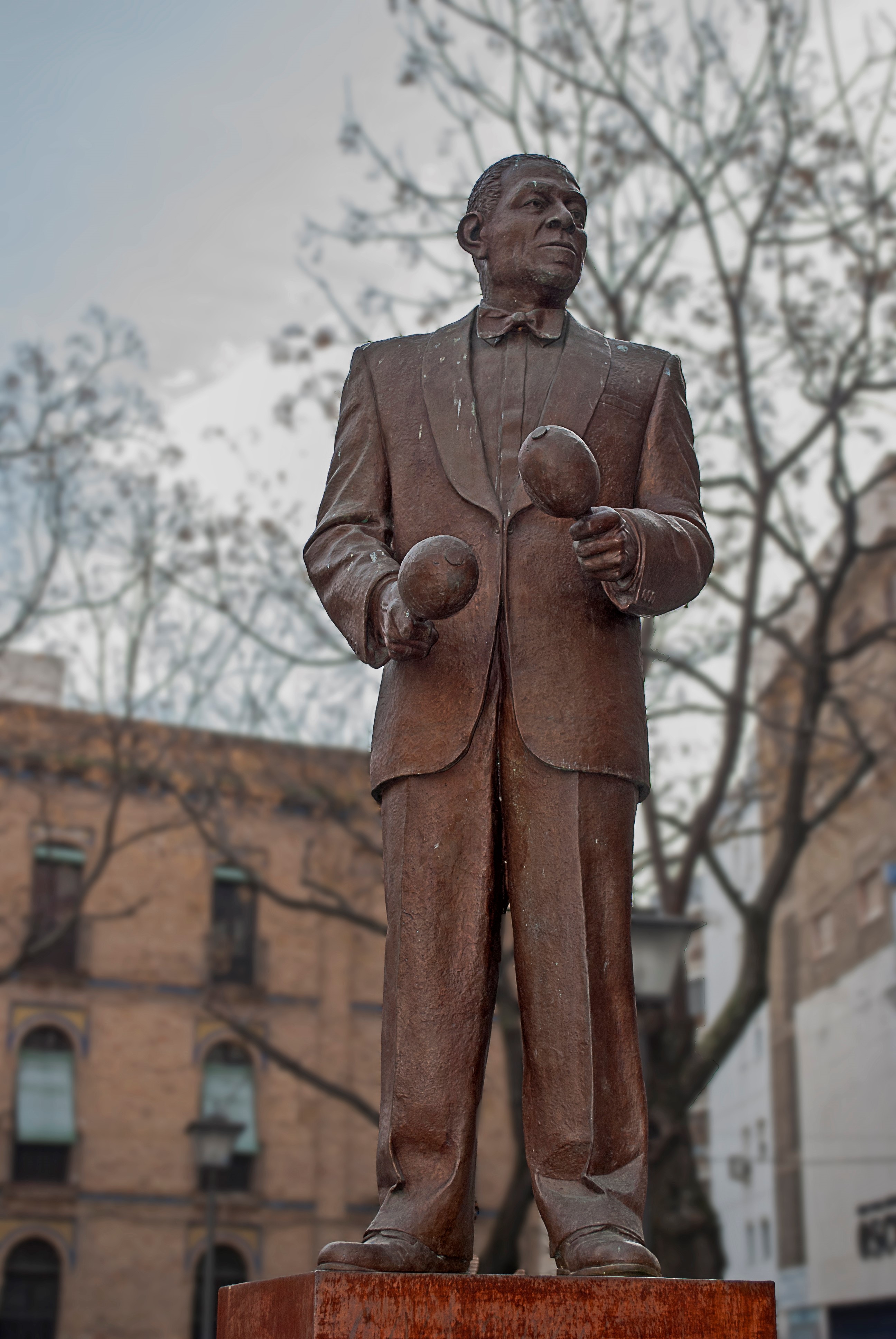

sourcesWikipedia — Beny Moré · El Tiempo — "Benny Moré, 100 años del 'Bárbaro del ritmo'" (backs the lean-years quote and the Machín/Riset/Valdés admiration) · El Anacrónico — "Memorias de Benny Moré con el Conjunto Matamoros" (backs the Siro Rodríguez discovery quote) · FIU Díaz Ayala Collection — "Benny Moré Biography" (corroborates the Conjunto Matamoros discovery and first recordings)
"Había noches que me acostaba con más hambre que sueño" — there were nights, Beny Moré told the Mexican press years later, he went to bed hungrier than tired, singing for tips outside Havana bars for four lean years. The break came in 1944: Miguel Matamoros, leader of the storied Conjunto Matamoros, was losing his voice, and Moré was hired to replace him, then kept the job outright, spending three years absorbing bolero-son before striking out with Pérez Prado's mambo orchestra in Mexico City. Renamed Beny after a bandmate warned him his old nickname "Bartolo" was Mexican slang for donkey, he returned to Cuba in 1953 to front his own La Banda Gigante, a swaggering big band he called his "tribe." Drinking himself toward death at 43, he became Cuban popular music's most complete synthesis: son, bolero, and mambo, sung by one restless voice.
the sound in question
1950
Bonito y SabrosoBeny Moré
walk the tributaries ↓
Miguel Matamoros1920s–40s · Son cubano / Bolero-son
By 1944, Miguel Matamoros — leader of the Conjunto Matamoros since the 1920s — was losing his voice on stage, and his singer Siro Rodríguez had already found the replacement at a Havana bar called El Templete: he recalled the newcomer's singing "causándole una gran impresión," a deep impression, before Matamoros or founding member Rafael Cueto had even heard him. Moré got the job, then inherited the group's lead role outright, spending three years, as his biography records, "learning and absorbing the lessons" of the guitar-led bolero-son fusion Matamoros had spent two decades perfecting.
listen: upstream & here
1944
Qué Será EsoMiguel Matamoros
1953
Cómo FueBeny Moré
listen forOn "Qué Será Eso," cut with the Conjunto when he was twenty-five, Moré's voice is already the instrument it would become — a light, elastic tenor that stretches a phrase behind the beat before snapping back into the son's clave. Nine years later on "Cómo Fue," the same rubato-into-clave trick reappears, slowed and deepened into pure bolero: he holds a note past where the melody asks him to, then lets the band catch up to him. That patience is the Conjunto's schooling, still audible a decade on.
Pérez Prado1950s · Mambo / Big band
Moré's real education in scale came next. Touring Mexico with Trío Matamoros, he met Pérez Prado, the bandleader building "mambo" into an orchestral craze, and Prado invited him to join his big band outright. Moré performed and recorded with Prado's orchestra from 1948 to 1950, cutting roughly twenty-two sides for RCA Victor — his biography notes he "made many recordings on the RCA/Victor label as a member of Prado's orchestra." It was here, fronting brass sections rather than a guitar trio, that Moré learned to sing over a full mambo band.
listen: upstream & heresource: Encyclopedia.com — "Moré, Beny" (Contemporary Musicians; backs the Matamoros apprenticeship and Pérez Prado orchestra years) ↗
1949
Locas por el MamboPérez Prado
1956
Qué Bueno Baila UstedBeny Moré
listen for"Locas por el Mambo," cut with Prado's own orchestra in Mexico, is built on stabbing horn hits that punch holes for Moré's voice to dart through — pure Prado arranging, brass treated as a rhythm instrument. "Qué Bueno Baila Usted," which Moré and his own, smaller Banda Gigante improvised live on Venezuelan television in 1956, uses the identical trick at a fraction of the budget: horns slam into silence, Moré fills the gap with an ad-libbed shout, and the two years fronting Prado's band are suddenly audible inside his own.
Antonio Machín1930s–40s · Bolero / Guaracha / Son cubano
Before Matamoros or Prado ever heard him, the unknown Moré already had models. A 2019 retrospective on his centennial names them plainly: "El lajero admiraba a Panchito Riset, a Antonio Machín y a Miguelito Valdés" — the boy from Las Lajas admired Riset, Machín, and Valdés, three Cuban singers already fronting orchestras of their own. Machín had gone furthest: in 1930 he became the first Cuban singer on an international hit, "El Manisero," recorded in New York with bandleader Don Azpiazú's orchestra — the exact template, singer plus dance band, that Moré spent the next two decades learning to fill.
listen: upstream & here
1930
El ManiseroAntonio Machín
1950
Bonito y SabrosoBeny Moré
listen forMachín's "El Manisero" turns a Havana peanut vendor's street cry into a full-orchestra showpiece — his voice riding easily over Azpiazú's brass, playful and unhurried, a lone Cuban sonero fronting a big American-style dance band. Two decades on, Moré's "Bonito y Sabroso" does the same job in Mexico: a street vendor's swagger blown up to big-band scale, horns punctuating his ad-libs rather than crowding them. Both are guaracha showcases built to let one charismatic voice carry an orchestra, the model Machín pioneered on record before Moré ever cut a side.