walking upstream…
Arsenio Rodríguez
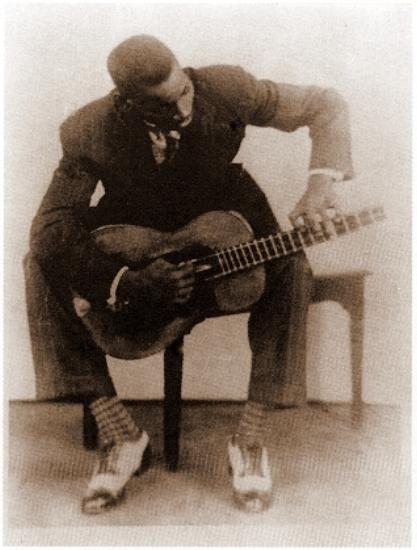
 photo: public domain ↗
Arsenio Rodríguez
A seven-year-old straddling a broomstick horse in Güira de Macurijes took a real horse's kick to the face in 1918; within months he was blind for life. (His own 1940 civil-registry statement gives his birth year as 1913; his Wikipedia infobox and several biographers say 1911 — even that detail never settled.) Ignacio Arsenio Travieso Scull, later "El Ciego Maravilloso," didn't invent his sound from silence: at fifteen a family-friend carpenter taught him conga, bass, and guitar, then finally the tres, staying until illness ended the lessons — and the newly blind teenager kept sharpening what he'd learned against the treseros already working Havana's rehearsal rooms. Two decades later he rebuilt the old son sexteto into the conjunto, horns and piano and congas stacked onto the format, but the technique underneath had been borrowed and refined long before it was his own.
the sound in question
1941
Dile a CatalinaArsenio Rodríguez
walk the tributaries ↓
Isaac Oviedo1920s-30s · Son
Once Feliciano's lessons ended, Arsenio kept teaching himself by ear, and his brother Raúl named the models he studied: he "continuaba mejorando su ejecución escuchando a Nené Manfugás, Issac Oviedo y Eiseo Silvera" ("kept improving his playing by listening to Nené Manfugás, Isaac Oviedo, and Eliseo Silvera"). Of the three, Oviedo left the clearest fingerprint. His thumbed alzapúa stroke voiced bass line, chord, and melody in a single pass on his 1920s RCA Victor sides — a one-man-band trick a listening teenager could actually study on record, since neither Manfugás nor Silvera left any.
listen: upstream & here
1928
Engancha CarreteroIsaac Oviedo
1941
Dile a CatalinaArsenio Rodríguez
listen forPlay Oviedo's 1928 "Engancha Carretero" and catch the thumb rolling under itself — bass note, chord, and melody landing almost on top of each other, no gap left for a second player to fill. Then put on "Dile a Catalina": Arsenio's tres runs the same layered, self-accompanying trick, just amplified, with a horn section riding the identical syncopation Oviedo worked out alone on a single instrument two decades earlier.
At fifteen, family friend and instrument-maker Víctor Feliciano — a carpenter who built instruments on the side — taught the newly blind Arsenio conga, bass, and guitar, then the tres itself, until, as his brother Raúl recalled, "se enfermó y no pudo servirle más de tutor" ("he fell ill and could no longer serve as his tutor"). It's the debt underneath every later tres lick: someone put the instrument in his hands before any recorded model ever reached him. One academic biography instead names this teacher Víctor González — the two accounts never reconcile in the sources available here.
listen: upstream & heresource: Herencia Latina — Max Salazar, "La vida fue como un sueño" (birth date, blinding, Víctor Feliciano lessons, tres role models, La Vida Es Un Sueño composition) ↗
1929
No known recordingVíctor Feliciano
1948
La Vida Es Un SueñoArsenio Rodríguez
listen forFeliciano never recorded — only the guitar he built survives in the story, not on tape. Cue up "La Vida Es Un Sueño" and notice how bare it is: just voice and guitar, no tres, no horns, the plainest possible showcase of the first instrument this carpenter ever put in Arsenio's hands. By his brother's account Arsenio composed it by feel, reciting the words on a sofa while his fingers searched the guitar neck for the right notes — the same searching Feliciano once guided.
Nené Manfugás1880s-90s · Son
The same family testimony names Manfugás alongside Oviedo as one of the ears Arsenio studied while sharpening his tres, but Manfugás's own reputation predates that debt by decades. A Cuban state-radio retrospective credits him with carrying son out of the Baracoa backcountry into the cities, and says his set at Santiago's 1892 carnival caused "una auténtica 'explosión' de popularidad" — played on a rough guitar-like forerunner of the instrument Arsenio would later make his own.
listen: upstream & heresource: Radio Siboney — "Nené Manfugás o el primer sonero de Cuba" (independent documentation of Manfugás's own significance) ↗
1892
No known recordingNené Manfugás
1950
Kila, Quique y ChocolateArsenio Rodríguez
listen forNo recording of Manfugás survives — he worked decades before Cuba had record labels. Listen instead for the shape he's credited with carrying into the city: on "Kila, Quique y Chocolate," tres and coro trade short, insistent phrases back and forth, call-and-response built for a crowd rather than a soloist, the same rural push-and-pull a lone campesino singer once traded with a carnival audience, now scored for a full conjunto.